
TL;DR:
- Trauma-informed coparenting emphasizes stability, boundaries, and emotional safety for parents and children. Building personal regulation skills and adhering strictly to legal and communication protocols are essential for healing. Consistent practice by one parent can positively influence coparenting dynamics, even if the other parent does not participate.
Coparenting after trauma is one of the hardest things a parent can do. Your nervous system is still raw. The other parent may have been the source of harm. And yet, you are expected to communicate, coordinate, and stay calm for the sake of your child. The legal and therapeutic systems surrounding coparenting often misread trauma responses as aggression, manipulation, or defiance, making an already painful situation feel impossible. But there is a way through. A trauma-informed approach to coparenting does not ask you to be perfect. It asks you to be present, boundaried, and grounded, one step at a time.
Table of Contents
- Understanding trauma and its role in coparenting
- Preparation: Foundation and requirements for trauma-informed coparenting
- Step-by-step trauma-informed coparenting process
- Troubleshooting and common mistakes in trauma-informed coparenting
- Step summary: Key differences between trauma-informed and traditional coparenting
- Why most trauma-informed coparenting advice falls short: A deeper look
- Take the next step: Support for your trauma-informed coparenting journey
- Frequently asked questions
Key Takeaways
| Point | Details |
|---|---|
| Trauma impacts coparenting | Understanding trauma helps explain behaviors and reduce conflict in coparenting relationships. |
| Preparation is essential | Having clear court orders, documentation tools, and emotional support strengthens your trauma-informed approach. |
| Follow trauma-informed steps | Use clear communication, document calmly, and prioritize emotional safety when coparenting after trauma. |
| Avoid common pitfalls | Recognize triggers, review your actions, and get professional help to avoid repeated mistakes. |
| Seek specialized support | Professional guidance can improve outcomes and foster long-term healing for you and your children. |
Understanding trauma and its role in coparenting
Before you can change how you coparent, it helps to understand what trauma is actually doing inside of you, and inside the dynamic itself. Trauma, in the coparenting context, is not just about a single event. It often means a pattern of experiences that taught your nervous system that connection is dangerous, that conflict means catastrophe, or that you are not safe unless you stay vigilant.
When two people who have experienced trauma (or when one person has caused it) are asked to coparent, the interactions become charged. Simple text messages can feel threatening. A delayed response can activate fear. A tone of voice during a child exchange can send your whole body into fight-or-flight mode. This is not weakness. This is your nervous system doing exactly what it learned to do to protect you.
The problem is that these responses are frequently misunderstood. Trauma responses in legal settings are often interpreted as defiance or non-compliance rather than survival behavior. Judges, mediators, and attorneys who lack trauma training may penalize a parent for an activated reaction without recognizing what they are witnessing.
Research also confirms there is still much work to be done. Therapeutic interventions show promise in improving coparenting relationships, but scoping reviews reveal that child perspectives are frequently left out of the conversation, and trauma-informed training for professionals remains inconsistently implemented. That gap matters deeply.
This is why building your own trauma-informed practice, separate from what others are doing, is so important. You can anchor yourself in trauma-informed care principles even when the system around you has not caught up.
Key ways trauma shows up in coparenting:
- Hypervigilance toward the other parent’s tone, word choices, or behavior
- Emotional flooding during exchanges or communication that feels threatening
- Shutdown or withdrawal when conflict feels overwhelming or unavoidable
- People-pleasing to avoid escalation, even at the cost of your own needs or safety
- Reactive communication that can look like aggression but is actually self-protection
“Trauma-informed parenting orders use clear language, specify trauma professionals, and include structured safeguards, because vague language leaves room for harm.” This is not just good legal practice. It is a compassionate recognition that trauma is real, and it changes how people function.
With an understanding of the emotional landscape, next is what you need to begin trauma-informed coparenting.
Preparation: Foundation and requirements for trauma-informed coparenting
You cannot build something stable on an unstable foundation. Before you begin actively applying trauma-informed strategies, there are some important things to put in place.
Know your legal documents inside and out. Your custody or parenting plan is not just paperwork. It is your structure, your protection, and your reference point when things get difficult. Court orders require strict adherence without negotiation. Document violations calmly and without engaging in conflict with your co-parent. This protects you legally and keeps your nervous system from getting pulled into unnecessary escalation.
Assess your capacity honestly. Trauma-informed coparenting takes emotional energy. Ask yourself: Do I have a support network right now? Am I working with a therapist or counselor? Do I have a trusted person who can help me process difficult interactions? Practicing trauma-informed self-care steps is not optional. It is the oxygen mask on the airplane. You cannot be regulated for your child if you are running on empty.

Set up your communication tools before you need them. Apps like TalkingParents or OurFamilyWizard create documented, timestamped communication logs that reduce the chance of “he said, she said” disputes. These platforms also create a layer of emotional distance that can help prevent reactive spirals.
Pro Tip: Create a simple “communication pause” ritual before replying to any co-parent message. Take three slow breaths, read the message once for content (not tone), and wait at least 15 minutes before responding. This single habit can prevent dozens of unnecessary conflicts over time.
| Traditional preparation | Trauma-informed preparation |
|---|---|
| Focus on legal rights and winning | Focus on stability and child well-being |
| Communicate whenever conflict arises | Set structured, boundaried communication windows |
| React based on what feels fair | Respond based on what the order specifies |
| Handle everything alone | Build a support network and professional team |
| Minimize personal history | Acknowledge trauma’s role in present behavior |
Finding a safe space for healing where you can process your own responses is equally important at this stage. You deserve that. And your child benefits when you do the work to take care of yourself.
After reviewing the foundational requirements, you are ready to put the trauma-informed approach into action.
Step-by-step trauma-informed coparenting process
Here is where the daily work lives. These steps are not about being flawless. They are about being intentional.
Follow the parenting plan exactly. Every time you honor the agreed schedule, you are building a track record of reliability. Document violations clearly without confrontation. Keep records in a written format. Photograph relevant situations when appropriate.
Use neutral, child-focused language in all written communication. Avoid sarcasm, accusations, or emotional language. Stick to logistics: schedules, health updates, school events. A simple formula is: What + When + Action needed. For example: “Emma has a doctor’s appointment Friday at 3pm. Can you confirm pickup or drop-off?”
Build a personal regulation plan for high-trigger moments. Exchanges at pick-up and drop-off are often the most charged. Identify your personal warning signs of activation (tight chest, clenched jaw, rapid thoughts) and create a short reset routine. Even stepping away for 90 seconds can interrupt the trauma response cycle.
Use trauma-informed language during child exchanges. This means keeping transitions brief and warm for the child, not using the child to relay messages, and resisting the urge to debrief or question your child after time with the other parent. Children should never be positioned as messengers or informants.
Check in on your child’s emotional well-being regularly. Even when the coparenting relationship is strained, you can still be a consistent, regulated presence for your child. Ask open-ended questions. Validate their feelings without putting the other parent down. Explore the process of healing trauma steps with a therapist who can support both you and your child.
Seek ongoing professional support for yourself. Incorporating trauma healing tips from evidence-based therapy approaches, such as EMDR (Eye Movement Desensitization and Reprocessing) or IFS (Internal Family Systems), helps you metabolize the past so it does not keep flooding your present.
Pro Tip: Keep a simple coparenting log. After each significant interaction, write down: the date, what happened, how you responded, and how you are feeling. Over time, this log becomes both a legal record and a personal growth tool.
Knowing the steps, let’s examine common mistakes and how to verify progress in trauma-informed coparenting.
Troubleshooting and common mistakes in trauma-informed coparenting
Even with the best intentions, you will hit walls. That is not failure. That is the nature of healing in a relational context.
The most frequent mistakes include:
- Reactive communication after triggering messages. Sending a response before your nervous system has settled can undo weeks of careful progress. Pause first. Always.
- Expecting the other parent to change. Trauma-informed coparenting is not about reforming your co-parent. It is about staying grounded in your own practice regardless of what they do.
- Using children as emotional support. This is one of the most common and most harmful patterns in high-conflict coparenting. Children are not equipped to hold adult pain.
- Treating every setback as a catastrophe. One difficult exchange does not erase your growth. Come back to your plan. Reset with compassion.
- Skipping therapy or support during hard stretches. This is often when people withdraw from professional support right when they need it most.
“The goal is not to control the other parent’s behavior. It is to become so anchored in your own trauma-aware practice that their behavior has less and less power to destabilize you.”
When you notice a pattern of mistakes, do not spiral into shame. Instead, consider reaching out to a professional who specializes in processing complex trauma. Getting feedback from someone who understands both trauma and family systems can help you course-correct without losing momentum.
To bring all these strategies together, see how they look side-by-side in a summary table.
Step summary: Key differences between trauma-informed and traditional coparenting
The table below shows how the two approaches diverge in meaningful ways.
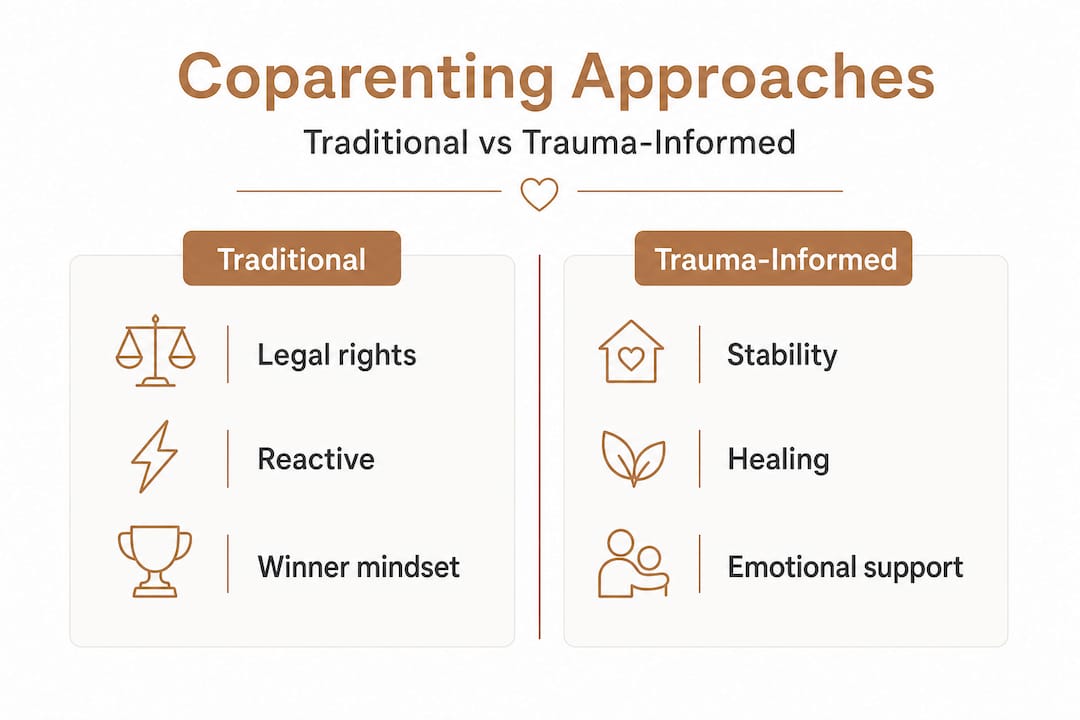
| Area | Traditional coparenting | Trauma-informed coparenting |
|---|---|---|
| Communication | Open, often reactive | Structured, boundaried, documented |
| Response to conflict | Escalation or shutdown | Grounded regulation before response |
| Child’s role | Sometimes caught in the middle | Consistently protected from adult dynamics |
| Legal compliance | Variable, often contested | Strict, non-negotiable adherence |
| Professional support | Optional or crisis-only | Integrated and ongoing |
| Long-term outcomes | Cyclical conflict, burnout | Resilience, stability, healing |
The difference is not just procedural. It is relational and neurological. Therapeutic interventions in coparenting show improved outcomes when trauma awareness is embedded in the approach, even when only one parent is practicing. And when professionals bring compassion in trauma therapy into the legal and therapeutic process, children and parents alike benefit from a safer, more attuned environment.
Having compared the two approaches, it is time for a candid, experience-based perspective.
Why most trauma-informed coparenting advice falls short: A deeper look
Here is an honest truth that most articles in this space skip over. The majority of trauma-informed coparenting guides hand you a checklist and call it healing. Follow the court order. Use neutral language. Communicate through an app. These steps are helpful, but they are not enough if the root is still untouched.
Real change happens in the nervous system, not on paper. No parenting plan, however well-written, can create emotional safety by itself. Emotional safety has to be cultivated, felt, and practiced in the body. This is where evidence-based modalities like EMDR and IFS become essential rather than optional. They work directly with the part of you that learned, through painful experience, that coparenting with this person means danger.
There is also a gap in how child perspectives are integrated. Most advice focuses entirely on what parents should do, without acknowledging that children in these situations are forming their own nervous system responses, their own beliefs about relationships, and their own trauma narratives. Asking a child how they are doing is not the same as genuinely witnessing their experience.
What truly makes a difference is this: one regulated, compassionate, present parent who has done their own work. Not a perfect parent. Not a parent who never makes mistakes. A parent who keeps showing up, keeps seeking support, and keeps choosing the child’s wellbeing even when it is hard. That kind of empathy in healing is not a strategy. It is a commitment. And it changes things, quietly and deeply, over time.
Take the next step: Support for your trauma-informed coparenting journey
You have been carrying this for a long time. And if you are reading this, something in you is reaching for a better way. That matters deeply.

At Simple Empathy KC, we hold space for exactly where you are right now. Whether you need support processing your own trauma, guidance on staying regulated through difficult coparenting moments, or a safe space for healing where your story is honored without judgment, we are here for that. Our therapists work with trauma-informed modalities like EMDR and IFS, grounded in trauma-informed care resources that recognize the whole of your experience. You do not have to do this alone. Reach out today to explore therapy services in Kansas City tailored to your healing journey.
Frequently asked questions
What makes an approach trauma-informed in coparenting?
A trauma-informed coparenting approach uses clear language, acknowledges trauma responses in legal settings rather than misreading them, and includes structured safeguards for emotional safety. It treats both parents and children as people with nervous systems shaped by their history.
Should I report every violation of the court order?
You should document every violation in writing and report without engaging in conflict or negotiation directly with your co-parent. Consistent, calm documentation protects you legally and keeps you out of reactive spirals.
How effective are trauma-informed strategies for child outcomes?
Therapeutic interventions show promise for improving coparenting relationships overall, but child perspectives are frequently left out of research, pointing to a need for more nuanced, child-centered trauma-informed training.
What if my co-parent refuses to follow a trauma-informed process?
Focus entirely on what you can control. Adhere to agreed orders, document interactions, and seek professional support or mediation when needed. Your regulated presence matters even when the other parent is not participating.
Is it necessary for both parents to join trauma therapy?
While it is ideal for both parents to engage in therapy, real progress is possible when even one parent consistently models trauma-informed behavior, seeks support, and prioritizes the child’s emotional safety.