
TL;DR:
- Personalized trauma therapy tailors approaches to each individual’s unique history, goals, and nervous system needs. It emphasizes phased, flexible, and relationship-based methods rather than rigid protocols. This individualized care is essential for deep healing, especially for complex trauma, anxiety, and identity transitions, resulting in better engagement and outcomes.
Most people assume that therapy is therapy. You sit across from someone, talk about your past, learn a few coping tools, and move forward. But that assumption quietly keeps a lot of people stuck. For those carrying complex trauma, anxiety rooted in early attachment wounds, or the disorientation of a major identity transition, a generic approach can feel hollow at best and retraumatizing at worst. Trauma-focused care works best when it is tailored in a phased, modular way that honors where you actually are, not where a protocol expects you to be. Personalized care isn’t a luxury. For deep healing, it’s the whole point.
Table of Contents
- What personalized care means in therapy
- Why personalization is essential for trauma, anxiety, and identity transitions
- How personalized care actually works: Phased and modular therapy in action
- What does the evidence say about personalized, trauma-informed care?
- A trauma therapist’s perspective: What most people get wrong about “just being trauma-informed”
- If you’re seeking truly personalized, trauma-informed therapy in Kansas City
- Frequently asked questions
Key Takeaways
| Point | Details |
|---|---|
| Therapy is not one-size-fits-all | Personalization tailors approaches and sequencing to your unique history and needs for deeper healing. |
| Personalized care drives outcomes | Evidence shows that therapy matched to readiness, attachment, and self-organization leads to better engagement and results. |
| Stabilization comes first | Effective trauma therapy often starts with safety and emotional regulation before direct trauma processing. |
| Clinical judgment is critical | There is no universal protocol—your therapist’s flexibility matters more than rigid adherence to technique. |
| Local trauma-informed resources | Kansas City offers trauma-informed therapists who prioritize personalized, evidence-based approaches for complex needs. |
What personalized care means in therapy
With the myth of one-size-fits-all therapy addressed, let’s define what it means for care to be truly personalized.
Personalized care in therapy means that your therapist designs the entire experience around you, not around a fixed script or single modality. Your history, nervous system patterns, emotional capacity, and goals all shape the approach. The pacing bends to meet you. The methods shift as you do. When something isn’t working, it gets adjusted rather than repeated.
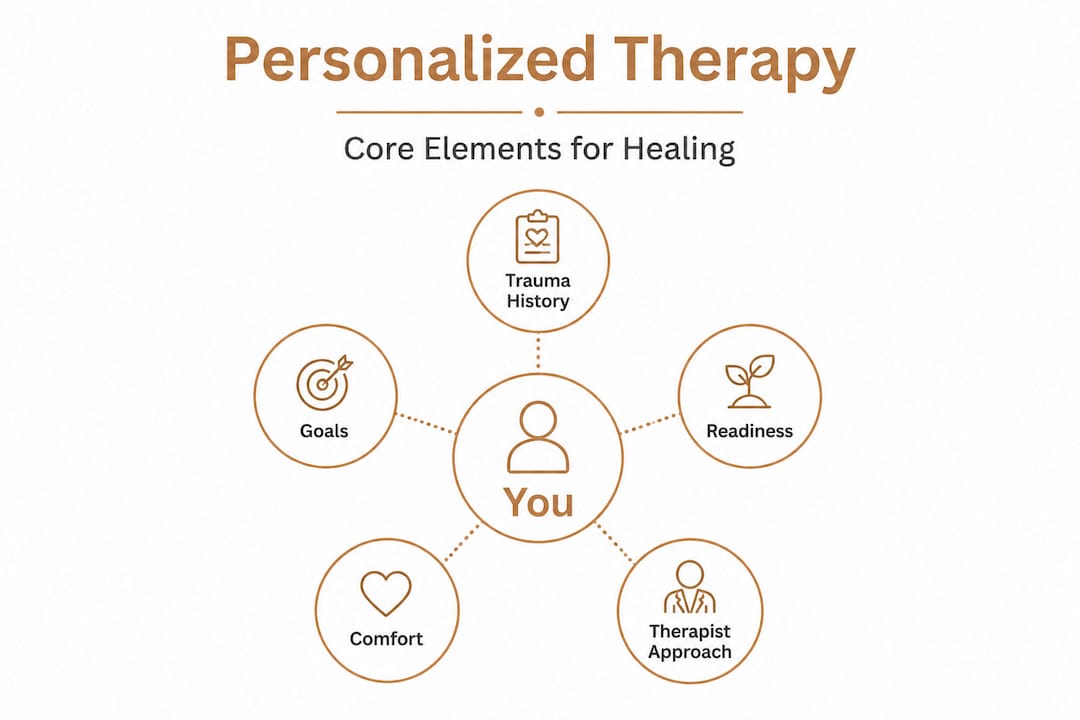
This is very different from protocol-driven therapy, where every client moves through the same structured steps regardless of where they are emotionally. Protocols can be valuable, but they work best when they are adapted. As StatPearls notes, person-centered therapy treats you as the expert in your own life, following your lead rather than directing you from the outside.
What does personalized care actually look like in practice? A few key features set it apart:
- Collaborative goal-setting: You and your therapist define what healing means for your life, not a generic list of symptom reduction targets.
- Flexible modality use: Your therapist may draw on EMDR, Internal Family Systems (IFS), somatic work, or talk therapy depending on what your nervous system can hold in that moment.
- Pacing that respects your window of tolerance: The window of tolerance is the zone where your nervous system can process emotion without shutting down or flooding. A personalized approach stays inside that window.
- Ongoing reassessment: Rather than following a preset plan to the end, the work is revisited and reshaped regularly based on your lived feedback.
Pro Tip: If your therapist never asks how a particular approach is landing for you, that’s worth naming. Your comfort, curiosity, and hesitation are all important data points in personalized care.
Learning more about trauma-informed care principles can help you recognize what a well-matched therapeutic relationship looks and feels like before you even walk through the door.
Why personalization is essential for trauma, anxiety, and identity transitions
Now that we understand what personalized care is, let’s look at why it’s indispensable for those seeking real change.
Complex trauma is not simply a collection of bad memories. It lives in the body. It shapes how you see yourself, how much you trust others, and how reliably you can regulate your own emotional experience. Disturbances in self-organization, including difficulty with emotion regulation, a fragmented sense of identity, and chronic relational wounds, require far more than symptom reduction. They require a therapeutic relationship that meets those disturbances with presence and patience.

For anxiety rooted in attachment wounds specifically, the process is even more layered. Anxiety isn’t always a thought pattern you can logic your way out of. Often it is a body-level response shaped by years of learning that the world wasn’t safe or that you couldn’t count on people to show up. A personalized approach recognizes that and works with the nervous system, not just the mind.
Patient-related factors such as attachment organization, readiness for change, and trauma history are meaningfully associated with therapy outcomes. This means that the same approach applied to two different people can lead to very different results. What works for someone with a single-incident trauma and a secure attachment history may be entirely wrong for someone with layered relational trauma and a history of being dismissed or harmed in caregiving relationships.
Here is a brief look at how different presentations call for different therapeutic priorities:
| Presentation | Key therapeutic priority | Why personalization matters |
|---|---|---|
| Complex trauma (CPTSD) | Safety, stabilization, then processing | Skipping stabilization can overwhelm the nervous system |
| Anxiety with attachment roots | Trust-building, regulation skills | The relationship itself is part of the healing |
| Identity transitions | Meaning-making, grief, self-compassion | Standard CBT frameworks may miss the existential layer |
| Grief and loss | Non-linear pacing, witnessing | Rigid timelines dishonor the unique shape of loss |
The most powerful piece of personalization is being seen accurately. When your therapist truly understands the specific contours of your experience, you don’t have to work as hard to be understood. That frees up your nervous system for the actual healing.
“Healing doesn’t happen on a schedule. It happens when you feel safe enough to be exactly where you are.”
Exploring evidence-based trauma recovery tips or reading about processing complex trauma can help you orient to what this process often involves before committing to a particular path.
How personalized care actually works: Phased and modular therapy in action
It’s helpful to see what personalized therapy looks like in practice. Here’s how it is structured and adapted for each person.
Most evidence-informed trauma therapy follows a general sequence, but the key word is sequence, not schedule. Personalized, phased approaches are necessary to address stabilization, self-organization issues, and the timing of trauma processing in a way that is safe and sustainable.
Here is what the phases typically look like, with the understanding that real therapy moves fluidly rather than in tidy steps:
- Stabilization: Building safety inside the therapeutic relationship and within your own nervous system. This includes grounding skills, learning to recognize your emotional states, and establishing basic distress tolerance tools. For some people, this phase takes weeks. For others, months. There is no wrong pace.
- Building capacity: Once foundational safety exists, you and your therapist begin strengthening your ability to hold difficult emotions without becoming overwhelmed. This might include working with internal parts (IFS), somatic awareness, or relational patterns.
- Trauma processing: With a stable foundation, it becomes possible to revisit and reprocess painful memories. EMDR is one well-researched approach here, working with the brain’s natural capacity to integrate stored experiences. Somatic therapy may be woven in to address what the body has been holding.
- Integration and identity work: This phase is often underestimated. After processing, many people find themselves asking: Who am I now? This is where identity reconstruction, meaning-making, and grief over lost time or lost selves become the work.
The beauty of modular, personalized therapy is that these phases aren’t rigid boxes. If life becomes suddenly stressful in phase three, you return to stabilization tools. If integration raises new memories, you cycle back to processing. Your unique rhythms are honored, not forced.
| Rigid protocol approach | Personalized, phased approach |
|---|---|
| Fixed number of sessions per phase | Duration based on your actual readiness |
| One primary technique throughout | Multiple modalities used as needed |
| Progress defined by the protocol | Progress defined by you and your therapist together |
| Assumes linear healing | Honors non-linear, spiral healing |
Pro Tip: Ask your therapist what phase of work you’re in and why. Understanding the map helps you feel less lost when the terrain gets complicated.
Reading about step-by-step trauma recovery can offer a clearer picture of what this process tends to look like from the inside. You may also find trauma-informed self-care steps helpful for supporting the work between sessions.
What does the evidence say about personalized, trauma-informed care?
With the process clarified, it’s important to see what evidence, and honest limitations, exist around personalized trauma care.
The research landscape here is genuinely encouraging, but it also calls for humility. Trauma-informed care is widely recognized as best practice, but as the AAFP editorial on the subject notes, there isn’t a universally consistent definition or clear causal evidence for trauma-informed care as a category. What this means in practice is that the label matters less than whether your specific therapist is genuinely responding to your individual presentation with flexibility and care.
Clinical judgment and adaptability are where the real power lives. A therapist who rigidly applies any modality, including even a well-researched one like EMDR, without reading your readiness and relational safety, is not offering truly personalized care.
Here is what the evidence does support clearly:
- Better engagement: Person-centered therapy increases engagement and supports self-direction, which is especially valuable for meaning-making and identity work. When you feel authorship over the process, you show up more fully.
- More sessions and adequate treatment dose: A naturalistic study of a real-world PTSD clinic found that personalized matching to evidence-based care correlated with more therapy sessions and a higher likelihood of completing an adequate course of treatment.
- Deeper outcome for complex presentations: For clients carrying layered trauma, matching the approach to readiness and attachment organization leads to meaningfully better outcomes.
“Technique matters. Relationship matters more. And the fit between the two matters most of all.”
The honest limitation: Personalization is harder to study than protocol fidelity, so the evidence base is less tidy. But that doesn’t mean it’s less real. It means the research is still catching up to what skilled, experienced therapists have always known. Exploring evidence-based trauma recovery can help you understand the foundation beneath any approach your therapist recommends.
A trauma therapist’s perspective: What most people get wrong about “just being trauma-informed”
Beyond research, long-time therapists see specific patterns and pitfalls. Here is a hard-earned perspective.
The phrase “trauma-informed” has spread widely in mental health spaces, and that’s genuinely good. But it has also become something that gets attached to any practice, any philosophy, any clinician without a clear shared meaning. And that ambiguity can mislead people who are looking for something real.
Here’s what we’ve seen matter far more than credentials or certifications: whether your therapist actually knows when to slow down. Premature trauma processing, jumping into EMDR or deep narrative work before stabilization and trust are established, can activate your nervous system in ways that feel destabilizing. It can reinforce the belief that healing is dangerous. Stabilization, alliance, and a flexible sequence are often more important than quick trauma processing, and this is especially true for complex trauma presentations.
The uncomfortable truth? Some people have been harmed by well-meaning therapists who skipped the relational foundation in favor of technique. Processing trauma without a regulated, safe nervous system is like trying to renovate a house that doesn’t have solid walls. It doesn’t hold.
Personalization isn’t a warm, fuzzy add-on. It is an ethical and clinical commitment to understanding you specifically well enough to know when to push, when to hold, and when to simply stay present without an agenda. That kind of knowing takes time, genuine curiosity, and a therapist willing to let your readiness lead.
The most powerful shift we see in clients isn’t the moment they finish processing a specific memory. It’s the moment they realize they can trust themselves again. That moment doesn’t come from technique. It comes from being witnessed, slowly and consistently, in a relationship that feels safe enough to be honest in. Reading about how compassion shapes trauma recovery offers a deeper look at why the relational element is so central to lasting change.
If you’re seeking truly personalized, trauma-informed therapy in Kansas City
You’ve read this far because something in you is looking for more than a generic approach. You deserve care that actually fits you, that moves at a pace your nervous system can trust, and that sees the full complexity of what you’ve lived through.

At Simple Empathy KC, our therapy services in Kansas City are built around exactly this kind of individualized, trauma-informed care. We integrate EMDR, Internal Family Systems, and somatic approaches in ways that are responsive to each client’s history, attachment patterns, and readiness. We don’t rush the process. We hold space for the whole journey. If you’re curious about what a truly personalized path forward might look like for you, our personalized trauma recovery guide is a gentle place to start. You don’t have to have it all figured out before reaching out. Coming home to yourself begins with one honest step.
Frequently asked questions
How does therapy change when it’s personalized?
Personalized therapy adapts methods, pacing, and goals based on your unique history and current capacity, making every session more relevant to where you actually are. Rather than following a fixed protocol, therapy fits the individual so that growth happens at a pace your nervous system can sustain.
Is trauma-informed care always person-centered?
Not always. While the principles often align, trauma-informed care varies widely in how it is defined and applied, and it may not be equally tailored to your specific story, readiness, and relational needs without an intentional focus on the individual.
Does personalized care slow down trauma healing?
It may involve more foundational work at the beginning, but that foundation is what makes processing safe and sustainable. Stabilization before processing is crucial, and moving at the right pace often leads to more lasting outcomes rather than fewer.
What results can I expect from a highly personalized approach?
Personalized, matched care correlates with better engagement and a meaningfully higher chance of completing an adequate course of treatment. Personalized matching to evidence-based approaches was associated with more sessions attended and greater treatment completion in real-world PTSD care settings.