
TL;DR:
- Attachment wounds are emotional injuries from early relationships that impact trust and connection throughout life. Healing is possible through trauma-informed therapy and building safety, self-compassion, and supportive relationships. Personalized, relational approaches are essential for lasting recovery and long-term emotional well-being.
Attachment wounds are invisible, but their weight is real. They show up in the way you brace for abandonment, the way intimacy feels terrifying, or the way your body tenses before a difficult conversation. So many people carry these patterns for years, not realizing that what feels like a personality flaw is actually a wound left by early relationships. The good news: healing is not only possible, it is achievable with the right support. This guide walks you through clear, evidence-based steps to begin your journey toward secure, grounded connection.
Table of Contents
- Understanding attachment wounds and why they matter
- What you need to begin healing: Essentials for a trauma-informed process
- Step-by-step: Healing attachment wounds in practice
- Common pitfalls and how to navigate them
- How to notice progress and support long-term healing
- Why personalized, compassionate support changes everything
- Start your personalized healing journey in Kansas City
- Frequently asked questions
Key Takeaways
| Point | Details |
|---|---|
| Healing is possible | With the right support, you can actively heal attachment wounds and build secure connections. |
| Safety comes first | A safe, trauma-informed environment is the foundation for any successful healing process. |
| Personalized steps work best | Evidence shows real-time, individualized support is more effective than one-size-fits-all approaches. |
| Progress is gradual | Celebrate small gains as real signs of growth—true change happens over time. |
Understanding attachment wounds and why they matter
Now that we’ve named the challenge, let’s start with what attachment wounds actually mean and why they impact so many people.
Attachment wounds are emotional injuries that form when early caregiving relationships feel unsafe, inconsistent, or absent. They often develop in childhood, when your nervous system was learning whether the world was a safe place and whether you could trust the people closest to you. When those lessons were painful or confusing, the effects can echo well into adulthood.
These wounds don’t just live in memory. They shape how you relate to yourself and others every single day. You might recognize yourself in some of these common signs:
- Persistent fear of abandonment or rejection
- Difficulty trusting others, even people who feel safe
- Emotional shutdown or numbness in close relationships
- Anxiety that spikes around conflict or separation
- A deep sense of not being “enough” or feeling fundamentally flawed
- Patterns of over-giving or people-pleasing to maintain connection
Research confirms what many people experience firsthand. Attachment-based interventions improve outcomes for individuals affected by relational trauma, and secure attachment has been shown to mediate the link between trauma and suicidality by 16.5%. That is not a small number. It tells us that healing your connection to yourself and others is one of the most protective things you can do.
“Your wounds are not proof that something is wrong with you. They are proof that you needed more safety than you received.”
In adulthood, these wounds often appear as anxiety in relationships, cycles of conflict or distance with partners, and trauma responses that seem to come out of nowhere. A gentle but honest truth: healing attachment wounds requires addressing both the emotional layer and the relational roots. One without the other often leaves people feeling stuck. Building a safe space for healing is the first, most essential step. Exploring IFS therapy for trauma is one powerful way to begin that work.

What you need to begin healing: Essentials for a trauma-informed process
Before jumping into the steps for healing, let’s make sure you have the right foundation in place, physically, emotionally, and relationally.
Healing attachment wounds is not about forcing yourself to “get over it” faster. It’s about preparing your system to safely open, process, and release old pain. The conditions you create around yourself matter enormously.
Research is clear that experienced providers and real-time coaching lead to better outcomes than going it alone, and that building safety before diving into trauma content is essential. Your nervous system needs to know it is held before it will let anything go.
Here is what a strong foundation looks like:
- A physically safe environment: A space, whether a therapy office or a quiet room at home, where you feel free from threat and interruption
- A trauma-informed therapist or provider: Someone trained to recognize how trauma lives in the body and the nervous system, not just in thoughts
- Emotional readiness: A willingness to be curious, not judgmental, about what comes up inside you
- Self-compassion: The ability to treat yourself with at least some of the kindness you would offer a close friend
- A support network: Even one or two people who make you feel genuinely accepted
| Foundation element | Why it matters | What to look for |
|---|---|---|
| Safe environment | Signals safety to your nervous system | Low stimulation, privacy, consistency |
| Trauma-informed therapist | Guides pacing and body-based healing | EMDR, IFS, or somatic training |
| Self-compassion practice | Reduces shame and self-attack | Journaling, self-talk exercises |
| Social support | Reinforces new relational patterns | Accepting, non-judgmental people |
| Emotional readiness | Allows genuine processing | Curiosity over self-judgment |
Pro Tip: If you are unsure whether you are emotionally ready, that uncertainty itself is worth exploring with a therapist. Readiness is not the absence of fear. It’s the decision to move gently toward it anyway.
The steps for trauma recovery outlined by trauma specialists consistently emphasize that safety comes before processing. Learning what trauma witnessing truly means, being truly seen in your pain without judgment, can also shift something profound in your system.
Step-by-step: Healing attachment wounds in practice
You’ve got your foundation. Now, let’s break down the actionable steps you can take toward healing.
There is no single path to healing attachment wounds. But there is a sequence that tends to work well across different people, rooted in what trauma science and clinical practice have shown to be most effective. EMDR and CBT are effective for PTSD and complex trauma, though personalized pacing remains essential across all approaches.
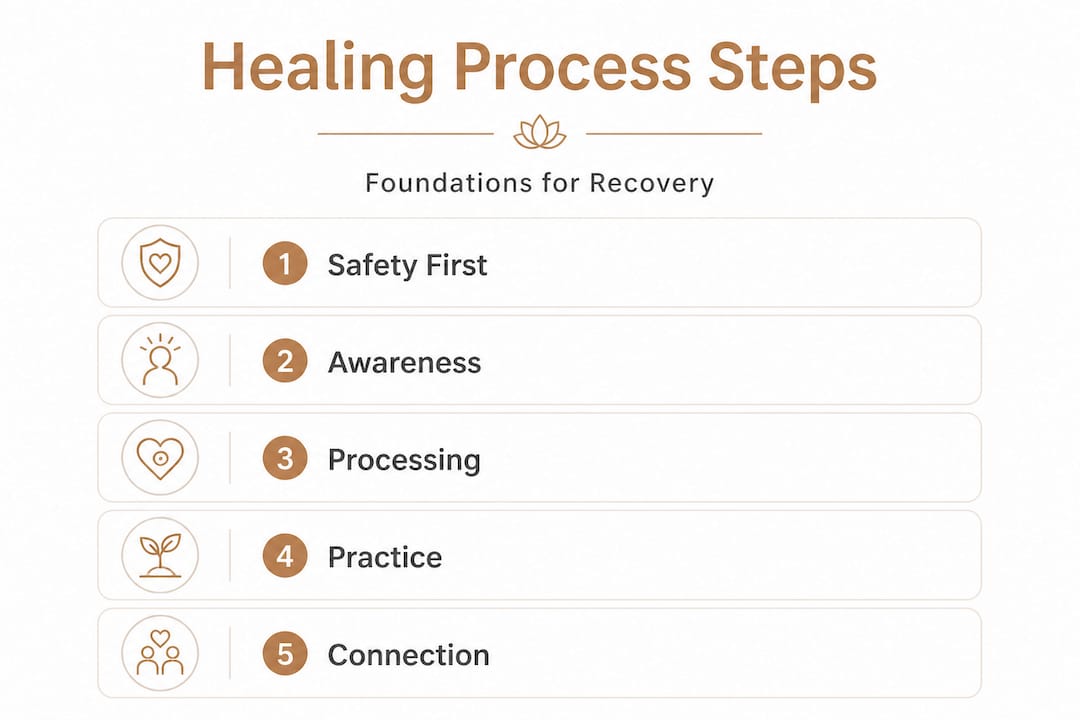
Recognize your patterns. Begin by noticing the recurring emotional or behavioral patterns in your relationships. Ask yourself: Where do I shut down? Where do I over-react? What do I avoid? Awareness, without judgment, is the entry point.
Create a felt sense of safety. Before any deep processing, practice grounding techniques. Deep breathing, gentle movement, and sensory anchoring (such as holding something warm) help your nervous system settle. You cannot do deeper healing from a place of constant activation.
Connect with a trauma-informed therapist. This step is not optional if you are dealing with significant relational trauma. A skilled therapist will help you pace the work so you are processing enough to move forward but not so much that you become overwhelmed.
Engage therapeutic modalities. Approaches like EMDR (Eye Movement Desensitization and Reprocessing), Internal Family Systems (IFS), and somatic therapy each offer distinct pathways to healing. EMDR helps reprocess traumatic memories stored in the nervous system. IFS helps you relate compassionately to wounded inner “parts” of yourself. Somatic therapy works directly with body sensations and stored tension.
Build new relational experiences. Healing attachment wounds requires actually experiencing safety in connection. This might mean practicing vulnerability in small doses, allowing yourself to receive care, or learning how to set limits without expecting rejection.
Integrate and consolidate. As you do the deeper work, build habits that reinforce your healing: journaling, mindfulness, regular therapy check-ins, and honest conversations with trusted people in your life.
| Therapeutic approach | Best for | What makes it effective |
|---|---|---|
| EMDR | Traumatic memory reprocessing | Bilateral stimulation, body-based |
| IFS | Inner critic, shame, complex trauma | Parts-based, self-compassion |
| Somatic therapy | Body tension, nervous system dysregulation | Sensation-focused, embodied |
| CBT | Unhelpful thought patterns, anxiety | Cognitive restructuring, skill-building |
| Attachment-based therapy | Relational wounds, trust issues | Relational presence, co-regulation |
A step-by-step trauma recovery process will look different for everyone. If you are navigating deeper relational trauma, understanding processing complex trauma can help clarify what to expect and how to pace yourself wisely.
Common pitfalls and how to navigate them
Even with the right steps, it’s normal to encounter challenges along the way. Here’s how to keep moving forward safely.
Healing is not a straight line. It spirals, doubles back, and sometimes goes quiet for a while before breaking open. That is completely normal. What matters is recognizing when you have drifted off course so you can gently return.
Here are the most common pitfalls, and how to handle each one:
- Overwhelming yourself with too much at once. Trauma content can be like a wound: some air is healing, but tearing it open repeatedly is not. Pacing matters deeply. Research consistently shows you should avoid over-relying on exposure before safety is established. More is not always better.
- Expecting linear progress. You might have a breakthrough one week and feel like you’re starting over the next. This is not failure. It is the nature of deep healing. The nervous system learns in cycles, not straight lines.
- Neglecting self-care or support. Sleep, nutrition, movement, and meaningful connection are not extras. They are the soil your healing grows in. Skipping them consistently will make the therapeutic work much harder to sustain.
- Isolating during hard moments. When things feel heavy, the instinct may be to withdraw. But isolation is often the wound speaking. Reaching out to a trusted person, even just to say “I’m struggling today,” can interrupt the old pattern.
“You do not have to process everything at once. Healing is permission to go slowly, return to yourself often, and trust that small steps still move you forward.”
Pro Tip: If you feel triggered during therapy or a self-reflection exercise, use a grounding technique before continuing. Name five things you can see, four you can touch, three you can hear. This brings your nervous system back to the present moment.
Useful trauma healing tips offer practical strategies to stay steady when things get hard. Understanding the role of presence in therapy can also remind you why the relational quality of healing matters just as much as the techniques used.
How to notice progress and support long-term healing
After following the steps and navigating roadblocks, it helps to know what true progress looks like, and how to keep building on it.
Progress in healing attachment wounds is often subtle at first. It’s not always a dramatic moment of insight. More often, it is small, quiet shifts you notice over time.
Early signs of healing include:
- Greater emotional regulation: You notice you can pause before reacting, rather than being swept away by old feelings
- Improved relationships: Conflicts feel less catastrophic. You can stay present with someone even when things get hard
- Less anxiety in connection: The constant background hum of “they’re going to leave me” starts to quiet
- More trust in yourself: You begin to rely on your own instincts and feelings rather than seeking constant external reassurance
- Physical softening: Tension you have held for years in your shoulders, chest, or jaw begins to ease
Science supports this kind of hope. Neuroplasticity, the brain’s ability to form new neural connections throughout life, means that “earned secure” attachment is genuinely possible. You do not have to be defined by the attachment patterns formed in childhood. With consistent support and the right conditions, your nervous system can learn new ways of relating.
| Sign of progress | What it looks like | How to support it |
|---|---|---|
| Emotional regulation | Pausing before reacting | Breathing practices, therapy |
| Relational ease | Less fear in closeness | Consistent, safe relationships |
| Reduced anxiety | Quieter inner alarm system | Mindfulness, somatic work |
| Self-trust | Honoring your own feelings | Journaling, reflection |
| Physical ease | Less chronic tension | Movement, bodywork, rest |
Celebrate small wins. Seriously. Noticing that you handled a conflict with more grace than last year deserves acknowledgment. These moments are not small. They are evidence of profound change happening inside you. Resources for healing for sensitive individuals can offer additional support for those who feel deeply and need a gentler-paced approach.
Why personalized, compassionate support changes everything
With all of these practical steps covered, let’s reflect on why a deeply personalized, relational approach is the real game-changer for lasting healing.
Here is something we believe with everything we do: cookie-cutter methods do not heal attachment wounds. A protocol that doesn’t account for your history, your nervous system, your pace, and your particular flavor of pain will always fall short. Healing is not a formula. It is a relationship, both with yourself and with whoever is walking alongside you in the process.
We have seen, again and again, how the quality of the therapeutic relationship matters just as much as the specific tools being used. When someone feels truly seen, not managed or diagnosed, but genuinely witnessed in their pain, something shifts at a cellular level. The nervous system begins to believe, maybe for the first time, that it is safe to open. That is empathy in trauma healing in its most honest form.
Kansas City’s trauma-informed therapists at practices like Simple Empathy KC lead with both science and heart. That means using evidence-based tools like EMDR, IFS, and somatic therapy, but always in service of the real human being sitting across from them. Not the symptom list. Not the diagnosis. You, with your specific story, your specific wounds, and your specific strengths.
The uncomfortable truth many people need to hear is this: healing attachment wounds takes longer than a few sessions, and it asks more of you than just showing up. It asks you to stay curious about the hard things, to keep returning to yourself when you want to run, and to believe that your softness is not a flaw but a gift worth protecting. The right support makes that kind of courage feel possible.
Start your personalized healing journey in Kansas City
If you’re ready to take your next step, here’s where to find help that truly meets you where you are.
Healing is closer than it might feel right now. If what you’ve read here has resonated with something deep in you, that recognition itself is meaningful. You don’t have to have it all figured out before you reach out.

At Simple Empathy KC, we offer Kansas City therapy services specifically designed for people who carry attachment wounds, complex trauma, and anxiety. Our therapists are trained in EMDR, IFS, and somatic therapy, and we work with you at your pace, honoring your story as sacred. Whether you are just beginning to name your pain or have been on this road for a while, we would be honored to walk alongside you. Explore our trauma-informed guide for more on what healing can look like, and reach out to schedule your first session. You deserve to come home to yourself.
Frequently asked questions
What are attachment wounds?
Attachment wounds are emotional injuries caused by inconsistent, neglectful, or traumatic early relationships, often creating lasting difficulties with trust and connection. Research confirms that these wounds affect relational health well into adulthood and increase vulnerability to anxiety and trauma responses.
Is it possible to fully heal from attachment wounds?
Yes, full healing is possible. Neuroplasticity supports the development of “earned secure” attachment, meaning your nervous system can genuinely learn new patterns of safety and connection with the right support.
How do I know if I have attachment wounds?
If you experience ongoing struggles with trust, persistent anxiety in close relationships, or recurring emotional pain connected to past caregiving, these patterns reflect how attachment wounds influence adult behavior and emotional life.
Can I heal alone or do I need a therapist?
Self-awareness and safe daily practices are genuinely helpful starting points, but experienced providers and supportive coaching consistently lead to better, more lasting outcomes than self-guided efforts alone.