
TL;DR:
- Compassionate therapy balances the brain’s threat, drive, and soothing systems for healing.
- Research shows CFT reduces self-criticism, depression, and PTSD symptoms effectively.
- A caring therapeutic relationship is essential for lasting trauma recovery and resilience.
Many people in Kansas City living with complex trauma or persistent anxiety share one quiet, exhausting experience: the feeling that no one truly understands what they carry. They’ve tried pushing through. They’ve been told to “just think positive” or “face your fears head on.” And yet the weight remains. There’s a widespread belief that healing has to be hard, that strength means white-knuckling through pain, and that softness is a liability. The science tells a very different story. Compassionate therapy is not the gentle backup plan. It is, increasingly, one of the most evidence-backed paths to lasting healing for trauma and anxiety.
Table of Contents
- The science behind compassionate therapy
- Evidence of healing: How compassion impacts outcomes
- Addressing fears and misconceptions about compassion
- Practical steps: Applying compassion in trauma-informed care
- Nuances and limitations: What the latest research reveals
- Fresh perspective: The real reason compassionate therapy works
- Discover compassionate, trauma-informed therapy in Kansas City
- Frequently asked questions
Key Takeaways
| Point | Details |
|---|---|
| Compassion regulates emotions | Compassionate therapy helps balance threat, drive, and soothing systems, fostering calm and healing. |
| Evidence supports effectiveness | Research shows significant reductions in anxiety, depression, and self-criticism using compassionate approaches. |
| Misconceptions can be overcome | Fears and doubts about compassion are addressed through education, making therapy more accessible. |
| Practical healing steps | Trauma-informed practices and reparative relationships are central to compassionate therapy’s real-world impact. |
| Nuance matters in therapy | A critical understanding of evolving research helps therapy seekers make informed decisions. |
The science behind compassionate therapy
Compassion Focused Therapy, often called CFT, was developed by psychologist Paul Gilbert to help people who struggle deeply with shame and self-criticism. It draws on evolutionary psychology, neuroscience, and mindfulness to address something most traditional therapies overlook: the way our brains are wired for threat.
Your nervous system operates through three core emotional regulation systems. The threat system activates anxiety, fear, and anger. The drive system pushes you toward achievement and excitement. The soothing system generates calm, connection, and safety. For people who have experienced trauma or chronic anxiety, the threat system tends to dominate. It stays switched on long after the danger has passed, because the nervous system learned that the world was not safe.
Soothing compassion science from Frontiers in Psychiatry shows that CFT balances these three systems by deliberately strengthening the soothing-affiliative system through compassion training. This is not vague or abstract. Compassion training activates the parasympathetic nervous system, reduces cortisol, and builds new neural pathways that allow the brain to register safety even when old patterns scream otherwise.
“CFT balances three evolved emotional regulation systems: threat, drive, and soothing-affiliative. Overactive threat systems in trauma and anxiety are regulated by strengthening soothing via compassion training.” — Frontiers in Psychiatry
This is why compassion transforms recovery in ways that sheer willpower cannot. You are not just changing your thoughts. You are changing the biological environment in which healing happens.
Here is how CFT works in practice:
- Psychoeducation: You learn why your brain responds the way it does, reducing shame about your own reactions
- Compassionate mind training: You practice directing warmth and understanding toward yourself, not as a performance, but as a neurological exercise
- Soothing rhythm breathing: A body-based technique that activates the soothing system directly through the breath
- Imagery work: Visualizing a compassionate presence to build the felt sense of safety in the nervous system
- Behavioral experiments: Gradually testing new, compassionate responses to situations that once triggered shame or threat
These practices, grounded in trauma-informed care principles, reshape the emotional landscape from the inside out.
| CFT Component | Primary System Targeted | Outcome |
|---|---|---|
| Soothing breathing | Soothing-affiliative | Parasympathetic activation |
| Compassionate imagery | Soothing-affiliative | Nervous system safety |
| Psychoeducation | Threat | Reduced shame, self-understanding |
| Behavioral experiments | Drive + Soothing | Balanced motivation, reduced fear |
Evidence of healing: How compassion impacts outcomes
With the science explained, let’s see how compassionate therapy actually changes lives, and what the research reveals about its effectiveness.

The numbers are striking. Meta-analyses show CFT reduces negative outcomes with an effect size of g=0.72, reduces depression (g=0.49), reduces self-criticism (g=0.40), and increases self-compassion (g=0.51). These are not small effects. For context, effect sizes above 0.50 are generally considered large in psychological research.
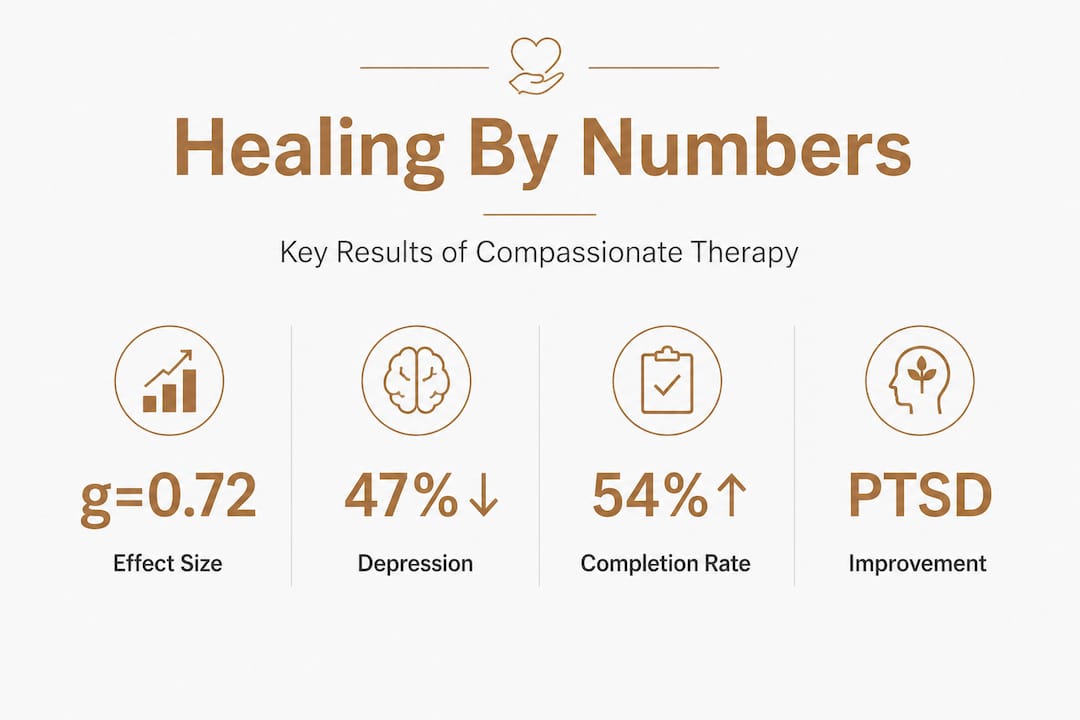
What about complex trauma specifically? A randomized controlled trial involving 41 participants with complex PTSD found that CFT matched prolonged exposure therapy in reducing PTSD symptoms, shame, depression, anxiety, and dissociation. It also increased self-compassion and the sense of soothing. Crucially, CFT showed higher tolerability: 76% of participants completed the CFT condition, compared to 60% in the prolonged exposure group. That difference matters enormously for real-world healing, because therapy you can stay with is therapy that works.
| Outcome Measure | CFT | Prolonged Exposure | Waitlist |
|---|---|---|---|
| PTSD Symptom Reduction | Significant | Significant | Minimal |
| Shame Reduction | Significant | Moderate | None |
| Self-Compassion Increase | Significant | Minimal | None |
| Completion Rate | 76% | 60% | N/A |
| Depression Reduction | Significant | Significant | Minimal |
For people navigating evidence-based trauma healing, the key benefits of CFT include:
- Reduced self-criticism and shame, which are often the hardest obstacles to healing
- Improved emotional regulation, so daily life feels less like walking a tightrope
- Greater self-compassion, which builds resilience over time
- Lower dropout rates, meaning more people actually finish treatment
- Comparable symptom relief to exposure therapy, with a gentler path to get there
The role of empathy in healing cannot be overstated here. Feeling genuinely witnessed in therapy is not a nice extra. It is an active ingredient in recovery.
Addressing fears and misconceptions about compassion
While effectiveness is clear, many people still worry that compassion might be “too soft” or ineffective. Let’s address these concerns directly, because they are worth taking seriously.
The most common fear is that self-compassion means letting yourself off the hook, that it is indulgent or weak. This belief often runs deepest in people who grew up in environments where they were criticized harshly, where emotional softness was seen as a flaw. If you were taught that love came with conditions, it makes sense that compassion feels dangerous.
Research on fears of compassion in Nature confirms that these fears are real and common, especially in people whose self-criticism has been resistant to CBT. Psychoeducation, meaning learning the actual science of what compassion does in the brain, is often what turns this around. When you understand that compassion activates a specific neurological system rather than simply feeling nice, it stops feeling like weakness and starts feeling like a skill.
Here are the most common fears, and what they actually mean:
- “Compassion means I won’t hold myself accountable” — In reality, self-compassion is associated with greater personal responsibility, not less, because it removes the defensive shame that blocks honest reflection
- “This will just make me wallow in my pain” — Compassion does not mean dwelling. It means acknowledging pain without being consumed by it
- “I don’t deserve compassion” — This thought itself is often a trauma symptom, not a fact
It is also worth noting that for some individuals, such as those experiencing active psychosis or certain phases of bipolar disorder, CFT requires careful adaptation. The research shows promise in these populations, but the evidence base is still developing. A skilled, trauma-informed therapist will always tailor the approach to your specific situation and create a safe healing space before moving into deeper work.
Pro Tip: If you notice resistance to compassion in yourself, get curious about it rather than pushing through. That resistance often holds important information about your history. A good therapist will help you approach it gently, at your pace. Trauma-informed self-care begins with respecting your own nervous system’s wisdom.
Practical steps: Applying compassion in trauma-informed care
Now that we’ve cleared the misconceptions, let’s look at how compassion gets put into practice for real healing in Kansas City.
One of the most powerful findings in psychotherapy research is that the therapeutic alliance, the relationship between you and your therapist, predicts outcomes more consistently than any specific technique. Compassion and neuroplasticity research shows that alliance and empathy predict outcomes at r=0.28, and that compassionate approaches actively enhance this alliance. For trauma survivors, the therapeutic relationship itself becomes a reparative experience. Through neuroplasticity, the brain learns new patterns of safety and trust through repeated, consistent experiences of being genuinely cared for.
Here is how to apply compassion-based approaches in your own healing:
- Start with your body. Before any insight or cognitive work, your nervous system needs to feel safe. Soothing breath practices and grounding techniques create the physiological foundation.
- Name your inner critic with curiosity. Rather than fighting harsh self-talk, get to know it. What is it trying to protect you from? When did it first appear?
- Practice small acts of self-kindness. These do not need to be grand gestures. Noticing when you are tired and resting. Choosing nourishing food. These are acts of compassion.
- Find a therapist who prioritizes the relationship. Your healing will move at the pace of trust. Rushing this stage rarely helps.
- Connect with community. Compassion grows in relationship. Isolation feeds the threat system.
For people who are healing for sensitive individuals, the pacing of compassion work is especially important. Sensitivity is not weakness. It is a sign that your nervous system has been highly attuned to your environment, often out of necessity.
Signs your therapist is using a compassionate approach:
- They normalize your emotional responses without dismissing them
- They slow down when you seem overwhelmed, rather than pushing forward
- They check in regularly about your sense of safety in the room
- They speak about your past with warmth and respect, not clinical detachment
- They acknowledge their own humanity rather than presenting as an expert authority
Pro Tip: For those processing complex trauma, the reparative relationship is often where the deepest healing happens. Look for a therapist who feels consistently safe, not just intellectually skilled.
Nuances and limitations: What the latest research reveals
To make confident choices as a therapy client, it is crucial to understand both the strengths and remaining questions in the research.
Evidence for self-compassion reducing psychopathology and improving wellbeing through improved emotion regulation and less rumination is robust. However, the field is still maturing. Some meta-analyses in depression research show signs of publication bias, meaning studies with positive results are more likely to be published, which can inflate how effective a treatment appears. Long-term randomized controlled trials are still limited in number.
“The evidence for self-compassion is strong in many areas, but honest evaluation requires acknowledging where gaps remain. Nuance is not a weakness in therapy decision-making. It is wisdom.” — Mindfulness Research
| Area | Strength of Evidence | Notes |
|---|---|---|
| Self-compassion and anxiety | Strong | Multiple meta-analyses |
| CFT for complex trauma/PTSD | Moderate to strong | Growing RCT base |
| Long-term outcomes | Limited | Needs more high-quality RCTs |
| CFT for psychosis/bipolar | Emerging | Promising, but limited data |
| Publication bias risk | Present in some reviews | Especially depression research |
Questions worth asking your therapist:
- What modalities do you use, and what does the research say about them for my specific concerns?
- How do you adapt your approach if something is not working for me?
- What does the evidence say about long-term outcomes?
- How do you handle setbacks or periods where I feel worse before I feel better?
- How do you stay current with trauma-informed research?
Understanding healing through presence means being an informed participant in your own care. You deserve a therapist who can hold both the hope and the honest complexity of what healing requires.
Fresh perspective: The real reason compassionate therapy works
Here is something you will not find in most articles about therapy: the reason harsh, push-through approaches often fail with complex trauma is not a lack of motivation on the client’s part. It is neurobiological. Our brains are what Paul Gilbert calls “tricky brains,” capable of imagining threats that are not present and reliving past pain as though it is happening now. When therapy focuses purely on exposure without addressing the underlying shame and nervous system dysregulation, it often retraumatizes rather than heals.
We have worked with Kansas City community members who arrived having already tried multiple forms of therapy. Some had completed exposure protocols. Some had done years of CBT. They were not failures. Their previous therapies had simply not addressed the root layer: the deep, often wordless belief that they were fundamentally broken, unworthy of care, or that the world would never be safe.
What changed things was not more intensity. It was being genuinely witnessed. When your nervous system finally experiences, perhaps for the first time, that a caring presence can tolerate your full reality without flinching or fixing or running, something shifts. That is not soft. That is the most precise, science-backed intervention possible.
Do not judge your therapy by how hard it feels. Intensity is not the same as depth. Some of the most profound healing happens in the quiet, when you finally let yourself be cared for. Kansas City compassion work shows us, again and again, that softness is not the opposite of strength. It is the foundation of it.
Discover compassionate, trauma-informed therapy in Kansas City
If what you have read here resonates with you, you do not have to keep searching alone. Healing is possible, and reaching out is not a sign that something is wrong with you. It is a sign that something in you still believes things can be different.

At Simple Empathy KC, we offer therapy services in Kansas City grounded in compassion, evidence, and deep respect for your story. We use modalities like EMDR, Internal Family Systems, and somatic therapy, not because they are trendy, but because they meet your nervous system where it actually lives. We believe every person deserves a creating a safe space for their healing, one that honors their history and trusts their capacity to come home to themselves. When you are ready, we are here.
Frequently asked questions
How is compassionate therapy different from traditional CBT or exposure therapies?
Compassionate therapy focuses on soothing the nervous system and addressing shame and self-criticism directly, while CBT and exposure therapies primarily work by confronting feared thoughts or situations. Research in Nature confirms that CFT is particularly effective for people whose self-criticism has not responded to CBT.
Does compassionate therapy work for complex trauma and PTSD?
Yes. A clinical trial for C-PTSD found that CFT matched prolonged exposure in symptom reduction, with higher completion rates (76% vs. 60%), making it a highly effective and more tolerable option for complex trauma.
What should I look for in a compassionate, trauma-informed therapist?
Look for a therapist who prioritizes the therapeutic relationship, empathy, and creating genuine safety. Therapeutic alliance predicts outcomes at r=0.28, and reparative relationships foster neuroplasticity and lasting integration.
Are there any risks or downsides to compassionate therapy?
For most people, compassionate therapy is safe and well-tolerated. However, for those with active psychosis or certain presentations of bipolar disorder, careful adaptation is needed, as research in this area is still limited and developing.
Does research prove compassionate therapy works long-term?
Short-term benefits are strongly supported by multiple meta-analyses, but long-term RCT evidence is still developing, and some depression research carries a risk of publication bias. The field is growing, and current findings remain highly encouraging.