
TL;DR:
- Skilled therapists use personalized, trauma-informed methods to address trauma’s effects on body, thoughts, and relationships.
- Building trust and a strong therapeutic alliance is essential for effective trauma recovery.
- Consistent attendance and culturally sensitive care are key to successful healing and identity affirmation.
There’s a common misconception that therapy is mostly about sitting quietly while someone listens to you talk. The reality is much richer than that. A skilled therapist actively shapes your recovery, adapting evidence-based methods to the specific ways trauma lives in your body, your thoughts, and your relationships. Whether you’re navigating anxiety, complex trauma, grief, or an identity transition, the therapist’s role is precise, intentional, and deeply personal. Understanding what that role looks like can help you step into the healing process with more clarity and confidence.
Table of Contents
- Personalized, trauma-informed care: The foundation of therapist support
- Building trust: The importance of therapeutic alliance
- Evidence-based therapies: Tailoring techniques for anxiety, trauma, and identity
- Engagement and dose: Why consistency matters in your healing
- Supporting identity transitions: Affirmative and culturally sensitive healing
- What most guides miss: Safety, pacing, and culture in therapy
- Finding the right therapist in Kansas City: Your next steps
- Frequently asked questions
Key Takeaways
| Point | Details |
|---|---|
| Personalized care | Therapists adapt evidence-based plans to each individual’s trauma, anxiety, or identity needs. |
| Therapeutic alliance | A strong therapist-client relationship is critical for meaningful and lasting recovery. |
| Flexible techniques | Therapists select and tailor therapy modalities to fit each client’s situation for the best outcomes. |
| Consistent engagement | Regular attendance and sufficient therapy sessions improve recovery chances after trauma. |
| Affirmative approach | Therapists use culturally sensitive, identity-affirming strategies to support unique healing journeys. |
Personalized, trauma-informed care: The foundation of therapist support
To understand the therapist’s real impact, start with the foundation: how personalized care changes everything about recovery.
Not all therapy is created equal. A trauma-informed approach starts by recognizing that trauma reshapes how you perceive safety, yourself, and other people. Before diving into deep processing work, a skilled therapist will first help you build stability. That means understanding your specific symptom triggers, identifying patterns of avoidance, and gently examining the beliefs trauma left behind, things like “I’m not safe anywhere” or “I must have deserved this.”
APA guidance for adults with PTSD and complex trauma emphasizes evidence-based psychotherapy over medication as the primary path forward. This matters because it places the relationship and the therapeutic process itself at the center of healing, not just symptom management.
Trauma-informed care is often misunderstood as simply being “gentle” or “soft.” It’s actually a rigorous clinical framework. Here’s what a personalized trauma-informed plan typically targets:
- Avoidance patterns that keep you from processing what happened
- Trauma-related beliefs about yourself, others, and the world
- Nervous system dysregulation that keeps your body in a state of hypervigilance or shutdown
- Attachment wounds that affect how safe you feel in relationships
- Identity disruptions caused by prolonged or early trauma
The difference between evidence-based and evidence-informed care is worth noting. Evidence-based means the approach has been tested in clinical trials with clear outcomes. Evidence-informed means the therapist draws on research principles but adapts flexibly based on your individual response. Both have value. A thoughtful therapist working in trauma-informed healing spaces will often blend both, staying anchored in proven methods while staying responsive to you.
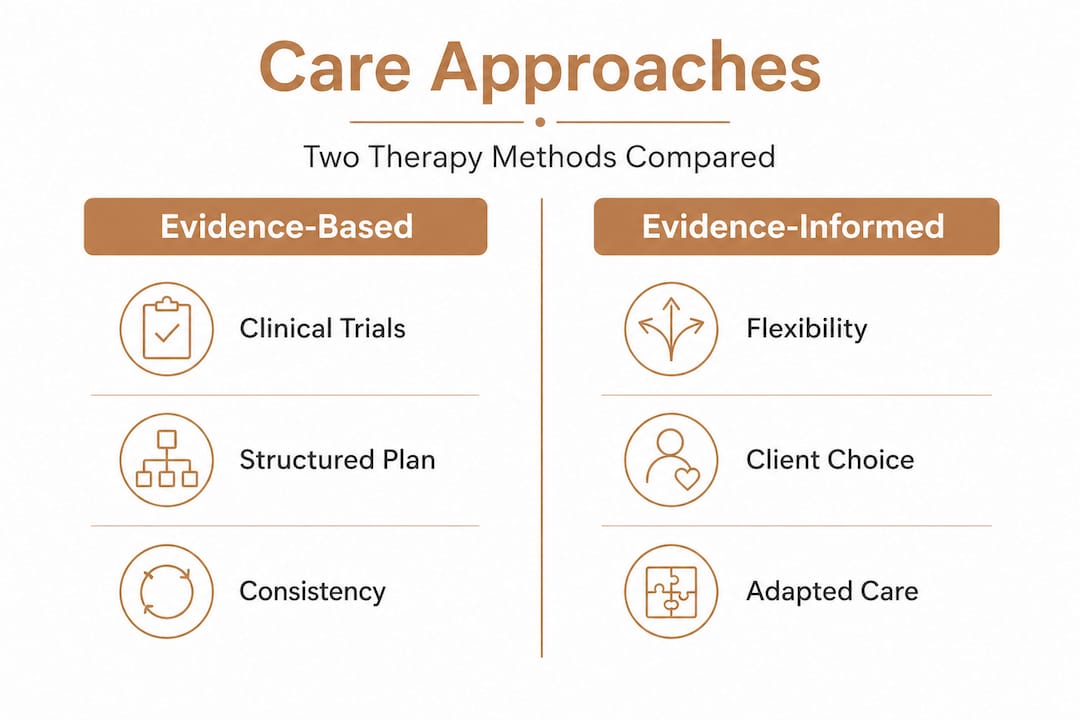
For practical starting points, trauma recovery tips grounded in evidence can help you understand what to expect as care begins.
| Care approach | Basis | Flexibility | Best for |
|---|---|---|---|
| Evidence-based | Rigorous clinical trials | Structured | Specific diagnoses like PTSD |
| Evidence-informed | Research principles | Adaptive | Complex or layered presentations |
| Integrated | Both combined | Highly personalized | Most trauma and anxiety cases |
Building trust: The importance of therapeutic alliance
Once a personalized plan is in place, a therapist’s effectiveness depends entirely on one thing: the relationship you build together.

The therapeutic alliance is the term clinicians use to describe the collaborative bond between you and your therapist. It includes trust, mutual respect, open communication, and your therapist’s ability to respond to your needs in real time. This isn’t just a warm feeling. It’s a clinical predictor of whether therapy works.
Research on therapeutic relationships in community mental health settings consistently treats the alliance as fundamental to long-term recovery, especially when trauma is complex and has affected how you see yourself and relate to others. When trauma has taught you that people aren’t safe, learning to trust a therapist becomes part of the healing itself.
“The therapeutic alliance is not just the backdrop to treatment. For many clients with complex trauma, learning to trust another person in the therapy room is the treatment.”
So what does trust-building actually look like in practice? Here are concrete ways skilled therapists nurture that alliance:
- Reflective listening: Repeating back what you’ve shared in a way that shows real understanding, not just surface acknowledgment
- Transparency: Being honest about the process, including what’s hard and what to expect
- Validation: Naming your experience as understandable, not dramatic or broken
- Consistency: Showing up the same way, session after session, so your nervous system learns to feel safe
- Repair: When misattunements happen, addressing them directly and with care
The role of empathy in healing can’t be overstated here. Being truly witnessed, not fixed or analyzed, is often what allows the deepest healing to begin. That experience of trauma witnessing through presence and attunement is one of the most powerful forces in recovery.
Evidence-based therapies: Tailoring techniques for anxiety, trauma, and identity
Building on trust, therapists help clients engage with specific methods that are customized to individual needs. This is where the clinical craft becomes most visible.
There’s no single therapy that works for every person. What CBT clinical guidelines describe as a structured therapeutic approach still requires significant adaptation in real-world practice. Therapists must understand not only which method fits your diagnosis but also how your nervous system, history, and identity shape your response to that method. The “what changes” in therapy is usually how you interpret anxiety sensations, how you relate to feared memories or situations, and how you see yourself within those experiences.
Here’s a comparison of key modalities used in trauma and anxiety-focused care:
| Modality | Focus | Best suited for | Core strength |
|---|---|---|---|
| CBT (Cognitive Behavioral Therapy) | Thoughts and behaviors | Anxiety, PTSD, depression | Structured, evidence-strong |
| DBT (Dialectical Behavior Therapy) | Emotional regulation | Intense emotions, self-harm | Skill-building, validation |
| ACT (Acceptance and Commitment Therapy) | Values and acceptance | Avoidance, identity shifts | Flexibility and self-compassion |
| CPT (Cognitive Processing Therapy) | Trauma beliefs | PTSD, sexual trauma | Targeting stuck points |
| IFS (Internal Family Systems) | Parts of the self | Complex trauma, shame | Deep self-understanding |
Learning more about IFS therapy benefits can help you understand why so many trauma-informed clinicians in Kansas City are drawn to it. IFS works with the different “parts” of you that developed to survive difficult experiences, offering a path toward compassion for all of them.
How does a therapist actually tailor therapy to you? The process typically looks like this:
- Initial assessment: Understanding your history, current symptoms, and what has or hasn’t worked before
- Goal setting: Collaboratively identifying what healing looks like for you specifically
- Modality selection: Choosing the primary approach based on your presentation and preferences
- Pacing decisions: Determining when to go deeper versus when to build more stability first
- Ongoing adjustment: Checking in regularly and shifting the approach as you grow and change
Pro Tip: Ask your therapist directly, “How do you adapt this therapy for someone like me?” A good therapist will welcome that question. It opens up the collaboration and helps you understand the intention behind each step.
Exploring evidence-based trauma healing can deepen your understanding of how these modalities work together in a complete recovery process.
Engagement and dose: Why consistency matters in your healing
Even the most carefully designed therapy plan relies on one thing you have some control over: showing up consistently.
In real-world settings, session attendance and receiving an adequate “dose” of therapy are often what determine outcomes. A retrospective chart review of 480 Veterans in a PTSD specialty clinic found significant variation in engagement rates, with factors like delivery format, therapist approach, and clinic environment all influencing whether clients received a therapeutic dose sufficient for recovery. Numbers like 71.87% and 45.42% completion rates across different treatment conditions underscore just how much consistency matters.
This isn’t about pressure or perfectionism. It’s about recognizing that healing deepens over time, and each session builds on the last. Here are some common barriers to consistent attendance, and how trauma-informed therapists help address them:
- Shame and avoidance: Feeling too overwhelmed to return after a hard session. Therapists address this by normalizing difficulty and checking in after intense work.
- Scheduling conflicts: Life gets complicated. Flexible scheduling, telehealth options, and short-notice accommodation can reduce dropout.
- Fear of the process: Not knowing what’s coming can feel frightening. Transparency about each step builds enough safety to keep going.
- Financial concerns: Discussing cost and insurance options openly prevents avoidance rooted in stress.
- Feeling “not bad enough”: Many people minimize their experiences. A validating therapist helps you recognize that your pain is real and deserving of care.
Following a structured trauma recovery steps process can help you understand where you are in your healing and why each phase matters. Between sessions, trauma-informed self-care practices extend the healing that happens in the room into your everyday life.
Supporting identity transitions: Affirmative and culturally sensitive healing
For those facing identity transitions, therapist support becomes even more personalized and affirming.
Identity transitions, whether related to gender, culture, religion, sexuality, or life roles, can carry their own form of trauma. They often bring grief, confusion, shame, and a renegotiation of who you are in the world. The therapist’s role in these situations requires not only clinical skill but also genuine cultural humility and affirmative practice.
Emerging research, including a pilot study of group therapy models designed for identity-focused healing, shows that integrating CPT-linked mechanisms with identity affirmation can meaningfully reduce shame, cognitive fusion, and suicidality. Group formats add an additional healing element: belonging.
Practical therapist actions in affirmative identity work include:
- Validation without agenda: Reflecting your experience without trying to direct or resolve it
- Cultural humility: Acknowledging your cultural context and not assuming universal frameworks apply
- Shame targeting: Actively working with CPT-style tools to address identity-based shame
- Fostering group belonging: Where appropriate, connecting clients with group therapy to reduce isolation
- Collaborative language: Using the words and frameworks that feel true to your identity, not clinical labels that feel distancing
Individual therapy provides space for deep personal work. Group therapy, when it’s the right fit, offers something else: the healing that comes from being witnessed by others who truly understand. Both have a place depending on where you are in your journey.
Affirmative trauma therapy and a truly personalized trauma recovery process work together to honor the full complexity of who you are.
Pro Tip: If you’re navigating an identity transition, consider asking your therapist about therapy groups in Kansas City. The experience of being truly understood by peers in a safe, facilitated space can accelerate healing in ways individual work alone sometimes cannot.
What most guides miss: Safety, pacing, and culture in therapy
Most articles about therapy focus on the “what.” They describe modalities, list benefits, and point to research. What they skip over is something just as important: the careful assessment of safety and pacing that makes those modalities actually work.
We see this often in conversations around IFS and parts-based work. These approaches can be profoundly healing for people with complex trauma. But important clinical cautions exist around identity and parts-based approaches for individuals who may be at risk of increased disorganization or destabilization. In those situations, a therapist’s training, capacity to assess carefully, and willingness to pace thoughtfully aren’t optional. They’re everything.
What does this look like in practice at a place like Simple Empathy KC? It means therapists don’t rush toward deep processing work just because a client asks for it, or because a particular method is trending. It means slowing down when the nervous system signals it needs more stability first. It means asking questions about your history, your current support system, and your capacity to tolerate distress before deciding what’s next.
Cultural and affirmative competence works the same way. A therapist who uses general frameworks without attending to your specific cultural background, identity, or community context can inadvertently cause harm, even with the best intentions. Kansas City is a diverse, layered city, and the therapists who serve it well are the ones who stay genuinely curious about each person’s story.
Our belief is this: safety is not a step you complete at the beginning of therapy and then move past. It’s a living quality of the relationship, something you and your therapist return to again and again. Healing happens when your nervous system learns, slowly and with evidence, that it is finally, truly safe to feel.
Pro Tip: Before beginning any new therapeutic approach, share your full history with your therapist, including past experiences in therapy that felt harmful or destabilizing. This information helps them calibrate their approach to you specifically and keeps the work safe.
Finding the right therapist in Kansas City: Your next steps
You deserve care that truly sees you. Not just your diagnosis or your symptoms, but the full, complex, beautifully feeling person you are.

At Simple Empathy KC, we offer therapy services in Kansas City built on exactly the principles this article describes: personalized assessment, strong therapeutic alliance, evidence-based modalities, consistent support, and deep cultural sensitivity. Whether you’re working through complex trauma, anxiety, grief, or an identity transition, our therapists meet you where you are. You can start by reading our safe healing space guide to understand what a truly trauma-informed environment feels like, or visit Simple Empathy KC to explore therapist profiles and book a consultation. Your healing is worth showing up for.
Frequently asked questions
What makes trauma-informed therapy different from traditional therapy?
Trauma-informed therapy centers on safety, stabilization, and evidence-based approaches tailored to trauma’s unique impact, rather than relying solely on general talk therapy. It treats the nervous system and trauma-related beliefs as central targets of care from the very first session.
How do therapists personalize treatment for clients with anxiety in Kansas City?
Therapists adjust techniques like CBT and DBT to each person’s experiences and needs, changing how clients interpret anxiety triggers and develop coping strategies. Structured evidence-based approaches are always adapted to individual history, identity, and response patterns.
Why is session attendance (dose) important for healing trauma?
Consistent attendance increases therapy’s effectiveness, with higher doses linked to better outcomes in trauma recovery. A retrospective study of Veterans in a PTSD clinic confirmed that adequate dose is one of the strongest predictors of treatment success.
What does affirmative therapy look like for identity transitions?
Affirmative therapy integrates cultural understanding and evidence-based trauma treatment, targeting shame and fostering group validation especially in group formats. Research from a group therapy pilot study shows this approach can meaningfully reduce shame and cognitive fusion tied to identity-based distress.
What should I ask a potential therapist to ensure safe and effective care?
Ask about their training in trauma-informed and identity-affirming approaches, and how they tailor therapy for safety and optimal pacing. Therapist training and careful pacing are especially critical when using parts-based or identity-focused approaches with vulnerable clients.