
TL;DR:
- Trauma-informed therapy creates a safe space to support deep identity shifts and healing.
- Different approaches, like CBT or psychodynamic therapy, suit various stages of identity transition.
- Building community and practicing self-compassion are vital for sustained self-discovery.
Identity transitions rarely arrive gently. Whether you’re stepping into a new sense of self after loss, coming out, ending a relationship, or leaving a career that once defined you, the experience can feel like the ground has shifted beneath you. Willpower alone doesn’t rebuild a sense of who you are. That takes something deeper, something more careful. This guide explores how trauma-informed therapy supports real healing during major identity shifts, what the research actually shows, and how you can take meaningful steps forward on your own path to self-discovery right here in Kansas City.
Table of Contents
- Understanding identity transitions in therapy
- Key principles of trauma-informed and identity-affirming therapy
- What the research says: Therapy approaches and outcomes
- Practical strategies for navigating identity transitions
- Why healing through identity transitions isn’t a one-size-fits-all process
- Trauma-informed support for your next chapter in Kansas City
- Frequently asked questions
Key Takeaways
| Point | Details |
|---|---|
| Identity shifts are complex | Navigating identity transitions is deeply personal and involves emotional, relational, and practical challenges. |
| Affirming therapy matters | Trauma-informed, identity-affirming therapy fosters safer, more sustainable healing during transitions. |
| Research backs multiple approaches | Both short- and long-term therapy show benefits, especially when care is culturally and contextually sensitive. |
| Community is key | Support networks and belonging play an essential role in healing and building resilience. |
| Personalized strategies help | Asking the right questions and seeking tailored strategies can make your therapy journey more effective. |
Understanding identity transitions in therapy
Identity transitions come in many forms. Coming out as LGBTQ+, losing a partner or parent, relocating to a new city, changing careers after decades, leaving a faith tradition, or moving through a relational separation are all experiences that can shake the very foundation of who you believe yourself to be. These are not small adjustments. They are often seismic, touching every layer of how you move through the world.
What makes these transitions so hard is that they don’t just change your circumstances. They change your story. And when your story changes, your nervous system has to catch up. That is where therapy, and specifically transforming trauma recovery, becomes so important.
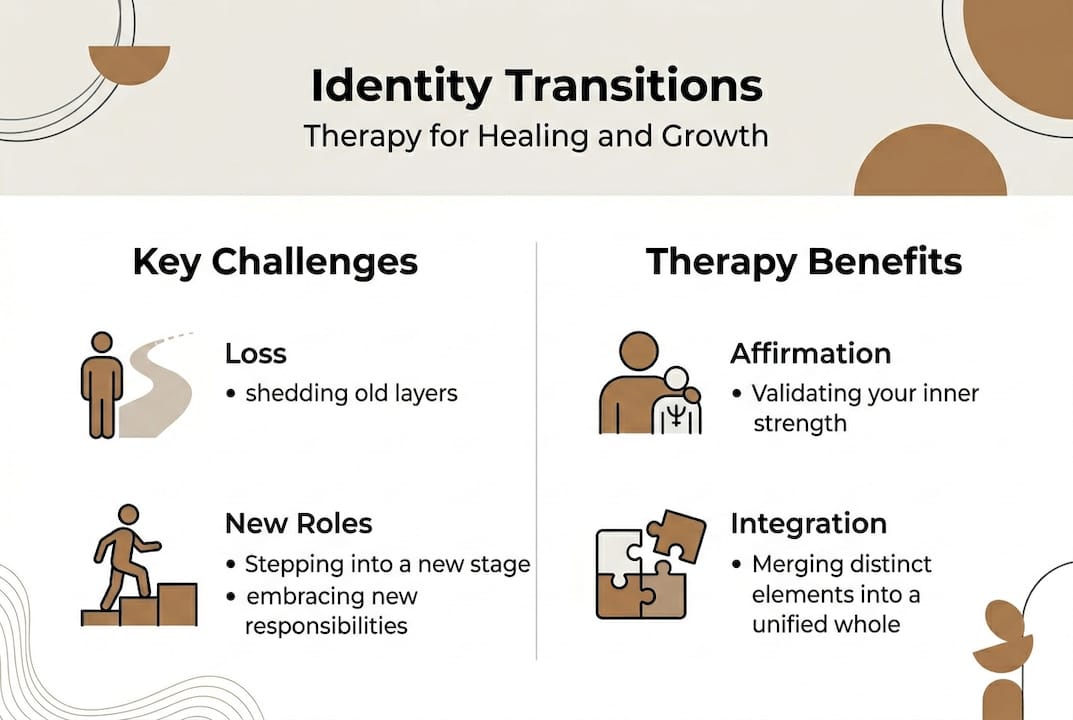
Therapy during identity transitions isn’t just about learning to cope. It’s about building a new internal map. Affirming, trauma-informed care creates the conditions for that map to form safely. Research shows that LGBTQ-affirmative CBT across 16 sessions produced meaningful reductions in depression, anxiety, and minority stress in transgender and gender expansive adults. A ketamine-assisted CPT group running nine weeks showed 100 percent retention and significant symptom reduction. Long-term psychodynamic therapy lasting two or more years led to deep themes of self-awareness, relational transformation, and identity integration.
Short-term models build skills quickly. Long-term approaches tend to cultivate the deeper integration that identity transitions often require. The right fit depends on where you are and what you’re carrying.
Here are some of the key emotional and relational challenges that commonly arise during identity transitions:
- Grief for the identity you’re leaving behind, even when the change is chosen or positive
- Fear of rejection from family, friends, or communities that knew your former self
- Confusion about belonging, especially when old social roles no longer fit
- Shame or internalized stigma, particularly in LGBTQ+ and marginalized experiences
- Disorientation in relationships, including uncertainty about how to show up with others
- Loss of future plans or expectations that were built around a self that has changed
| Therapy approach | Primary focus | Best suited for | Typical outcome timeframe |
|---|---|---|---|
| LGBTQ-affirmative CBT | Minority stress, cognitive skills | Coming out, early identity shifts | 12 to 16 sessions |
| Long-term psychodynamic | Insight, relational patterns | Complex identity integration | 2 or more years |
| Ketamine-assisted CPT | Trauma processing, cognitive fusion | TGE adults with trauma history | 9 weeks |
| IFS therapy | Parts work, internal healing | Fragmented self-perception | Variable, often long-term |
Understanding IFS therapy for healing trauma can also offer tremendous clarity here, especially when you feel like different parts of you are in conflict during a transition.
Key principles of trauma-informed and identity-affirming therapy
After understanding what identity transitions involve, it’s important to unpack how trauma-informed and identity-affirming approaches work.
Not all therapy is built the same. A therapist who is technically skilled but who approaches your identity shift with subtle bias or a pathologizing lens can actually deepen harm. Trauma-informed and identity-affirming therapy is built on a specific set of principles that protect you from that experience.
The core pillars of this approach include:
- Safety: Your nervous system needs to feel secure before healing can begin. A skilled therapist creates this through consistency, warmth, and predictability.
- Trust and transparency: You always know what to expect. There are no hidden agendas in the room.
- Empowerment: You are the expert on your own experience. Your therapist is a guide, not an authority over your story.
- Choice: You get to set the pace. Nothing is forced, especially when trauma is involved.
- Collaboration: Therapy is something you do together, not something done to you.
- Cultural and contextual humility: Your therapist acknowledges the social, cultural, and structural forces shaping your experience without minimizing them.
Experts highlight a critical nuance here. Therapeutic safety practices emphasize the need to avoid pathologizing identity through trauma frameworks, meaning your identity shift should never be framed as a symptom or a wound in itself. Group and relational elements also significantly amplify a sense of belonging and healing, especially for those navigating marginalized identity transitions.
“Healing during identity transitions is not about fixing what is broken. It is about being witnessed as you become. Your identity is not a problem to solve.”
You can explore how creating a safe space in therapy looks and feels in practice, which can help you recognize what affirming care actually looks and feels like in the room.
Pro Tip: When meeting a potential therapist, ask them directly how they approach the intersection of trauma and identity. Notice whether they invite your experience with curiosity or subtly suggest your identity shift is the problem. Your comfort in answering that question is data.
What the research says: Therapy approaches and outcomes
Understanding these therapy principles sets the stage for looking at what research actually tells us about outcomes and approaches.
The evidence is encouraging, and also nuanced. Different therapy models serve different needs, and no single approach works universally. That is not a flaw. That is honesty.
Here is how common approaches compare across identity transition contexts:
| Therapy model | Strengths | Limitations | Identity transition fit |
|---|---|---|---|
| Short-term CBT or DBT | Builds coping skills quickly | Less depth for complex identity work | Early stage, acute distress |
| Long-term psychodynamic | Fosters insight, relational healing | Slower, requires sustained commitment | Deep integration, relational wounds |
| Group-based or network methods | Builds community, shared belonging | Requires readiness to engage with others | Social identity transitions |
| Trauma-integrative pilots | High retention, strong early results | Pilot-scale evidence, not yet widely available | Complex trauma plus identity shift |
Research framing recovery through the lens of trauma healing evidence shows that the Social Identity Model of Recovery, known as SIMOR, views recovery as a shift from one social identity group to another. However, qualitative studies reveal that network changes during recovery are non-linear and complex, heavily influenced by stigma and structural barriers. Psychodynamic approaches build deep insight over time, while short-term CBT and DBT focus on immediate skill development.
Key research-backed benchmarks worth knowing:
- Stable symptom reduction maintained at 12 or more months of follow-up is a meaningful marker of genuine progress.
- Improved daily functioning, including work and relationships, signals that identity integration is taking hold.
- Reduced relapse rates, including a relative risk of 0.78 for psychodynamic approaches in depression, show sustained benefit.
- High acceptability and feasibility in identity-trauma pilots suggest these approaches feel safe and relevant for participants, not just statistically effective.
One unexpected finding in this space involves marginalized groups. Some trauma-informed interventions for transgender and gender diverse adults showed empowerment and positive symptom shifts, while simultaneously revealing unexpected increases in risk in certain areas. This doesn’t mean trauma-informed care doesn’t work. It means the work is complex, and staying with a skilled, affirming clinician who monitors these nuances is essential.
Practical strategies for navigating identity transitions
Having established what works, how do you actually apply these insights to your own therapy journey?
You don’t have to figure this out alone. There are concrete, meaningful steps you can take starting today.
Here are actionable strategies to support your identity transition:
- Find a therapist who explicitly names affirming care. Look for language like “LGBTQ-affirming,” “trauma-informed,” and “identity transitions” on their profile or website. This matters because therapist fit dramatically affects outcomes.
- Build or rebuild community intentionally. Kansas City has a rich network of affinity groups, LGBTQ+ centers, grief circles, and peer support spaces. Ask your therapist about local resources or look into organizations like the Kansas City LGBTQ+ Community Center for connection.
- Start a transitions journal. Research supports that integrating multiple self-aspects enhances resilience during identity shifts. Writing about different parts of who you are, who you were, and who you are becoming can help hold all of those truths at once.
- Name your support network and notice what needs to shift. Some relationships will grow with you. Others may not. Relational recovery frameworks emphasize that social network shifts are often as important as internal identity changes.
- Move at your own pace. One of the most important things presence in therapy teaches is that your timeline is valid. Healing is not a race.
- Ask about somatic or body-based work. Identity transitions often live in the body, not just the mind. Somatic therapy and EMDR can help your nervous system process what words alone can’t reach.
Pro Tip: When linking trauma to your identity, be careful about therapists who draw those lines too tightly or too quickly. Connecting trauma history to identity exploration can be useful, but done without sensitivity, it can feel invalidating or distressing. Look for someone who holds both pieces with care, not certainty.
It’s also worth knowing that long-term approaches like psychodynamic therapy tend to sustain their gains well over time, though research suggests that a higher initial intensity of sessions isn’t necessarily superior in the long run. More time, not just more sessions early on, tends to matter most.
In Kansas City, you don’t have to navigate this alone. Trauma-informed therapy is more accessible here than ever, and finding the right fit is worth taking the time for.
Why healing through identity transitions isn’t a one-size-fits-all process
Let’s step back and consider a different angle: what do conventional recovery models miss when it comes to real identity transitions?

Most clinical frameworks assume a relatively straight line from distress to resolution. Identify the problem, apply the intervention, measure improvement, close the file. That model fails people who are mid-transformation. Identity work is rarely linear. You might feel more yourself than ever one week, and then feel completely lost again after a family gathering or a life event. That is not regression. That is the actual shape of becoming.
The compassion in trauma recovery perspective matters enormously here. Healing through identity transitions requires permission to redefine yourself, sometimes repeatedly, over years. It requires a therapist who doesn’t pathologize the setbacks and community structures that reflect the real complexity of your social world.
Kansas City’s diverse communities also shape what healing looks like here. Local social context, neighborhood culture, and community belonging all influence what feels supportive and what doesn’t. Prioritize self-compassion over milestone chasing. Your process is sacred, and it belongs to you.
Trauma-informed support for your next chapter in Kansas City
Ready to take the next step toward healing?
At Simple Empathy KC, we believe your story deserves to be witnessed without judgment. Whether you’re navigating a major life transition, sitting with grief, or exploring who you are becoming, you don’t have to do it alone. Our therapists specialize in safe space for healing and bring genuine warmth and expertise to every session.

We integrate EMDR, Internal Family Systems, and somatic therapy to support your nervous system through the complexity of identity transitions. If you want to understand more about our trauma-informed care principles, we invite you to explore and reach out when you feel ready. Your healing is possible, and we are honored to walk alongside you.
Frequently asked questions
What are common identity transitions addressed in therapy?
Common transitions include coming out, gender exploration, career change, becoming a caregiver, and major losses or trauma. Each carries its own emotional weight and timeline.
How does trauma-informed therapy help with identity transitions?
Trauma-informed therapy prioritizes emotional safety and integration without pathologizing shifts in identity, helping you build a new relationship with yourself that feels grounded and authentic.
Are short-term or long-term therapies more effective for identity-related issues?
Both modalities offer value, but longer approaches tend to foster sustained self-awareness and deeper integration, while short-term models like LGBTQ-affirmative CBT quickly build practical coping skills for managing distress.
What is the role of community and social networks in identity transitions?
Social network shifts are often central to identity recovery, amplifying belonging and healing in ways that individual therapy alone cannot fully provide, especially for marginalized groups.
How do I find an identity-affirming therapist in Kansas City?
Look for clinicians who explicitly name trauma-informed and LGBTQ-affirming care in their profiles, and ask about their direct experience supporting identity transitions during an initial consultation.