
TL;DR:
- Modern anxiety therapy often incorporates trauma-informed methods addressing the nervous system and emotional history.
- Trauma-focused therapies like EMDR and TF-CBT offer deeper, longer-lasting relief for trauma-related anxiety.
- Finding a qualified, trauma-informed therapist in Kansas City involves research, asking about training, and assessing safety and compatibility.
If you’ve ever wondered whether anxiety therapy is really “just talking about your problems,” you’re not alone. Many people in Kansas City hold back from seeking help because they aren’t sure what therapy actually involves or whether it will work for someone with their particular history. The truth is, modern anxiety therapy, especially when it’s trauma-informed, draws on well-researched, powerful methods that address not just your thoughts, but your whole nervous system, your emotional history, and your sense of self. This guide will walk you through what anxiety therapy means, how trauma-focused approaches work, and how to find the right support right here in Kansas City.
Table of Contents
- Defining anxiety therapy: Key concepts and approaches
- How CBT and trauma-focused therapies treat anxiety
- Comparing trauma-focused and standard anxiety therapies
- Finding trauma-informed anxiety therapy in Kansas City
- Our take: What most guides miss about trauma and anxiety
- Ready to take the next step?
- Frequently asked questions
Key Takeaways
| Point | Details |
|---|---|
| Therapy is evidence-based | Modern anxiety therapy relies on proven approaches like CBT and trauma-focused care. |
| Trauma-informed care matters | Addressing past experiences and complex emotions is crucial for lasting anxiety relief. |
| Local resources are available | Kansas City has therapists specializing in trauma-informed anxiety treatment. |
| Personalization is key | Effective therapy plans are tailored to each person’s unique history and needs. |
Defining anxiety therapy: Key concepts and approaches
Anxiety therapy is not a single, one-size-fits-all experience. It’s a carefully guided process that meets you where you are, honors what you’ve been through, and helps you move toward a life that feels more manageable, more yours. Anxiety therapy encompasses psychotherapies like Cognitive Behavioral Therapy, known as CBT, aimed at treating anxiety disorders by addressing maladaptive thoughts, emotions, and behaviors. That means therapy isn’t just about naming your feelings. It’s about understanding why certain thoughts and reactions show up, and gently reshaping them at their roots.
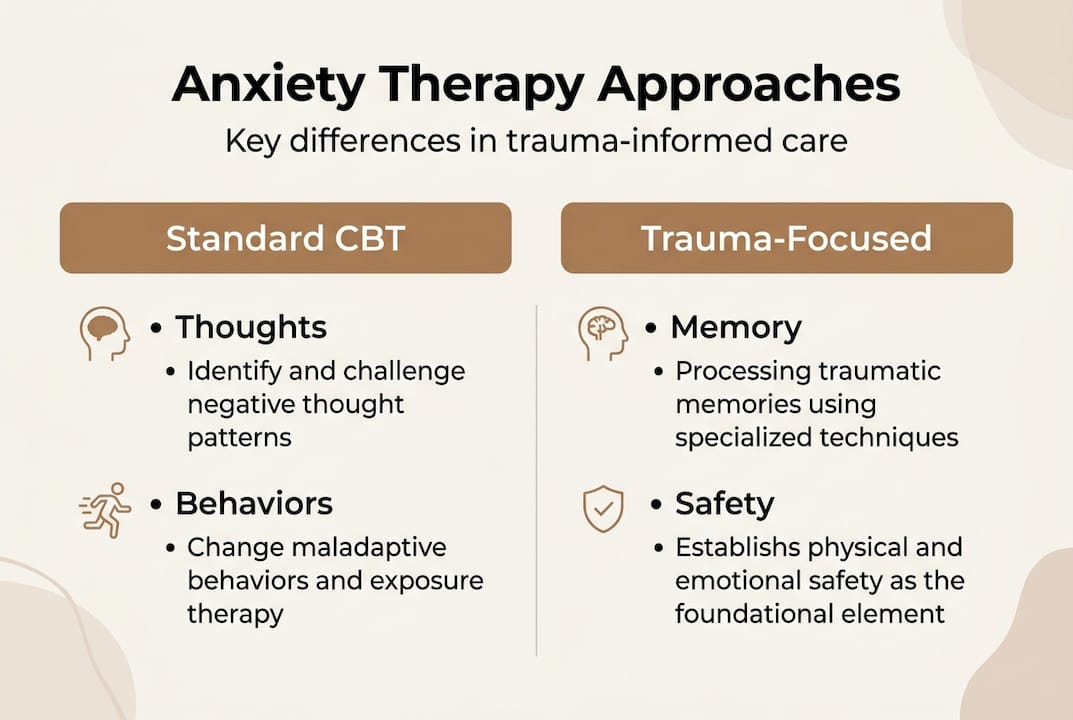
CBT is one of the most widely recognized and studied forms of anxiety therapy. It works by helping you notice patterns in your thinking, challenge the ones that cause harm, and practice new ways of responding to stress. For many people, this alone brings enormous relief. But for those whose anxiety is connected to past trauma, attachment wounds, or major life transitions, standard CBT may not go deep enough.
That’s where trauma-informed care enters the picture. Trauma-informed therapy doesn’t just add a few extra techniques onto a standard approach. It fundamentally changes how a therapist shows up for you. A trauma-informed therapist understands that your nervous system carries memory, that your reactions are not overreactions, and that safety must come before any real healing can happen. Approaches like EMDR (Eye Movement Desensitization and Reprocessing), Internal Family Systems (IFS), and somatic therapy are often woven into trauma-informed work, helping the body and mind process what words alone cannot always reach.
Here’s what trauma-informed anxiety therapy typically addresses:
- Maladaptive thought patterns that developed as protection and now cause suffering
- Emotional responses rooted in past experiences, including fear, shame, and grief
- Nervous system dysregulation that keeps you in a constant state of fight, flight, or freeze
- Attachment wounds that affect how you relate to yourself and others
- Identity and life transition stress, including grief, loss, and major personal change
You can explore the full range of therapy services KC to understand how these approaches come together in a personalized, compassionate setting.
Pro Tip: When you first contact a potential therapist, ask directly about their training in trauma-informed methods. A well-trained therapist will welcome that question and be clear about their approach.
How CBT and trauma-focused therapies treat anxiety
Once the basics are clear, it’s useful to understand the science behind popular therapies and why they’re trusted by experts. CBT has decades of research behind it, and its effectiveness for anxiety is not in question. However, when trauma is part of your story, a more specialized version called Trauma-Focused Cognitive Behavioral Therapy (TF-CBT) often produces deeper and longer-lasting results.
TF-CBT is superior to no treatment and outperforms many alternative treatments for PTSD and co-occurring depression. The research is consistent: CBT and TF-CBT meaningfully reduce anxiety symptoms for a significant majority of people who engage with them consistently. Studies suggest that between 60 and 80 percent of people who engage in CBT experience meaningful improvement in their anxiety symptoms. That’s not a small number. That’s most people who give it a genuine chance.
“Trauma-focused cognitive behavioral therapy doesn’t just treat what’s on the surface. It helps people process the deeper emotional wounds that anxiety often masks, leading to more complete and lasting relief.” This is the kind of healing that restores not just function, but a sense of wholeness.
What makes these approaches effective for Kansas City residents considering therapy is how directly they address the link between unresolved trauma and ongoing anxiety. When something frightening or overwhelming happens and isn’t fully processed, the nervous system holds onto it. TF-CBT, along with modalities like EMDR and IFS therapy, helps the brain and body complete that processing so the alarm system can finally quiet down.
Here’s a quick look at how different therapy types compare in terms of effectiveness for anxiety and trauma:
| Therapy type | Primary focus | Anxiety effectiveness | Trauma effectiveness |
|---|---|---|---|
| Standard CBT | Thoughts and behaviors | High (60-80%) | Moderate |
| TF-CBT | Trauma-specific thought patterns | High | High |
| EMDR | Trauma memory processing | Moderate to high | Very high |
| IFS (Internal Family Systems) | Inner parts and self-compassion | High | Very high |
| Somatic therapy | Body-based trauma responses | Moderate | High |
Each of these modalities has its own strength. A skilled therapist will often use more than one approach, drawing on whichever tools best support your unique nervous system and story. The best therapy KC residents can access is usually the kind that’s flexible, responsive, and rooted in genuine relationship.
Comparing trauma-focused and standard anxiety therapies
Now that you know how therapies work, let’s compare trauma-focused versus standard anxiety therapies to help you choose what’s best. Both are valuable. But they’re not interchangeable, and knowing the difference can save you time and frustration.
Standard anxiety therapies, like general CBT or mindfulness-based approaches, are highly effective for anxiety that isn’t deeply rooted in past trauma. They teach practical skills, help you manage stress responses, and build resilience. For many people, this is exactly what’s needed. But if your anxiety is layered with grief, complex trauma, attachment disruptions, or identity-level confusion, standard approaches may feel like putting a bandage on a wound that needs something more.
Trauma-focused treatments outperform non-trauma-focused approaches for PTSD, and therapies like Prolonged Exposure (PE) and Cognitive Processing Therapy (CPT) carry some of the strongest evidence available for trauma-related anxiety. Prolonged Grief Therapy has also emerged as a specialized option for those navigating complicated bereavement. The takeaway is simple: the more your anxiety is connected to what you’ve lived through, the more you need a therapist who understands that history.

Here’s a side-by-side comparison to help you make a more informed choice:
| Feature | Standard anxiety therapy | Trauma-focused therapy |
|---|---|---|
| Primary target | Thoughts and current behaviors | Past experiences and nervous system patterns |
| Best suited for | Generalized anxiety, phobias, social anxiety | PTSD, complex trauma, grief, identity wounds |
| Duration | Short to medium term | Medium to long term |
| Approach to body | Minimal | Central (somatic and body-based work) |
| Relational focus | Moderate | High, including attachment patterns |
| Lasting outcomes | Good for skill-building | Often deeper, more lasting emotional repair |
When you’re choosing an approach, consider these guiding questions:
- Does your anxiety feel connected to specific past experiences or relationships?
- Do you struggle with emotional numbing, flashbacks, or a sense of unreality?
- Have you experienced significant loss, grief, or a major shift in your identity?
- Does your body feel chronically tense, hypervigilant, or shut down?
- Have previous therapy attempts felt incomplete or like something important was being missed?
If you answered yes to any of those, trauma-focused therapy is likely to serve you better. Resources like trauma healing tips and trauma recovery steps can also give you a clearer sense of what the healing path looks like before you even walk into a therapist’s office.
Finding trauma-informed anxiety therapy in Kansas City
With a clear comparison, your next step is to find a provider who fits your unique needs, and this section shows you how. Kansas City has a growing community of skilled, compassionate therapists who specialize in trauma-informed care. Finding the right one takes a little intentional effort, but it’s well worth it.
Evidence-backed techniques that target underlying causes of anxiety aren’t just reserved for major cities or elite wellness centers. They’re available right here. The key is knowing how to look, what to ask, and what to trust in yourself as you navigate the process.
Here are practical steps for finding the right trauma-informed therapist in Kansas City:
- Start with a specific search. Use directories like Psychology Today or Therapy Den and filter for trauma-informed, EMDR-trained, or IFS-certified therapists in Kansas City. Being specific helps you narrow down quickly.
- Read therapist bios carefully. Look for language that signals genuine trauma competency, words like “attachment,” “somatic,” “nervous system,” “relational,” and “trauma-informed” are meaningful indicators.
- Ask about their training directly. When you reach out, ask what specific trauma-focused training they have and how they approach anxiety that’s connected to past experiences. A well-aligned therapist will answer clearly and warmly.
- Request a consultation. Most therapists offer a brief initial call. Use it to notice how you feel in their presence. Does their voice feel calm? Do they seem curious about your story? Safety is something you can sense.
- Check for specializations in grief and identity work. If your anxiety is wrapped up in loss, cultural identity, or a major life transition, look for a therapist who explicitly mentions these areas. Healing in those spaces requires particular sensitivity and skill.
- Verify credentials and licensure. Make sure any therapist you work with is licensed in Missouri. For trauma-specific modalities like EMDR, look for training from recognized institutes.
Before your first session, it helps to prepare a few things. Jot down your main concerns, the areas of your life that feel most affected, and any past therapy experiences that felt helpful or unhelpful. You don’t need to have everything figured out. You just need to show up as honestly as you can.
Pro Tip: Look for therapists who explicitly list grief and identity transitions in their specialties. Anxiety that comes from losing a part of yourself, or a person you love, needs a different kind of presence than anxiety driven by everyday stress.
Knowing how to create a safe space in your own healing process is also part of this work. A trauma-informed therapist will help you build that safety from the inside out.
Our take: What most guides miss about trauma and anxiety
Most online guides treat trauma-informed therapy as if it’s simply a more sensitive version of standard CBT. Add some validation here, acknowledge the trauma there, and you have trauma-informed care. But that’s not what it actually is. Real trauma-informed therapy is not a technique layered on top of another technique. It’s a completely different orientation toward you as a human being.
True trauma-informed care asks: How did this person learn to survive? Not: What’s wrong with this person’s thinking? That shift in question changes everything about how therapy unfolds. It means your responses are respected as intelligent adaptations, not symptoms to be corrected away. It means your nervous system is treated as sacred ground, not a problem to be managed.
For Kansas City’s diverse community, that distinction matters deeply. Grief, cultural identity shifts, immigration-related stress, racial trauma, and the quiet losses that come with life transitions all deserve a therapist who understands the full weight of what you’ve carried. A guide that reduces trauma-informed therapy to a checklist misses the relational, lived reality of this work.
“Healing doesn’t happen because someone taught you the right techniques. It happens because someone truly witnessed you, and in that witnessing, you came home to yourself.”
That kind of processing complex trauma is what moves people from managing anxiety to genuinely transforming their relationship with themselves. It’s slower, sometimes harder, and absolutely worth it.
Ready to take the next step?
If you’ve read this far, something in you is already moving toward healing. That matters. You don’t have to have everything figured out before you reach out.

Simple Empathy KC offers therapy services KC rooted in trauma-informed care, designed specifically for individuals navigating anxiety, grief, complex trauma, and identity transitions. Our therapists bring warmth, deep training, and genuine presence to every session. Whether you’re just beginning to explore therapy or you’ve tried before and felt something was missing, we’d be honored to hold space for your story. Flexible scheduling and a compassionate, non-judgmental environment make taking that first step a little softer. Reach out today, and let’s find out what healing can look like for you.
Frequently asked questions
What is anxiety therapy and how does it help?
Anxiety therapy uses evidence-based methods like CBT to address maladaptive thoughts and behaviors, reducing anxiety symptoms and improving overall well-being. It helps you understand the roots of your anxiety and develop healthier, more sustainable ways of responding to stress.
Is trauma-focused therapy more effective for anxiety related to past trauma?
Trauma-focused approaches outperform non-trauma-focused therapies for PTSD and co-occurring depression, offering deeper and longer-lasting relief. If your anxiety is rooted in past experiences, trauma-focused therapy is likely to produce more complete healing.
How do I choose a trauma-informed therapist in Kansas City?
Look for licensed therapists with specific training in trauma-informed modalities like EMDR or IFS, and ask directly about their experience with grief or identity transitions. A good fit will feel safe, curious, and genuinely warm from the very first conversation.
What can I expect during my first anxiety therapy session?
Your therapist will take time to understand your symptoms, your history, and what you’re hoping to experience through therapy, then begin co-creating a personalized treatment plan with you. You won’t be expected to share everything at once.
How soon can improvements be seen with CBT for anxiety?
Most people notice meaningful improvement within six to twelve weeks of consistent sessions, with 60 to 80 percent of CBT clients experiencing significant relief. The timeline can vary depending on the complexity of your history and how trauma is involved.