
TL;DR:
- Sensitivity is an innate trait, not caused by trauma, and offers unique strengths and challenges.
- Trauma-informed healing emphasizes safety, trust, and empowerment tailored to sensitive individuals.
- Correct environment and personalized care can help highly sensitive adults thrive in therapy and life.
You’ve probably been told you’re “too sensitive” more times than you can count. Maybe you’ve even wondered if your sensitivity is a wound left by hard experiences. Here’s the truth: sensitivity is not a flaw, and it is not caused by trauma. It is a deeply human trait, one that comes with extraordinary gifts and, yes, unique challenges. This guide is for you, the person who feels things deeply, processes richly, and longs to heal in a way that truly honors who you are. Trauma-informed healing was made for people like you.
Table of Contents
- Understanding high sensitivity: What it is and isn’t
- Core principles of trauma-informed healing for the sensitive
- Why high sensitivity means greater risk and greater reward
- Practical strategies: Supporting sensitive adults in therapy and daily life
- Why the right context is everything for sensitive healing
- Find your trauma-informed healing path in Kansas City
- Frequently asked questions
Key Takeaways
| Point | Details |
|---|---|
| Sensitivity is innate | Being highly sensitive is a natural trait, not caused by trauma or emotional weakness. |
| Trauma-informed principles matter | Safety, trust, and empowerment are crucial for effective therapy—and especially vital for sensitive individuals. |
| Environment shapes healing | Sensitive people are deeply affected by their surroundings and thrive best in positive, supportive spaces. |
| Action drives growth | Daily self-care, nature connection, and professional support help sensitive adults manage overwhelm and flourish. |
Understanding high sensitivity: What it is and isn’t
Let’s start by separating two things that often get tangled together: being a Highly Sensitive Person (HSP) and having a trauma response. They can coexist, but they are not the same thing. Recognizing the difference is one of the most freeing realizations you can have on your healing journey.
A Highly Sensitive Person is someone whose nervous system is wired to process sensory and emotional information more deeply than most. This is not a diagnosis. It is a personality trait, first identified by psychologist Dr. Elaine Aron in the 1990s. The trait shows up in about 15 to 20% of the population, meaning roughly one in five people experiences the world at this depth. And it is not caused by trauma. Research consistently confirms that HSP is innate, written into your biology before your first difficult experience ever happened.
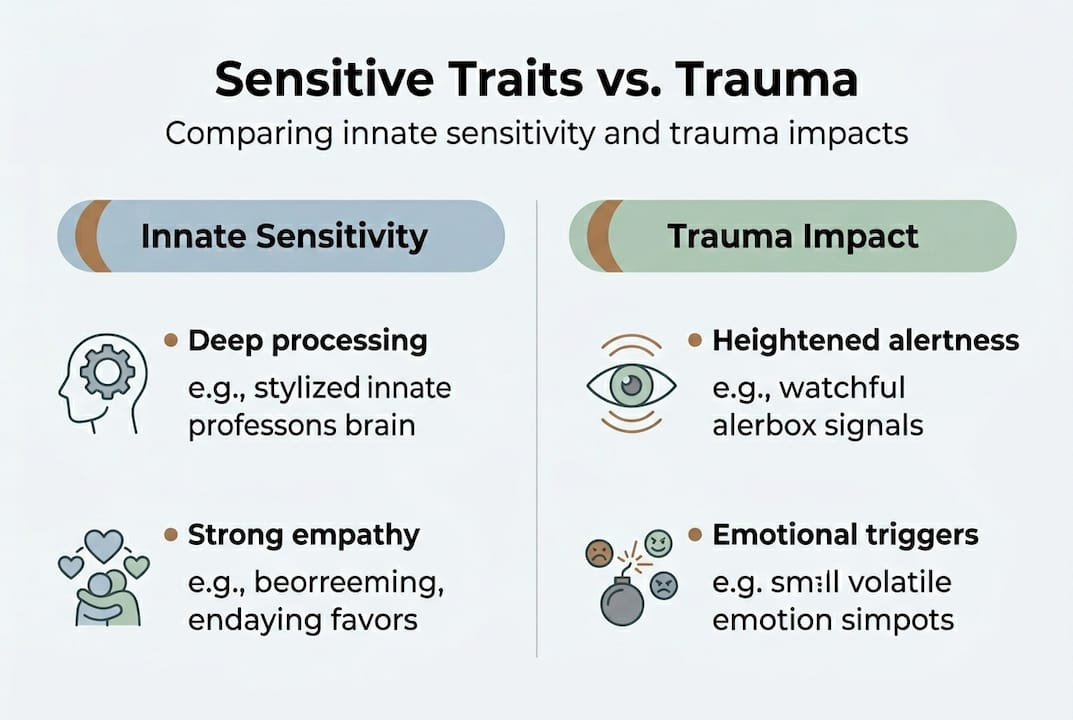
A trauma response, on the other hand, is your nervous system’s learned way of protecting you. It shows up as hypervigilance, emotional flooding, numbness, or avoidance. These responses can look like sensitivity from the outside, but they come from a different place entirely.
Here is why the distinction matters so much:
- If you believe your sensitivity is a trauma wound, you may spend years trying to fix or eliminate it, rather than befriending and leveraging it.
- If you treat a trauma response as just “who you are,” you may miss the chance to heal patterns that are genuinely causing you pain.
- Knowing which is which helps you and your therapist build a plan that actually fits you.
“Your softness is not a flaw. Your depth of feeling is not a disorder. It is part of how you were made.”
The environment you grow up in also shapes how sensitivity expresses itself. Sensitive children raised in warm, stable homes often thrive. Those raised in chaotic or critical environments may carry more pain. This is sometimes called differential susceptibility, the idea that sensitive people are more affected by their surroundings in both directions.
Understanding what creates a safe space for a sensitive person begins with honoring this distinction. You are not broken. You are wired differently, and healing means working with your nervous system, not against it.
Core principles of trauma-informed healing for the sensitive
With a clearer picture of sensitivity, let’s explore how trauma-informed healing works, and why it is especially powerful for those who feel and process deeply.
SAMHSA’s trauma-informed care framework outlines six foundational principles. Each one carries particular weight for sensitive individuals.
- Safety. Everything begins here. For an HSP, feeling physically and emotionally safe is not optional. It is the foundation from which any real healing can grow. A therapy room that feels rushed, cold, or unpredictable will keep your nervous system in protection mode.
- Trustworthiness and transparency. Sensitive people pick up on subtle cues. They notice when something feels off. Consistency, honesty, and clear communication from a therapist build the trust that makes vulnerability possible.
- Peer support. Connection with others who truly understand your experience reduces shame and isolation. For HSPs who often feel “too much” for the people around them, finding community is profoundly healing.
- Collaboration and mutuality. Healing is not something that happens to you. It happens with you. Trauma-informed care in Kansas City and beyond prioritizes a partnership between client and therapist, where your voice shapes every step.
- Empowerment and choice. When trauma or difficult environments have taken away your sense of control, rebuilding agency is essential. Sensitive people often internalize helplessness more deeply, so the experience of making choices, even small ones, restores something fundamental.
- Cultural, historical, and gender sensitivity. Your identity shapes how you experience both sensitivity and trauma. A trauma-informed approach honors the full context of who you are.
| Principle | Why it matters for HSPs |
|---|---|
| Safety | HSPs need felt safety, not just logical reassurance |
| Trustworthiness | Sensitive people detect inconsistency easily |
| Peer support | Reduces the “too much” shame HSPs often carry |
| Collaboration | Preserves agency that trauma can strip away |
| Empowerment | Rebuilds the inner voice that criticism silences |
| Cultural sensitivity | Honors all the layers of your identity and story |
Pro Tip: When you first meet a potential therapist, notice how your body feels in the room. Sensitive people are often good at reading attunement. That initial felt sense of safety is real data worth trusting.
Exploring evidence-based trauma healing tips through this lens helps you see that each principle is not just a nice idea. It is a specific need your nervous system has, and a good therapist will meet it.
Why high sensitivity means greater risk and greater reward
Here is something that might surprise you. Research shows that sensitivity is not simply a vulnerability. It is a double-edged quality, one that means your experiences on both ends of the spectrum are amplified. This is the concept of differential susceptibility: HSPs are more negatively affected by harsh or unstable environments, but they also flourish more than others in positive, supportive ones.

Think about what that means for therapy. When the environment is right, you are not just doing okay. You are genuinely thriving, potentially more deeply than someone who is less sensitive. Your nervous system’s capacity for depth becomes an asset in the healing room rather than a liability.
Research on nature connectedness and sensitivity adds another layer to this. Studies show that connection with nature moderates the relationship between sensitivity and flourishing, meaningfully boosting well-being in HSPs. The same research found that overstimulation tends to peak in the afternoons, worsening with fatigue and negative mood, while positive stimuli and restorative environments can shift this significantly.
What this tells us:
- Timing matters. Scheduling therapy or challenging conversations earlier in the day, when your nervous system is fresher, may help you engage more fully.
- Environment is medicine. A walk outside, sunlight through a window, or even a calming playlist is not just self-indulgence. It is actual nervous system support.
- The right support amplifies your growth. Because you feel things deeply, positive therapeutic experiences land more powerfully in your body and mind than they might for someone less sensitive.
| Factor | Impact on non-HSPs | Impact on HSPs |
|---|---|---|
| Harsh environments | Moderate negative effect | Stronger negative effect |
| Supportive environments | Moderate positive effect | Greater positive effect |
| Nature exposure | Mild well-being boost | Significant well-being boost |
| Overstimulation (afternoon) | Manageable | More pronounced fatigue |
Exploring evidence-based recovery steps through this lens shifts the entire conversation. You are not fragile. You are responsive. And in the right container, that responsiveness becomes one of your greatest strengths.
Building a trauma-informed self-care workflow around these realities is not just helpful. It is transformative.
Practical strategies: Supporting sensitive adults in therapy and daily life
Understanding the science is only part of the picture. The rest lives in the daily choices and practices that help your nervous system feel safe enough to heal. Here is what that can look like, both inside the therapy room and out in the world.
In therapy, modifications for sensitive clients matter:
- Slower pacing. Trauma-informed therapy for HSPs often moves more deliberately, giving your nervous system time to integrate each step before moving to the next. This is not weakness. It is wisdom.
- Body-based check-ins. Modalities like somatic therapy and Internal Family Systems (IFS) pay close attention to what your body is communicating, not just your words. For sensitive people, the body holds enormous amounts of information.
- EMDR (Eye Movement Desensitization and Reprocessing). This evidence-based therapy helps process traumatic memories without requiring you to relive them in graphic detail. Many sensitive clients find it gentler than traditional talk therapy for trauma processing.
- Collaborative goal-setting. You and your therapist build the plan together. No one tells you where you have to go or how fast you have to get there.
- Attention to sensory environment. Lighting, sound, temperature, and even the scent of a therapy room can affect an HSP’s ability to feel present. A therapist attuned to this will notice and adjust.
In daily life, these practices build resilience:
- Morning routines that ease your nervous system in. Gentle movement, quiet time, or even just a warm drink before screens or demands helps regulate your baseline.
- Nature as a daily anchor. As research supports, nature connectedness boosts well-being in sensitive people more than in others. A 15-minute walk outside is not a luxury. It is a healing practice.
- Boundary language you can actually use. “I need a few minutes before I can respond to that.” “I’m at capacity today.” These are complete sentences. Practice them.
- Sensory downtime. Plan for quiet, low-stimulation time each day. Not as a reward, but as a non-negotiable.
- Grounding techniques. The 5-4-3-2-1 method (naming five things you see, four you can touch, and so on) brings you back into the present moment when overwhelm rises.
Creating safe spaces for healing is not just the therapist’s job. You build safety in your own life, one small practice at a time. And healing through presence begins when you start witnessing your own needs with the same tenderness you offer others.
Pro Tip: Keep a simple “overstimulation log” for one week. Note the time of day, what happened, and how you felt. Patterns will emerge that help you schedule protective space exactly when you need it most.
Why the right context is everything for sensitive healing
Here is what most general therapy guides miss: knowing the principles is not enough. Sensitive people do not just need a trauma-informed therapist. They need one who genuinely gets sensitivity as a trait and can hold space for its gifts alongside its challenges.
Cookie-cutter approaches, even well-meaning ones, can leave sensitive clients feeling unheard or subtly pathologized. When every session treats your depth of feeling as a symptom to manage rather than a capacity to honor, healing stalls. You may leave session after session feeling like you’re somehow doing it wrong.
What actually moves the needle is deep therapeutic attunement. It is the therapist who notices your breath shift when a topic arises. It is the silence that feels safe rather than pressured. It is a care model built on the understanding that your nervous system is not a problem to be solved.
We believe that trauma-informed care principles only reach their full potential when they are applied with full awareness of who is in the room. Not a diagnosis. Not a type. A person. You deserve care that starts there. If you have walked away from therapy feeling more managed than witnessed, that is important information. The right fit exists, and it changes everything.
Find your trauma-informed healing path in Kansas City
If this guide has named something you have been carrying for a long time, you do not have to keep carrying it alone.

At Simple Empathy KC, we offer safe, trauma-informed healing that is built around who you actually are, not a one-size-fits-all template. Our therapists specialize in EMDR, IFS, and somatic approaches, and they understand what it means to work with a deeply sensitive nervous system. Whether you are navigating anxiety, attachment wounds, grief, or a major identity shift, we are here to walk alongside you. Explore our therapy services in Kansas City and take the next step toward coming home to yourself. You do not have to earn the right to feel supported. You already do.
Frequently asked questions
Is being highly sensitive the same as having trauma?
No, high sensitivity is innate, present in roughly 15 to 20% of the population, and is not caused by trauma, though sensitive individuals may respond more intensely to difficult experiences.
How does trauma-informed care support sensitive individuals?
Trauma-informed care prioritizes safety, trust, collaboration, and empowerment, creating the conditions sensitive people need to feel secure enough to heal deeply and authentically.
What practical steps can help sensitive adults manage overwhelm?
Grounding techniques, protective morning routines, sensory downtime, and regular nature connection all meaningfully reduce overstimulation and support flourishing in highly sensitive adults.
Are highly sensitive people more likely to benefit from therapy?
Yes, because HSPs respond more strongly to both positive and negative environments, a well-matched, trauma-informed therapeutic relationship can produce especially deep and lasting growth.