
TL;DR:
- Body-based healing works with physical sensations to process trauma stored in the nervous system.
- It effectively reduces PTSD, dissociation, and improves emotional regulation through phased approaches.
- Caution and professional guidance are essential to prevent destabilization, especially for severe mental health conditions.
Trauma doesn’t only live in your thoughts. It lives in your shoulders, your chest, the catch in your breath before you speak. For decades, healing was treated as a conversation, something to think your way through. But somatic approaches reduce PTSD, dissociation, and depression in ways that talk therapy alone often can’t reach. If you’ve sat in therapy and described your pain without ever feeling it shift in your body, you’re not alone. Body-based healing offers a different path. This guide will walk you through what it is, how it works, the real risks involved, and when it can become one of the most transformative choices you make for your nervous system and your sense of self.
Table of Contents
- Understanding body-based healing: The science and frameworks
- How the body holds trauma: Physiology and emotional patterns
- Somatic integration for complex trauma and identity transitions
- Risks, limitations, and professional safeguards in body-based healing
- Our take: Where body-based healing shines and where caution matters
- Explore trauma-informed therapy and body-based healing with Simple Empathy KC
- Frequently asked questions
Key Takeaways
| Point | Details |
|---|---|
| Body-based healing defined | Body-based healing targets trauma stored in physical patterns, not just thoughts or emotions. |
| Clinical evidence growing | Somatic approaches show promise for PTSD, anxiety, and complex trauma, but evidence is still emerging. |
| Careful application required | Risks exist; working with qualified, trauma-informed therapists is essential for safe, effective healing. |
| Identity transitions supported | Somatic integration can aid self-concept rebuilding and relational safety in CPTSD and developmental trauma. |
| Empathy and integration matter | True healing relies on blending body-based and cognitive approaches, customized to each person. |
Understanding body-based healing: The science and frameworks
Body-based healing, often called somatic therapy (from the Greek word soma, meaning body), is an approach that works with your physical sensations, posture, breath, and movement to process trauma stored in the nervous system. Unlike traditional talk therapy, which focuses on changing thought patterns, somatic therapy works from the body upward. You might notice a tightness in your throat, a collapse in your chest, or an impulse to freeze, and your therapist helps you gently work with those signals rather than push past them.
To understand what is somatic healing in practice, it helps to know that most body-based approaches follow a phase-based model. This means therapy begins with stabilization (building safety and regulation), moves toward trauma processing, and then supports integration into daily life. This structure matters because rushing into trauma content without a regulated nervous system can do more harm than good.
Here are some of the key clinical outcomes that somatic approaches have shown:
- Reduction in PTSD symptoms and hypervigilance
- Decreased levels of dissociation
- Improved emotional regulation
- Lower rates of depression and chronic anxiety
- Greater body awareness and tolerance for physical sensation
The table below summarizes the evidence base for several established modalities:
| Modality | Core method | Evidence level |
|---|---|---|
| Sensorimotor Psychotherapy | Movement, posture, sensation tracking | Moderate, growing |
| Somatic Experiencing | Titration of body sensation | Moderate |
| EMDR | Bilateral stimulation with body awareness | Strong |
| Trauma-Sensitive Yoga | Breath and movement integration | Preliminary |
“Somatic and sensorimotor psychotherapy show meaningful clinical outcomes for trauma, with an empirical base growing but still considered preliminary. Prioritize established, credentialed sources when seeking care.”
The somatic psychotherapy evidence base is genuinely encouraging. But it also calls for discernment. Many wellness trends borrow somatic language without clinical grounding.
Pro Tip: When researching somatic therapists, ask about their specific training and certification. Established frameworks like Somatic Experiencing or Sensorimotor Psychotherapy require significant supervised hours. A credential matters here.
How the body holds trauma: Physiology and emotional patterns
Your autonomic nervous system (ANS) is your body’s internal alarm system. It regulates fight, flight, and freeze responses without you consciously choosing them. When trauma occurs, especially repeatedly, the ANS can become stuck in states of high alert or shutdown. This is not a character flaw. It is biology doing its best to protect you.
Interoceptive awareness is your ability to notice internal body signals, like your heartbeat, muscle tension, or gut sensations. Body-based practices build this skill deliberately. Body-based practices regulate the ANS via interoceptive awareness, reducing hyperarousal and helping the nervous system return to a calmer baseline.
Common physical responses to trauma include:
- Chronic muscle tension, especially in the jaw, neck, and shoulders
- Shallow or restricted breathing
- Digestive disruption or nausea
- Fatigue that doesn’t improve with rest
- Numbness or disconnection from your body
- Startling easily or feeling always “on edge”
These are not just stress symptoms. They are your body communicating that something important still needs attention. Somatic approaches are effective at reducing pain and somatization disorders, which means physical symptoms that have psychological roots often respond well to body-centered work.
When you work with a trauma-informed therapist trained in somatic methods, sessions might include tracking where you feel tension, noticing what happens in your body when a difficult memory surfaces, or using gentle movement to discharge held energy. The goal isn’t to relive the trauma. It’s to help your nervous system complete responses it couldn’t finish at the time.

Looking at trauma-informed self-care practices can also support what happens between sessions, extending the regulation work into your daily life.
Pro Tip: Your body’s signals are valid data, not overreactions. If your chest tightens when someone raises their voice, that is information worth bringing to therapy, not something to talk yourself out of.
Somatic integration for complex trauma and identity transitions
Complex trauma (often called CPTSD) happens when trauma is repeated, prolonged, or occurs early in development, such as childhood neglect, emotional abuse, or attachment wounds. It shapes not just memory, but identity. You may not know who you are outside of survival mode. That is one of the most painful parts.
Somatic integration supports self-concept rebuilding in CPTSD through embodiment and relational safety. In other words, healing your sense of self often has to move through your body first.
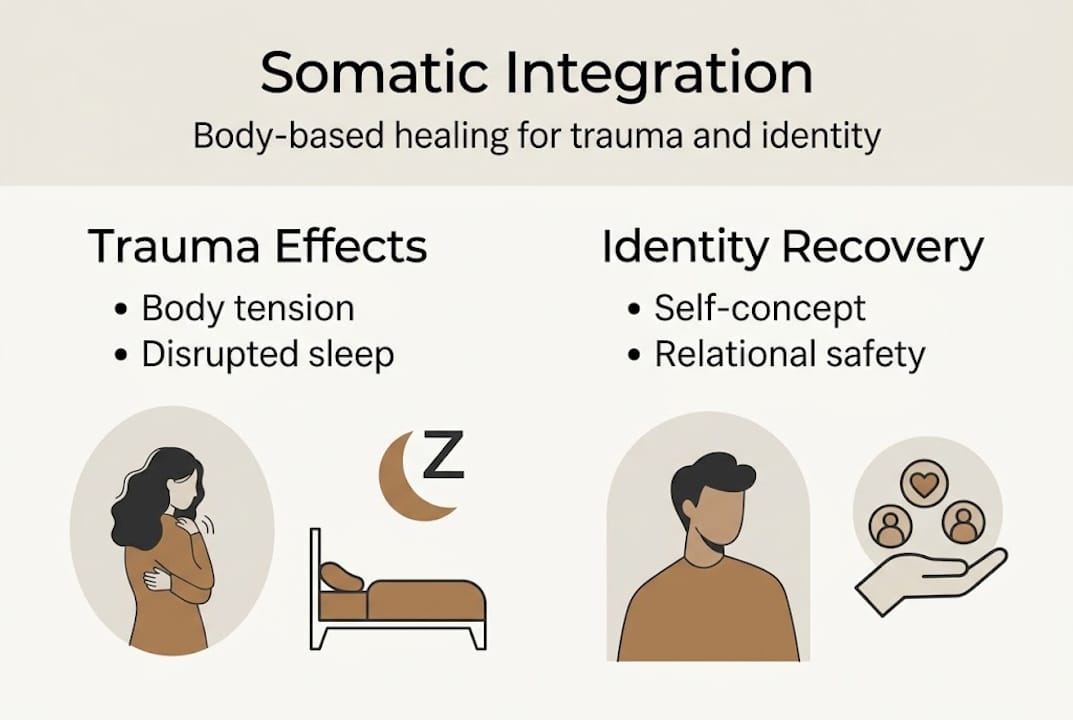
Here’s how somatic work compares to traditional top-down therapy for complex trauma:
| Approach | Entry point | Strength | Limitation |
|---|---|---|---|
| Somatic integration | Body sensation, nervous system | Accesses pre-verbal trauma | Requires trained specialist |
| Traditional talk therapy | Cognition, narrative | Great for insight and meaning-making | May not reach body-stored material |
| Combined approach | Both | Most complete healing path | Requires coordination |
For those navigating identity transitions, such as leaving an abusive relationship, recovering from religious trauma, or shifting gender identity, body-based healing offers something specific. Here is how somatic support helps in those moments:
- Reconnects you with physical boundaries that may have been overridden or ignored
- Builds a felt sense of self that doesn’t depend only on external roles or approval
- Reduces the shame held in the body, not just challenged in the mind
- Supports relational safety so you can begin to trust again from a grounded place
- Helps integrate grief about who you were before, honoring the losses of transition
Approaches like IFS therapy for trauma work especially well alongside somatic methods because they address the inner parts of you that hold fear, shame, or protective roles, while the body work helps those parts actually settle rather than just being understood conceptually.
Risks, limitations, and professional safeguards in body-based healing
Body-based healing is not a universal solution. It can be genuinely powerful, and it can also be genuinely destabilizing if it’s not done carefully. This is not said to discourage you. It’s said because you deserve honest information.
Risks of destabilization in somatic work are real, particularly for those with active psychosis, severe dissociative disorders, or current eating disorders. In these cases, intensive body-focused work may increase distress rather than reduce it. Therapist training is critical in recognizing these contraindications before beginning.
Key risks and limitations to know:
- Somatic work can temporarily increase body awareness in ways that feel overwhelming
- It is not a standalone approach for processing specific traumatic memories (EMDR or other trauma-focused methods are often better suited for that)
- Promising preliminary evidence exists for many somatic techniques, but insufficient large-scale randomized controlled trials (RCTs) mean they are not yet considered first-line by major clinical bodies
- Trendy social media somatic exercises (like “somatic shaking”) lack clinical oversight and may not be appropriate for trauma survivors without professional guidance
- Some practitioners use somatic language without adequate training, which can cause harm
Phased approaches are the professional standard for good reason. You build a regulated, resourced nervous system before going deeper. A skilled clinician knows when to slow down. Reading about safe space for healing can help you understand what that foundation looks like before you begin.
The relational container matters enormously. Empathy in trauma therapy is not a soft extra. It is the active ingredient that makes body-based work safe enough to do at all.
Pro Tip: Always seek a trauma-informed, credentialed practitioner. Ask if they follow a phased model. Ask what they do when a client becomes overwhelmed in session. How they answer tells you a great deal.
Our take: Where body-based healing shines and where caution matters
Here is what most guides won’t tell you: body-based healing works not because it’s exotic, but because the body never lies. People who came into sessions deeply skeptical of somatic work often become its most committed advocates, not because they believed in it, but because they finally felt something shift that years of talking hadn’t moved.
The real value isn’t in choosing one modality over another. It’s in integration. A therapist who can read your nervous system, track your body cues, and hold space for what surfaces without rushing you toward insight is offering something irreplaceable. That is where trauma witnessing and presence becomes the actual medicine.
Where caution matters most is in the space between clinical work and wellness culture. Many somatic practices shared online lack the relational grounding that makes them therapeutic. For deeply sensitive people carrying complex trauma, skipping that grounding in favor of a trending technique can widen the wound rather than close it. Healing that is truly yours must be paced to your nervous system, not to someone else’s timeline.
Explore trauma-informed therapy and body-based healing with Simple Empathy KC
If what you’ve read here has stirred something in you, that recognition is worth following. You don’t have to keep managing your pain in isolation.

At Simple Empathy KC, we offer trauma-informed therapy that weaves body-based healing into personalized, relational care. Whether you’re navigating complex trauma, anxiety, or a profound identity shift, our therapists meet you where your nervous system actually is. Our therapy services integrate EMDR, IFS, and somatic approaches within a compassionate, phased framework. If you’re ready to feel supported in your healing rather than just talked at, we’d love to hold space for you. Start with our trauma-informed healing guide or reach out to schedule a session. Your story is sacred here.
Frequently asked questions
What is body-based healing and how does it differ from traditional therapy?
Body-based healing uses physical sensation, movement, and nervous system awareness to process trauma, while traditional therapy centers on cognition and verbal narrative. Somatic approaches offer solutions that reach material talk therapy often cannot access alone.
Can body-based healing help with anxiety and chronic pain?
Yes. Research shows that body-based practices regulate the ANS, reducing both anxiety symptoms and pain associated with somatization, making them a meaningful complement to other treatment approaches.
Is body-based healing suitable for everyone?
Not without careful assessment. It may destabilize individuals with psychosis, active eating disorders, or severe dissociation. Destabilization risks are real when work is not phased and led by a trained, credentialed therapist.
Does body-based healing work for identity transitions?
Evidence is still building, but somatic integration supports self-concept rebuilding and relational safety in CPTSD, making it particularly valuable during identity shifts when the sense of self feels fragmented or lost.
Is body-based healing endorsed by established mental health organizations?
Preliminary evidence exists for many somatic techniques, but insufficient large-scale RCTs mean the APA does not yet endorse them as first-line treatments, though many clinicians integrate them effectively within broader trauma-informed frameworks.