
TL;DR:
- Speaking your truth in therapy helps many heal by creating coherence and safety.
- Structured approaches like Narrative Exposure Therapy organize memories and reduce PTSD symptoms.
- Caution is needed with suggestive or ungrounded techniques to avoid false memories and harm.
Many people carry a quiet fear that talking about their trauma will only make things worse. It feels safer to keep the past locked away. But structured trauma therapy integrates memories and fosters validation rather than harm, according to current research. Truth, when held gently and with care, can actually be one of the most powerful tools you have. This article walks you through why truth matters in recovery, which therapies use it most effectively, what risks to watch for, and how to take practical steps toward healing that honors your own pace and story.
Table of Contents
- Why truth matters in healing from trauma
- How therapies use truth for memory integration
- Risks and controversies: When truth-telling may backfire
- Practical steps for safe and effective truth-based healing
- Our take: Why truth is necessary but not always sufficient for healing
- Next steps: Find trauma-informed support in Kansas City
- Frequently asked questions
Key Takeaways
| Point | Details |
|---|---|
| Truth enables healing | Sharing your trauma story with support helps integrate memories and reduce lasting distress. |
| Evidence-based methods work | Structured therapies like NET show clear benefits for PTSD, depression, and quality of life. |
| Safe pacing matters | Truth-telling is most effective when you feel emotionally secure and not rushed. |
| Be cautious of suggestion | Avoid therapists who push ‘recovered memories’ without clear evidence. |
Why truth matters in healing from trauma
Trauma has a way of fragmenting your story. Memories feel scattered, disconnected, and sometimes impossible to put into words. That fragmentation is not a flaw in you. It is how your nervous system protected you when things felt unbearable. But healing often asks you to gently gather those scattered pieces and weave them into something coherent.
This is where truth becomes sacred. Empathy and narrative healing work together because when you speak your truth to a skilled, caring therapist, something shifts. You are no longer alone with the weight of what happened. Being truly witnessed, heard without judgment, activates the part of you that can begin to believe: I survived this, and I am more than this.
Narrative-based therapies help you build a coherent story out of what once felt like chaos. Research shows that coherent trauma narratives play a central role in reducing PTSD symptoms by helping your brain integrate memories in a stable, emotionally regulated way. This is not about performing your pain. It is about giving your experience a beginning, middle, and place to rest.
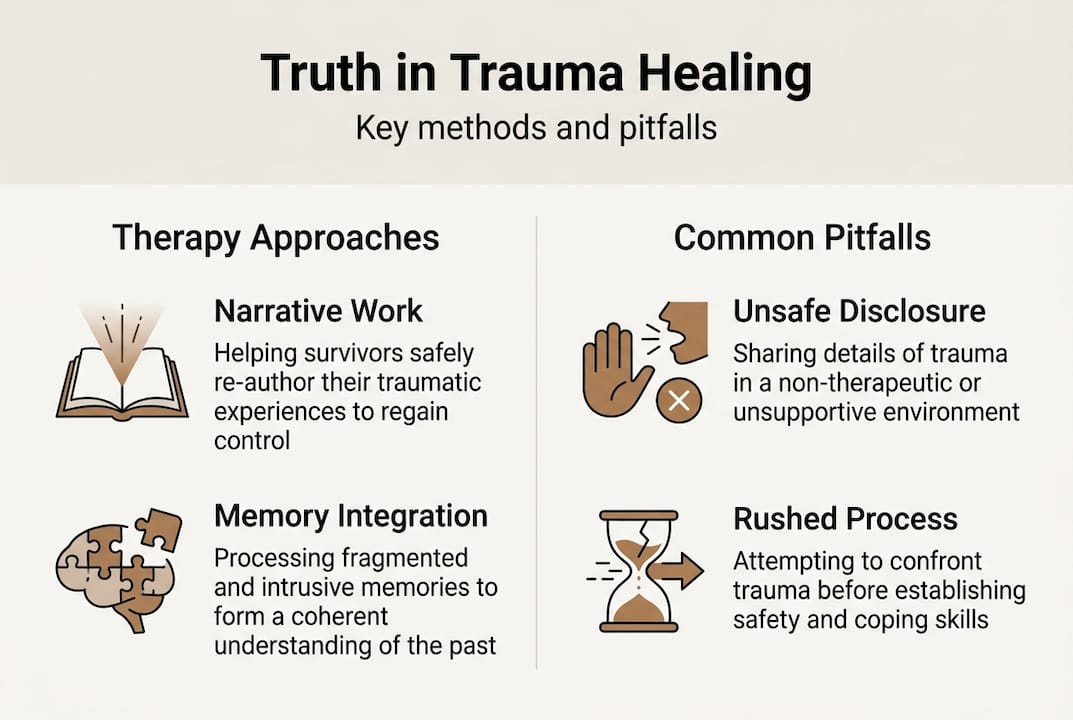
Validation is a core part of this process. When a therapist reflects your truth back to you without minimizing or dramatizing it, your nervous system begins to settle. Safety becomes possible again. Hope becomes possible again.
| What fragmented trauma looks like | What integrated truth looks like |
|---|---|
| Intrusive flashbacks and nightmares | Memories that feel contained and manageable |
| Emotional numbness or overwhelm | A wider, more regulated emotional range |
| Shame and self-blame | Self-compassion and clarity |
| Disconnection from identity | A returning sense of self and continuity |
“Your story is not something to be ashamed of. It is something to be witnessed, held, and ultimately, understood.”
Truth, spoken in safety, becomes the bridge between surviving and truly living.
How therapies use truth for memory integration
Understanding why truth heals is only part of the picture. The therapies designed to use truth effectively have specific structures, and knowing what those look like can help you choose wisely.
Narrative Exposure Therapy (NET) is one of the most researched approaches for trauma. It asks you to construct a chronological timeline of your life, placing both painful and meaningful events in context. This process helps your brain organize traumatic memories rather than letting them float untethered. Research shows that NET reduces PTSD by 4.7 to 5.4 points on standardized scales, with large effects in intensive formats.
A typical NET or narrative therapy process looks like this:
- Build safety and trust with your therapist before any deep disclosure
- Construct a lifeline, a visual or verbal timeline of your life experiences
- Revisit traumatic events with structure, moving through them rather than around them
- Integrate meaning, placing the trauma in the larger context of your whole life story
- Close each session with grounding and stabilization
- Review and consolidate insights over time
For people processing complex trauma, this kind of structure matters enormously. Wandering into painful memories without a container can feel retraumatizing. But with a skilled guide and a clear process, the same memories become something you can hold rather than something that holds you.
| Therapy type | Core mechanism | Best suited for |
|---|---|---|
| Narrative Exposure Therapy (NET) | Chronological lifeline construction | Complex, repeated trauma |
| Prolonged Exposure (PE) | Gradual, repeated retelling | Single-incident PTSD |
| Narrative Therapy | Externalizing and re-authoring story | Identity and meaning-making |
| EMDR | Bilateral stimulation with memory | Wide range of trauma types |
It is also honest to name that dropout rates in some exposure-based therapies can be significant. Some people find the intensity too much without adequate support. Reading about evidence-based trauma recovery steps and top healing tips can help you set realistic expectations before you begin.

Pro Tip: Look for a therapist who explicitly discusses pacing and safety before diving into your trauma narrative. A good therapist will never rush your story.
Risks and controversies: When truth-telling may backfire
Structured truth-sharing helps many people heal deeply. But it is important to understand that not all forms of truth recovery are equal, and some can actually cause harm.
One of the most serious concerns in the field involves recovered memory therapy. Some therapeutic approaches, particularly older ones, have used suggestion, hypnosis, or leading questions to help clients “uncover” memories of abuse or trauma. The problem is that therapist suggestion can create false memories, and research shows that roughly 60% of therapists report working with clients who have recovered memories, often without sufficient evidence-based grounding.
False memories are not a sign of weakness or deception. They are a genuine psychological phenomenon. When a well-meaning therapist repeatedly suggests that a client must have experienced something, the mind can begin to construct a memory that feels completely real. This can result in broken family relationships, unnecessary trauma, and legal consequences that affect real lives.
“The goal of trauma therapy is to help you trust your own inner experience, not to lead you toward a particular conclusion about your past.”
Watch for these warning signs in any trauma therapy setting:
- Your therapist suggests specific events you do not actually remember
- Sessions feel more like interrogation than exploration
- You feel pressured to confirm a particular narrative about your past
- Techniques like hypnosis are used to “retrieve” buried memories without your clear informed consent
- Your therapist seems personally invested in what your memories reveal
This does not mean all memory work is dangerous. It means the quality of your therapist’s training and approach matters enormously. Evidence-based methods, clear boundaries, and a therapist who follows your lead rather than directing it are what keep truth recovery safe.
Contrasting perspectives exist within the field. Some clinicians believe strongly in the body’s capacity to hold repressed memories. Others argue that the science does not support that framework. What most agree on is this: healing happens through presence, not pressure.
Practical steps for safe and effective truth-based healing
Knowing the risks and rewards of truth-based healing, here is how you can move forward safely and at a pace that honors where you are right now.
Steps for integrating truth safely into your healing journey:
- Assess your readiness. You do not need to dive into the deepest waters first. Notice whether you feel some baseline stability, safety in your daily life, and at least one trusted person in your corner.
- Find a trauma-informed therapist. Look for someone trained in evidence-based modalities like NET, EMDR, or Internal Family Systems (IFS). A personalized trauma recovery guide can help you understand what to ask.
- Create a supportive environment. Before and after sessions, lean on grounding practices: slow breathing, time in nature, connection with safe people. Think of these as anchors that help your nervous system stay regulated.
- Build your support circle. Healing in isolation is harder. Whether it is a trusted friend, a support group, or a somatic practice, creating a safe space around your healing is not optional. It is essential.
- Develop a self-care rhythm. Recovery is not linear. A consistent self-care workflow helps you metabolize what comes up in therapy rather than carrying it alone.
- Monitor your window of tolerance. If sessions consistently leave you flooded or shut down for days, tell your therapist. The pace should challenge you gently, not destabilize you.
Research confirms that structured trauma therapy aids healing and does not worsen symptoms when done thoughtfully. You deserve an approach that holds both your courage and your tenderness.
Pro Tip: Trust your own pace. Safe, steady processing will always serve your healing better than rushing toward resolution.
Our take: Why truth is necessary but not always sufficient for healing
Let’s step back for a candid look at what really makes truth-telling transformative, and what the headlines often miss.
Truth alone does not heal. We have seen this clearly. A person can speak every detail of their story and still leave a session feeling worse, not better. What makes the difference is the container around the truth: the therapist’s presence, the emotional safety in the room, and the client’s own readiness to receive what they are sharing without judgment.
The clients who flourish are not the ones who rush to disclose everything. They are the ones who learn to tell their truth slowly, with self-compassion as their companion. They discover that the power of witnessing is not just about being heard. It is about being received with care.
Black-and-white thinking about truth recovery, the idea that you simply “tell it and heal” or that you must “never go there,” misses the full picture. Context determines everything. Therapist skill, emotional pacing, and your own sense of inner safety are not secondary factors. They are the heart of it.
Next steps: Find trauma-informed support in Kansas City
You have taken in a lot here, and that matters. Learning about truth-based healing is its own form of courage.

If you are ready to take the next step, trauma-informed care in Kansas City is closer than you might think. At Simple Empathy KC, we believe your story deserves to be held with skill, warmth, and deep respect. Whether you are just beginning to consider therapy or you are ready to go deeper, our team is here to walk alongside you. Explore creating safe healing spaces or learn more about Simple Empathy’s therapy services to find the right fit for where you are right now.
Frequently asked questions
Is it really safe to talk about my trauma in therapy?
Yes. Meta-analyses confirm that talking about trauma in a structured, supportive setting helps healing and rarely makes symptoms worse. The key is working with a trained, trauma-informed therapist who respects your pace.
How do I avoid false memories in therapy?
Look for therapists who use evidence-based methods and avoid suggestive or leading questions. Therapist beliefs in repression can lead to practices that unintentionally create false memories, so asking about your therapist’s specific approach matters.
What therapy works best for integrating traumatic memories?
Narrative Exposure Therapy (NET) and other structured, narrative-focused approaches are highly effective. NET is supported by randomized controlled trials and shows meaningful reductions in PTSD symptoms for many people.
How can I know if my trauma recovery therapist is the right fit?
Choose someone who prioritizes your emotional safety, uses evidence-based practices, and respects your pace in sharing your story. A therapist who follows your lead, rather than directing it, is a strong sign you are in the right hands.