
TL;DR:
- Therapist empathy is a key predictor of positive therapy outcomes across all styles.
- Genuine empathy involves understanding, feeling, and communicating care while maintaining boundaries.
- Empathy creates safety, trust, and healing, especially crucial in trauma-informed therapy.
Researchers have spent decades searching for the secret ingredient behind successful therapy. What they keep finding surprises many people: it isn’t a specific technique or method that predicts healing. It’s empathy. A meta-analysis of 82 studies found a meaningful correlation between therapist empathy and positive treatment outcomes, cutting across every therapy style tested. If you’re in Kansas City and carrying the weight of trauma, anxiety, or a painful identity shift, this finding matters deeply for you. Understanding how empathy works, why it heals, and what it looks like in practice can help you find the kind of support that actually moves you forward.
Table of Contents
- What is empathy in therapy?
- Why empathy matters: Evidence from psychotherapy
- Empathy’s role in trauma-informed care
- Empathy in action: Practical strategies for healing
- A therapist’s perspective: What most miss about empathy in therapy
- Find trauma-informed, empathic therapy in Kansas City
- Frequently asked questions
Key Takeaways
| Point | Details |
|---|---|
| Empathy fuels healing | Empathy is the proven foundation behind successful therapy, supporting deep emotional transformation. |
| Evidence backs empathy | Meta-analyses and physiological studies confirm empathy’s direct impact on therapy outcomes. |
| Essential for trauma care | Empathy creates safety and trust, making it crucial for trauma survivors’ healing and empowerment. |
| Actionable empathy skills | Simple techniques like attuned listening and reflection can empower both therapists and clients in healing. |
What is empathy in therapy?
Empathy is one of those words everyone uses and almost no one fully defines. In therapy, it means something specific and profound. It is the therapist’s ability to enter your inner world, to sense what you feel, and to communicate that understanding back to you in a way that makes you feel truly seen.
It helps to separate empathy from two related words you’ve probably heard: sympathy and compassion. Sympathy is feeling sorry for someone from a distance. Compassion is the desire to help ease suffering. Empathy goes further. It means stepping into another person’s experience without losing yourself in it. That last part is important, and we’ll return to it.
Therapists and researchers recognize three core components of empathy:
- Cognitive empathy: Understanding how another person thinks and sees the world, taking their perspective seriously
- Affective empathy: Actually feeling the emotional resonance of what they’re experiencing, not just analyzing it
- Behavioral empathy: Communicating that understanding through words, tone, body language, and presence
All three need to work together. A therapist who only understands you intellectually can feel cold. One who only feels with you can lose their grounding. True therapeutic empathy holds all three in balance.
“To be empathic is to perceive the internal frame of reference of another with accuracy and with the emotional components and meanings which pertain thereto.” — Carl Rogers
There are also real risks when empathy isn’t practiced carefully. Emotional contagion happens when a therapist absorbs a client’s pain so fully that they lose their own stability. Overidentification happens when a therapist’s personal history blurs with the client’s story. Both can compromise care. That’s why genuine empathy requires clear boundaries and self-awareness. It isn’t just warmth. It is warmth held with intention.
If you’re curious about what empathy in trauma therapy looks like in practice, it goes far beyond nodding along. It means your nervous system is met with steadiness. It means your story is received, not redirected.
Why empathy matters: Evidence from psychotherapy
With empathy defined, let’s look at why it matters so much, backed by concrete evidence.
The data is clear and worth sitting with. A meta-analysis across 82 studies showed a correlation of r=0.28 between therapist empathy and positive therapy outcomes. That’s comparable in strength to the overall therapeutic alliance, which most clinicians consider the single most important factor in healing. Empathy isn’t a bonus. It’s a foundation.
What makes this especially striking is that the effect holds across therapy types. Whether a therapist uses cognitive behavioral approaches, psychodynamic methods, somatic techniques, or EMDR, when empathy is present, outcomes improve. This challenges the idea that you must find the “right” method. The right relationship matters just as much.
| Empathy element | Effect on therapy outcomes |
|---|---|
| Cognitive empathy | Increases client trust and openness |
| Affective empathy | Reduces emotional isolation |
| Behavioral empathy | Strengthens therapeutic alliance |
| Overall empathy (r=0.28) | Predicts positive outcomes across all approaches |
The body also responds to empathy in measurable ways. Physiologic concordance, measured through skin conductance, correlates with perceived therapist empathy at r=0.47 (p=0.03). In plain terms: when you feel understood, your nervous system responds. Your body knows before your mind catches up.
This matters enormously for trauma and anxiety work. When your system has been on high alert, genuine empathy from a therapist signals safety. Not just emotionally, but physiologically. Your heart rate can settle. Your breath can deepen. That kind of safety is not a side effect of therapy. It is the entry point.
Here’s what empathy consistently does for clients in therapy:
- Opens emotional access that defenses would otherwise block
- Reduces shame, which is often what keeps trauma locked in place
- Builds the sense of being worth someone’s full attention
- Creates conditions where trauma-informed care evidence can actually take root
When you feel met, you can begin to move. That is the quiet power of empathy in the room. It is also why creating a safe space in therapy isn’t just a nice idea. It is a clinical necessity.
Empathy’s role in trauma-informed care
Evidence shows how powerful empathy is in therapy, but its impact is particularly profound in trauma-focused, compassionate care.
For trauma survivors, the world has often felt unsafe. Sometimes that unsafety came from the very people who were supposed to protect them. Walking into a therapy room can carry echoes of those experiences. Empathy is what shifts that dynamic.
Trauma-informed care places empathy at the center of five core principles:
- Safety: Creating environments where clients feel physically and emotionally protected
- Trustworthiness: Being transparent, consistent, and honest so trust can rebuild over time
- Choice: Returning a sense of agency to people who have felt powerless
- Collaboration: Working with clients rather than doing things to them
- Empowerment: Recognizing and building on each person’s inherent strengths
Empathy threads through all five. You cannot create genuine safety without it. You cannot build real trust without it. It is the soil in which all other healing grows.
Empathy in trauma-informed care is not a technique. It is a way of being present that says: your experience is real, it matters, and you are not alone in it.
For trauma survivors specifically, empathy prevents re-traumatization. That happens when a therapeutic encounter accidentally recreates the helplessness or disconnection of the original wound. An empathic therapist stays attuned to your responses, adjusts their pace, and never pushes faster than your nervous system can follow.

Pro Tip: When exploring trauma-informed self-care between sessions, practices like grounding, journaling, and gentle movement extend the empathic work done in therapy into your everyday life.
If you’re in Kansas City and ready to explore what this kind of support looks like, a step-by-step trauma recovery approach can help you understand your own healing path. And the right therapy options in Kansas City will center your safety from the very first conversation.
Empathy in action: Practical strategies for healing
Understanding the principles of empathy is important, but how does it look in real therapy, and what makes it work?
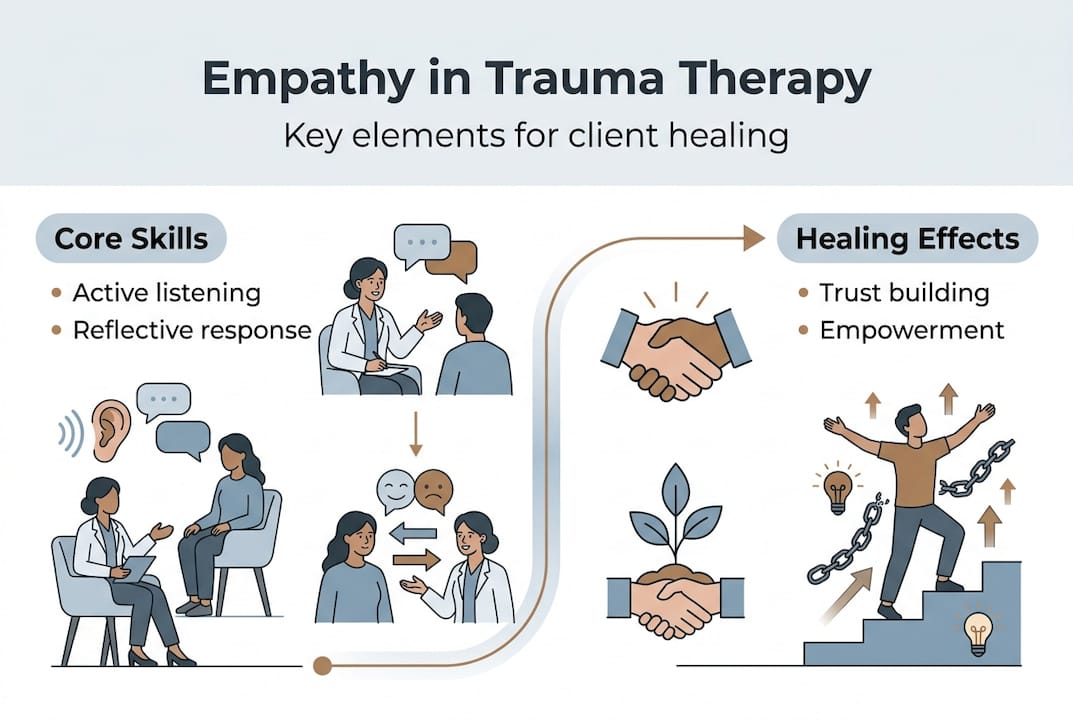
Empathy in session isn’t passive. It involves specific, practiced skills that skilled therapists use with intention. Key practices include:
- Reflective listening: Mirroring back what a client says, not word for word, but in a way that shows genuine understanding
- Validation: Naming that an emotion makes sense given what someone has experienced
- Perspective-taking: Actively imagining the world through the client’s eyes, without judgment
- Attuned presence: Staying fully engaged, tracking both words and body language
Research on empathy facets shows that mentalizing, experience sharing, and empathic concern each promote relationship-oriented strategies like validation, which are exactly what clients in distress most need.
| Empathy skill | What it looks like | Therapeutic effect |
|---|---|---|
| Reflective listening | “It sounds like you felt invisible in that moment” | Deepens trust and openness |
| Validation | “That reaction makes complete sense” | Reduces shame and self-blame |
| Perspective-taking | Considering the client’s history before responding | Prevents misattunement |
| Attuned presence | Full attention, no distraction | Signals you are worth being heard |
Self-empathy is equally important for you outside the therapy room. Treating yourself with the same patience and understanding your therapist offers you extends the healing between sessions. This is not self-indulgence. It is evidence-based recovery in action.
Common challenges include countertransference (when a therapist’s own unresolved material gets activated) and personal distress from sitting with heavy pain. Good therapists address these through supervision and self-awareness. Empathy in trauma-informed therapy builds the therapeutic alliance, reduces re-traumatization, and supports deep, lasting healing when practiced carefully.
Pro Tip: Ask a potential therapist how they practice self-care and seek supervision. A therapist who tends to their own nervous system is far better equipped to hold space for yours. Approaches like IFS therapy for trauma also use empathy as a core healing mechanism, helping you befriend the parts of yourself that have been carrying pain alone.
A therapist’s perspective: What most miss about empathy in therapy
Here’s something worth saying plainly: empathy cannot be scripted. You can teach a therapist every reflective listening technique in the textbook, and if they aren’t genuinely present, clients feel it. That incongruence, the mismatch between words and actual presence, can actually widen the disconnect rather than bridge it.
The most common mistake well-meaning therapists make is treating empathy as a set of responses rather than a state of being. Real empathic attunement comes from the therapist’s own inner work, their willingness to sit in discomfort without rushing to fix it.
Another misconception: more sympathy equals more healing. It doesn’t. Sympathy can inadvertently communicate that your pain is too much, that it needs to be softened or managed. True empathy says: I can be with this alongside you. That is an entirely different message.
The power of therapeutic presence is what clients in Kansas City deserve to seek and expect. Not a therapist who performs care, but one who is genuinely moved by your story without being swept away by it. That is the real skill, and it makes all the difference.
Find trauma-informed, empathic therapy in Kansas City
You deserve to feel truly witnessed. Not managed. Not advised. Witnessed.

At Simple Empathy KC, empathy isn’t a method we add on top of therapy. It is the foundation everything else is built on. Our approach integrates EMDR, Internal Family Systems, and somatic therapy within a deeply relational, trauma-informed framework. If you’ve been carrying trauma, anxiety, or the disorientation of a major life transition, we want you to know: your story is safe here. Explore our trauma-informed therapy options or read more about trauma-informed care principles to understand how we hold space for your healing.
Frequently asked questions
How does empathy differ from sympathy in therapy?
Empathy means truly feeling and understanding a client’s inner experience, while sympathy is feeling sorry from a distance without real shared understanding. Empathy involves both cognitive and affective components, making it far more healing than sympathy alone.
Is empathy proven to improve therapy outcomes?
Yes. A meta-analysis of 82 studies found a meaningful correlation between therapist empathy and positive outcomes, making it one of the most reliably effective elements of any therapeutic relationship.
Why is empathy especially important in trauma therapy?
Empathy helps create the safety, trust, and empowerment that trauma survivors need to heal without being accidentally re-traumatized by the therapeutic process itself.
Can a therapist be too empathic?
Empathy without boundaries can lead to emotional burnout or overidentification with the client’s pain. Genuineness and boundary maintenance are essential safeguards that keep empathy healing rather than harmful.