
TL;DR:
- Trauma recovery often takes 8 to 10 years, with witnessing being a key supportive tool. Witnessing involves being fully seen without judgment, fostering safety and trust before processing trauma. Group witnessing provides additional benefits by reducing shame and promoting belonging, especially during identity transitions.
Trauma recovery takes longer than most people expect. PTSD symptoms peak 8 to 10 years post-trauma on average, with a median improvement time of nearly 9 years. That’s not a flaw in you. That’s the nature of deep wounds healing slowly. And yet, one of the most powerful tools in recovery is also one of the most misunderstood: witnessing. Many people assume healing means retelling every painful detail. It doesn’t. Witnessing is something quieter, more sacred, and far more effective. This guide will show you exactly what witnessing means, why science supports it, and how it can help you come home to yourself.
Table of Contents
- What does it mean to witness in healing?
- How witnessing catalyzes trauma recovery
- The impact of group witnessing and identity transitions
- Risks, limitations, and controversies in therapeutic witnessing
- Our perspective: why safe witnessing unlocks genuine healing
- Find trauma-informed witnessing and support in Kansas City
- Frequently asked questions
Key Takeaways
| Point | Details |
|---|---|
| Witnessing promotes healing | Being truly seen and validated builds emotion regulation and supports trauma recovery. |
| Recovery is a long process | Healing from trauma often takes years, and empathetic support can change long-term outcomes. |
| Group validation matters | Group witnessing especially helps those undergoing identity transitions by reducing shame and creating belonging. |
| Safety is essential | Not all witnessing is helpful—trauma-informed, evidence-based care prevents potential harm. |
What does it mean to witness in healing?
Witnessing is not about reliving your trauma. It’s not about analyzing what happened or finding the perfect words to describe your pain. At its core, witnessing is the act of being fully seen by another person without judgment, without advice, and without the pressure to fix anything.
Think of it this way: when someone truly witnesses you, they are not waiting for their turn to speak. They are not scanning your story for inconsistencies. They are simply with you. That kind of presence is rarer than it sounds, and it is profoundly healing.
Many people confuse witnessing with venting or storytelling. But there is a meaningful difference. Retelling trauma in detail can sometimes reactivate the nervous system without offering resolution. Witnessing, by contrast, creates a container of safety first. It prioritizes your emotional regulation over the details of what happened.
Research confirms this distinction. Therapeutic alliance built on empathy and trust is foundational for complex PTSD treatment, with phase-based approaches prioritizing safety before any trauma processing begins. Witnessing is what makes that safety real.
Here are some common myths about witnessing that deserve to be challenged:
- “Witnessing is passive.” Not true. It requires deep attunement, active listening, and emotional presence.
- “You have to talk about what happened in detail.” Witnessing can happen without a single word about the traumatic event itself.
- “Emotional exposure always helps.” Unstructured emotional exposure without safety can overwhelm the nervous system rather than heal it.
- “Only therapists can witness you.” Trusted friends, community members, and group settings can all offer meaningful witnessing.
“Being witnessed is not about being fixed. It is about being held in the truth of your experience until you can hold it yourself.”
Witnessing also supports creating a safe space for healing by building relational trust before any deeper processing begins. That sequence matters enormously, especially for complex trauma.
How witnessing catalyzes trauma recovery
Now that we understand what witnessing is, let’s look at how it actually moves the needle in trauma recovery.
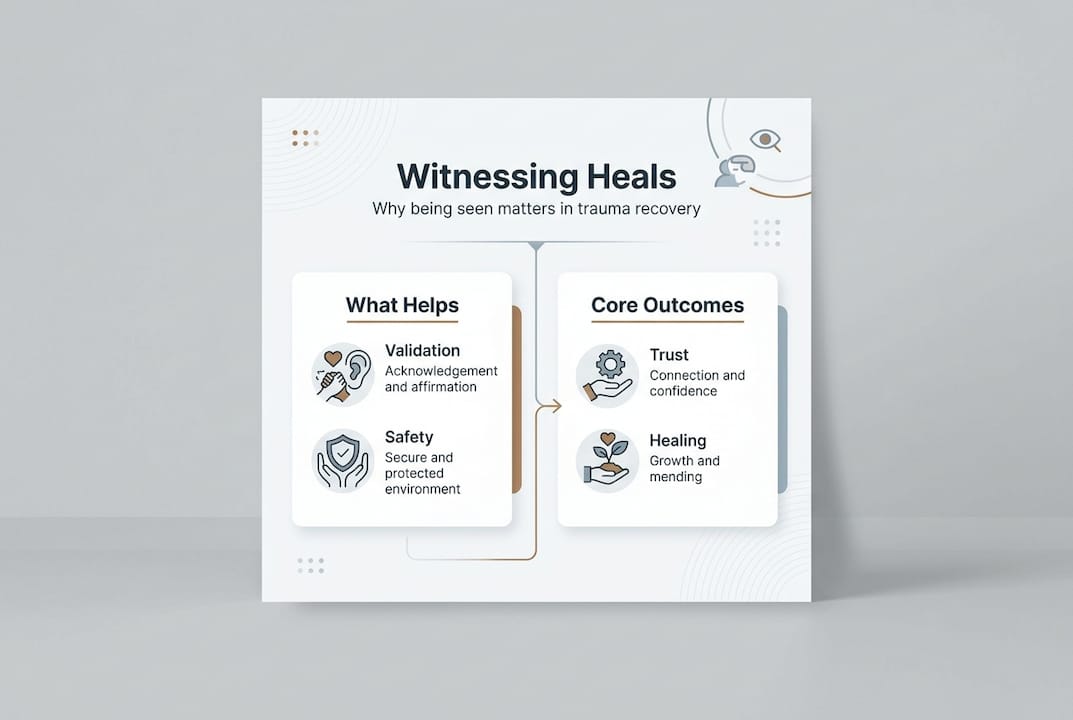
Healing from trauma is not linear. Recovery trajectories vary widely, and approximately 10% of people experience chronic PTSD symptoms. That means for many, recovery is a long and winding road. Witnessing supports that journey by creating the relational conditions where genuine healing becomes possible.
Here is the sequence that trauma-informed care follows:
- Safety first. Before any trauma processing, the nervous system needs to feel safe. Witnessing builds this foundation.
- Relational trust. A therapist or trusted person offers consistent, nonjudgmental presence. You begin to believe you are worth being seen.
- Emotion regulation. As you feel witnessed, your capacity to tolerate difficult feelings grows. You are no longer alone with them.
- Meaning-making. With a regulated nervous system and a trusted witness, you can begin to integrate your experience and find new meaning.
This phase-based model stands in contrast to pure exposure or reliving approaches, which ask clients to revisit traumatic memories without necessarily building safety first.
| Approach | Focus | Risk level | Best for |
|---|---|---|---|
| Witnessing/phase-based | Safety, regulation, then processing | Lower | Complex PTSD, attachment wounds |
| Exposure therapy | Gradual reactivation of trauma memory | Moderate | Single-incident PTSD |
| Reliving/re-narration | Detailed retelling of trauma | Higher | Structured clinical settings only |
Understanding trauma-informed care principles helps clarify why the sequence of safety before processing is so important. Skipping that foundation can leave people feeling more destabilized, not less.
Pro Tip: If you are unsure whether a therapy approach is right for you, ask your therapist directly: “Do we build safety before we process?” A trauma-informed clinician will always say yes.
For practical strategies that complement witnessing, evidence-based trauma healing tips can help you support your own nervous system between sessions.
The impact of group witnessing and identity transitions
While one-on-one witnessing is powerful, group settings offer unique healing advantages, especially during identity transitions.
For people navigating major identity shifts, such as gender identity, cultural belonging, or life-role changes, being witnessed by a community carries a particular kind of weight. It says: you are not alone in this, and your experience is real.
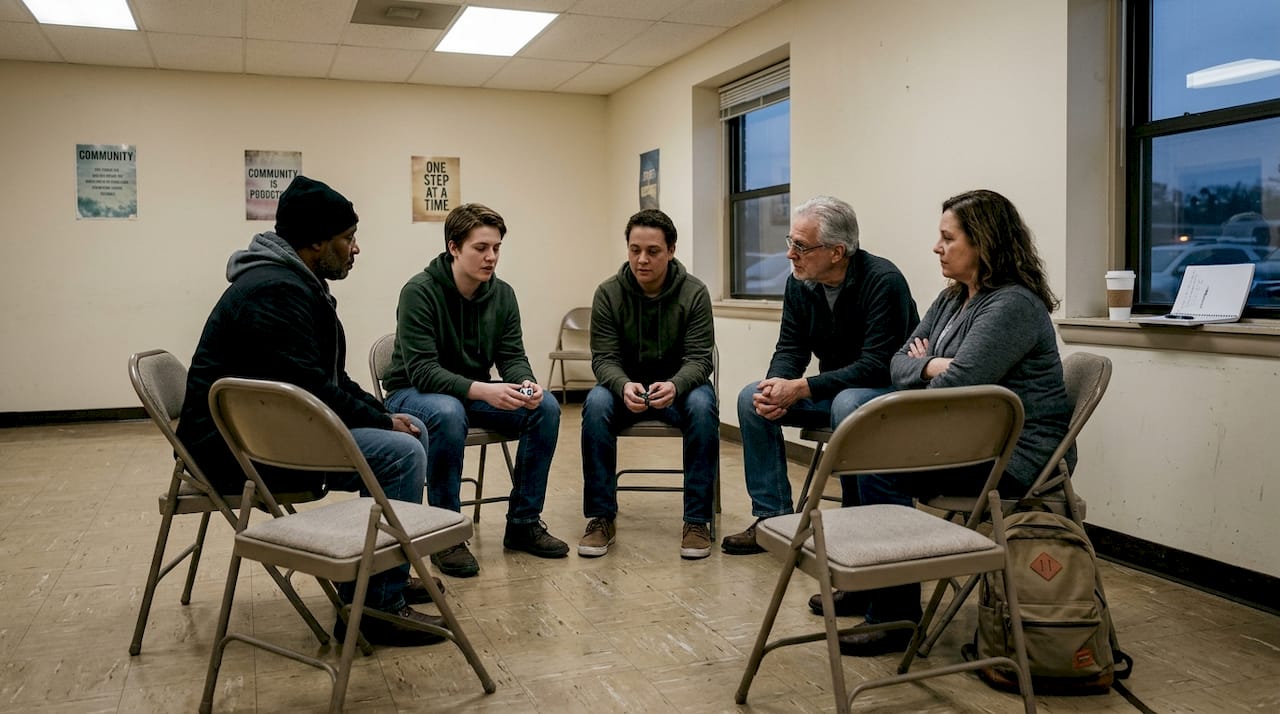
Group witnessing through validation significantly reduces shame and suicidality in trans and gender-diverse individuals. The HOPE intervention, a group-based model for 2STNB (two-spirit, trans, and nonbinary) clients, showed high retention rates and meaningful mental health improvements. That is not a small finding. Shame and suicidality are among the heaviest burdens carried by people in identity transition, and community witnessing directly addresses both.
Here is what group witnessing can look like in practice in Kansas City:
- Trauma support groups where members share experiences and reflect back each other’s truths without advice-giving
- Identity-affirming circles for trans and nonbinary individuals where presence and validation are the primary tools
- Grief groups where loss is witnessed collectively, reducing isolation
- Somatic group sessions where body-based healing happens in community
| Outcome | Individual witnessing | Group witnessing |
|---|---|---|
| Shame reduction | Moderate | High |
| Sense of belonging | Moderate | Very high |
| Suicidality reduction | Moderate | High (especially for trans/2STNB) |
| Nervous system co-regulation | High | High |
The risks in group settings are real, too. Not every group is trauma-informed. Some environments can inadvertently reinforce shame or create unhealthy comparison. That is why the facilitator’s training matters deeply.
For those in identity transitions, pairing group witnessing with individual trauma-informed self-care practices creates a more complete support system. Your healing does not have to happen in one place or in one way.
Risks, limitations, and controversies in therapeutic witnessing
Every healing practice has drawbacks. Witnessing is no exception, and you deserve an honest picture.
One of the most discussed controversies involves Internal Family Systems therapy (IFS), a popular model that uses witnessing as a core tool. In IFS, a client’s “Self” is asked to witness and hold space for internal “parts” that carry trauma. For many people, this is genuinely transformative. But IFS witnessing carries risks for those with complex PTSD or dissociation, including destabilization, false memories, and disorganized reality testing. Critics also note that IFS lacks robust randomized controlled trials (RCTs), and some researchers have raised concerns about pseudoscience elements in its framing.
This does not mean IFS is harmful for everyone. It means that context matters enormously. A skilled, trauma-informed clinician will assess your specific history before choosing any approach.
Here are warning signs that witnessing, in any form, may not be going well for you:
- You feel more destabilized or confused after sessions, not less
- You are experiencing intrusive memories or flashbacks that are increasing in frequency
- You feel pressured to “go deeper” before you feel safe
- Your therapist does not check in about your window of tolerance
- You feel unseen or judged, even in a setting meant to be supportive
Pro Tip: Your nervous system is a reliable guide. If something feels unsafe, that signal deserves respect. A good therapist will slow down with you, not push through.
“Witnessing without safety is not healing. It is exposure without a net. The container matters as much as the content.”
For those working through layered trauma, processing complex trauma safely requires a clinician who understands the difference between productive discomfort and harmful destabilization. That distinction can change everything.
Our perspective: why safe witnessing unlocks genuine healing
Here is something most trauma guides will not say plainly: the technique matters less than the relationship.
We have seen clients come to us after years of therapy that focused heavily on tools, frameworks, and structured protocols. Some found relief. Many still felt unseen. What changed things was not a new technique. It was the experience of being truly witnessed, without agenda, without correction, without the quiet pressure to heal on someone else’s timeline.
Witnessing is a countercultural act. We live in a world that rewards fixing, optimizing, and moving on. Sitting with someone in their pain, without trying to change it, feels almost radical. But that is exactly what empathy’s healing role looks like in practice.
For the Kansas City community we serve, this means we prioritize being with over doing to. Your story is not a problem to solve. It is a truth to be held. When you are held in that truth consistently, something in your nervous system begins to soften. You start to trust that you are safe. And from that safety, real healing grows.
Your softness is not a flaw. Your sensitivity is not a liability. It is the very thing that makes you capable of deep healing.
Find trauma-informed witnessing and support in Kansas City
If what you have read here resonates, you do not have to keep searching alone. Kansas City has compassionate, trauma-informed therapists who understand the healing power of presence and witnessing.
At Simple Empathy KC, we offer individual therapy, group support, and specialized services grounded in evidence-based modalities including EMDR, somatic therapy, and IFS, all within a framework that prioritizes your safety and your story. Whether you are navigating complex trauma, an identity transition, or simply the weight of being deeply human, we are here. Learn more about trauma-informed care in Kansas City or explore the benefits of IFS therapy as one path toward healing. Your next step can be a gentle one.
Frequently asked questions
How is witnessing different from re-telling your trauma story?
Witnessing is about being heard and validated without reliving or analyzing your trauma in depth. As phase-based CPTSD treatment shows, safety and emotion regulation come before any detailed trauma processing.
Does witnessing help if trauma happened years ago?
Yes. Because PTSD symptoms often peak 8 to 10 years post-trauma, witnessing remains valuable long after the original event, supporting healing across extended recovery timelines.
Can witnessing be harmful in some therapy approaches?
In some models, yes. IFS-based witnessing risks include destabilization and disorganized reality testing for those with complex PTSD or dissociation, which is why trauma-informed guidance matters.
How does group witnessing help with identity transitions?
Group validation reduces shame and suicidality meaningfully for trans and gender-diverse individuals by building community, shared recognition, and a sense of belonging that individual therapy alone may not provide.