
TL;DR:
- Trauma healing requires personalized, phased approaches that engage the whole nervous system.
- Evidence-based therapies like EMDR and TF-CBT are effective, especially when combined with safety and relational repair.
- Relationship, safety, and genuine support are crucial beyond specific techniques for a successful recovery.
Trauma healing is rarely what people imagine it to be. Most assume it means sitting in a chair, talking about painful memories until they hurt less. But the truth is both more hopeful and more layered than that. Research shows that effective healing, especially for complex trauma, anxiety, attachment wounds, or identity transitions, requires phased, personalized care that engages your whole nervous system, not just your thoughts. This article walks you through how trauma works, what therapies the evidence supports, how to match approaches to your specific needs, and what it actually looks like to begin coming home to yourself.
Table of Contents
- Understanding trauma: Types, effects, and what makes healing complex
- Core methods in trauma healing: What does the evidence support?
- How effective is trauma therapy? What the science shows
- Matching healing approaches to individual needs
- Our perspective: What most trauma healing guides leave out
- Begin your trauma healing journey with support
- Frequently asked questions
Key Takeaways
| Point | Details |
|---|---|
| No one-size-fits-all | Trauma healing works best when tailored to your unique history and needs. |
| Varied therapies, strong results | Several evidence-based methods show large, sustained benefits for PTSD and related issues. |
| Phase-based for complexity | Complex trauma often requires a staged approach with a focus on emotional skills and safety. |
| Healing is relational | Building trust with a trauma-informed provider is as important as picking the therapy method. |
Understanding trauma: Types, effects, and what makes healing complex
Trauma is your nervous system’s response to experiences that felt too overwhelming, too fast, or too alone to fully process. It isn’t defined by the event itself, but by how your body and mind absorbed it. A single frightening experience, like a car accident or medical emergency, is often called single-incident trauma. Complex trauma, on the other hand, builds over time through repeated experiences: chronic neglect, relational abuse, identity-based harm, or growing up in an environment where safety was never guaranteed.
The effects of trauma touch every part of life. You might notice them in how you think, feel, relate to others, or experience your own body. Common effects include:
- Hypervigilance: feeling constantly on guard, even when you’re safe
- Dissociation: a sense of being disconnected from your body or surroundings
- Emotional flooding: overwhelming feelings that arrive without warning
- Difficulty trusting others: especially in close or vulnerable relationships
- Shame and self-blame: a deep sense that something is fundamentally wrong with you
- Chronic physical tension: pain, fatigue, or numbness that lives in the body
For those with complex trauma, attachment wounds, or grief layered across years, creating a safe space for healing is not a luxury. It is the foundation everything else is built on. Standard talk therapy, while valuable, often isn’t enough for these deeper wounds.
Phase-based treatments involving stabilization, trauma processing, and integration with skills training in emotion regulation and relational repair are recommended for complex trauma over single-modality therapies.
This matters because jumping into trauma processing before your nervous system is stable can sometimes feel retraumatizing rather than healing. Personalized trauma recovery honors your history, your pace, and your capacity at every stage of the work.
Core methods in trauma healing: What does the evidence support?
Understanding the spectrum of effects, let’s explore the specific methods therapists use and what the research says about them. Several evidence-based trauma healing approaches have strong research behind them, though no single one works for everyone.
| Modality | Best for | Main focus | Considerations |
|---|---|---|---|
| TF-CBT | Single-incident trauma, younger adults | Challenging distorted thoughts | May feel cognitive-heavy for some |
| CPT | PTSD, military trauma | Rewriting stuck beliefs | Requires cognitive readiness |
| PE (Prolonged Exposure) | PTSD avoidance patterns | Gradual exposure to memories | Can feel intense early on |
| EMDR | PTSD, disturbing memories | Bilateral stimulation and reprocessing | Gentle, often faster than talk therapy |
| Somatic Experiencing | Body-based trauma, shutdown states | Releasing stored tension in the body | Slower paced, very regulating |
| Phase-based approaches | Complex trauma, attachment wounds | Sequential stabilization and processing | Longer term, highly individualized |
Key trauma therapy methodologies include TF-CBT, CPT, Prolonged Exposure, EMDR, Somatic Experiencing, and phase-based approaches, each targeting different layers of the healing process.
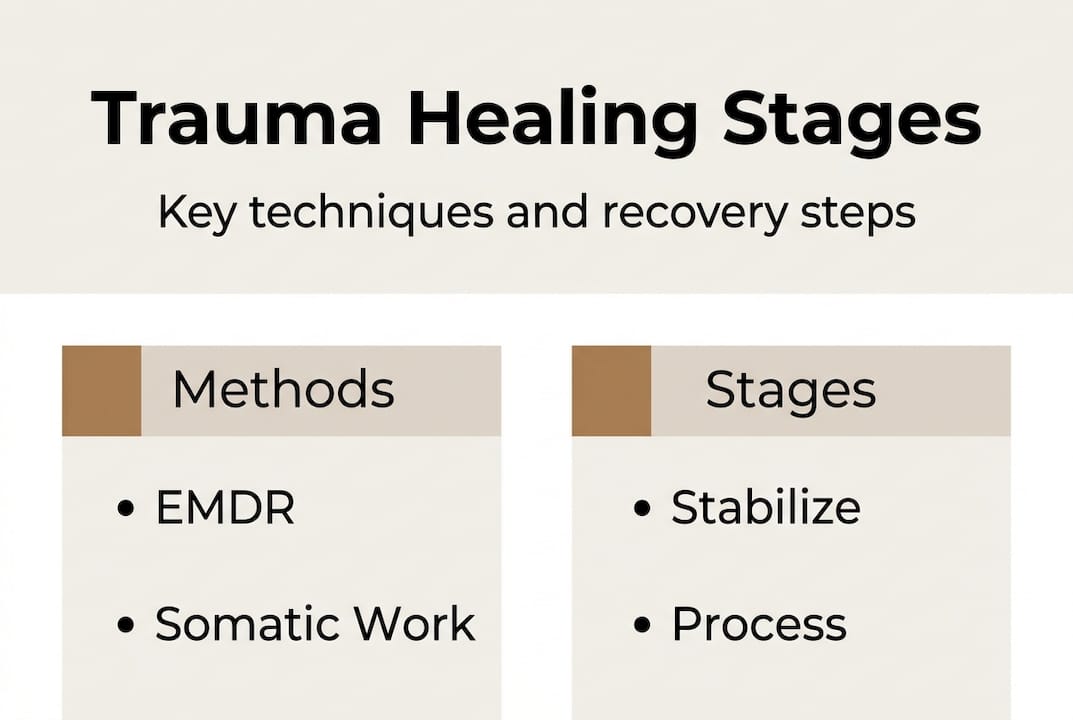
For readers navigating complex backgrounds, trauma-informed care principles emphasize safety, choice, and collaboration over any single protocol. No modality is a magic fix. Each one offers a doorway, and the right doorway depends on where you are right now.

Pro Tip: The goal isn’t to find the “perfect” therapy before you start. An experienced trauma-informed therapist will help you figure out what fits your nervous system and adjust as you grow.
How effective is trauma therapy? What the science shows
But what does the evidence really say about outcomes, especially for those navigating complex diagnoses? The short answer: trauma therapy works, and the data is genuinely encouraging.
TF-CBT and EMDR show large effect sizes for PTSD symptoms, with Hedge’s g values of 0.95 to 1.32 at follow-up. Psychotherapies also significantly reduce depression and anxiety in complex PTSD cases, with effect sizes around g = 1.12 and 1.25 respectively, and these gains are sustained over time. That’s not a small shift. That’s people reclaiming their lives.
| Outcome area | Effect size (g) | Notes |
|---|---|---|
| PTSD symptoms | 0.95 to 1.32 | Large, sustained at follow-up |
| Depression | ~1.12 | Significant across modalities |
| Anxiety | ~1.25 | Strong response in complex PTSD |
| DSO (self-organization) | Smaller | Requires specialized, phase-based work |
There is an important nuance worth naming. Evidence-based therapies excel on PTSD core symptoms but show smaller effects on what researchers call disturbances in self-organization (DSO). DSO includes things like difficulty with trust, unstable sense of self, emotional dysregulation, and relational struggles. These pieces of the puzzle often need more specialized, phase-based, or psychodynamic work to shift meaningfully.
This is why those working through steps for complex trauma often find that a blended approach, combining EMDR or somatic work with relational repair, touches the places that standard protocols can’t quite reach on their own. Healing is rarely a straight line. But the evidence is clear: it is possible, and you don’t have to do it alone.
Matching healing approaches to individual needs
With the effectiveness data in mind, let’s clarify how you and your therapist can choose the right healing plan. One of the most important things to understand is that the sequence of healing matters as much as the method itself.
Here is a practical way to think through the process:
- Assess your current symptoms and stability. Before any trauma processing begins, your therapist will want to understand what your nervous system needs right now.
- Determine readiness for trauma processing. Not everyone is ready to approach difficult memories directly. That is not failure. It is wisdom.
- Begin with stabilization if needed. Skills like grounding, breathing, and emotion regulation create the safety net that makes deeper work possible.
- Explore trauma-focused work collaboratively. Your therapist guides pacing. You bring your truth. Together, you decide what is next.
- Integrate what emerges. Healing isn’t just processing pain. It’s building a new relationship with yourself, your body, and the world.
- Revisit and adjust over time. Your needs will change. A good therapist adapts with you.
For complex cases, trauma-focused therapies like PE and CPT are first-line but may feel overwhelming for those with poor emotion regulation. Somatic, mindfulness-based, or DBT approaches are often preferred initially to build capacity and safety. Following stabilization, trauma-informed self-care steps can support ongoing integration between sessions.
Pro Tip: Progress in trauma healing is not always forward-moving. Plateaus, grief, and even temporary intensification of symptoms are normal parts of the process. Open, honest communication with your therapist keeps the work safe and attuned to where you actually are.
Our perspective: What most trauma healing guides leave out
After understanding the toolkit, here’s what we’ve learned from years helping clients heal in Kansas City: most people spend enormous energy searching for the right therapy method when the most transformative ingredient is something quieter. It’s relational safety. It’s being genuinely witnessed by someone who holds your story with care.
Most breakthroughs happen not in the technique itself, but in the moment a client realizes they are not too much, not broken, not beyond repair.
Protocols matter. Evidence matters. But what we see again and again is that empathy in trauma recovery creates the conditions for the real work to happen. Healing lives inside a relationship where repair is possible, where your nervous system learns it is safe to soften, and where your story is held as sacred rather than something to be fixed. The method is the container. The relationship is the medicine.
Begin your trauma healing journey with support
If something in this article landed for you, that recognition matters. You don’t have to have everything figured out before you reach out. Healing begins with one honest step.

At Simple Empathy KC, we offer therapy services in Kansas City grounded in true relational safety, EMDR, somatic work, Internal Family Systems, and phase-based care tailored to your unique story. Whether you’re navigating complex trauma, anxiety, grief, or an identity transition, you deserve support that meets you where you are. Explore our trauma-informed healing guide to learn more, or reach out to schedule a consultation. You don’t have to carry this alone.
Frequently asked questions
How long does trauma healing take?
Trauma healing varies widely depending on the individual’s history, symptom complexity, and the approach used. Phase-based complex trauma treatments involve sequential stages rather than a fixed timeline, so patience and flexibility are essential.
What if traditional trauma therapy feels overwhelming?
Feeling overwhelmed is a signal, not a failure. Starting with somatic, mindfulness-based, or DBT approaches builds the regulation skills you need before approaching more direct trauma processing safely.
Is one therapy method proven superior to others?
TF-CBT and EMDR show comparable, strong results for PTSD over time, and no significant long-term difference has been found between them. For complex trauma, a combined and flexible approach tends to serve people best.
Can trauma healing help with anxiety or depression?
Absolutely. Trauma-focused psychotherapies produce significant reductions in anxiety and depression in complex PTSD, with effects that hold well beyond the end of treatment.