
TL;DR:
- Trauma is common, and trauma-informed care shifts focus from “what’s wrong with you” to “what happened to you.”
- It emphasizes safety, trust, collaboration, empowerment, and cultural sensitivity in the healing process.
- Research shows trauma-informed care improves mental health outcomes but requires genuine practitioner empathy and ongoing training.
Most people who seek therapy carry more than they can name. Trauma is far more common than many realize, with high trauma prevalence documented in up to 94-98% of pediatric care populations. Yet most people still walk into therapy wondering if something is fundamentally wrong with them. Trauma-informed care starts from a completely different place. It asks not what is broken in you, but what has happened to you. If you are in Kansas City and have been carrying complex trauma, anxiety, grief, or a deep sense of disconnection from yourself, understanding this approach could change everything about how you experience healing.
Table of Contents
- What is trauma-informed care?
- The 6 core principles and foundational mechanics
- How trauma-informed care works for complex trauma, CPTSD, and related issues
- Evidence, outcomes, and critiques: What does the research actually show?
- Why trauma-informed care is misunderstood, and what Kansas City gets right
- Start your trauma-informed healing journey in Kansas City
- Frequently asked questions
Key Takeaways
| Point | Details |
|---|---|
| Safety is central | Trauma-informed care prioritizes emotional and physical safety for both clients and providers. |
| Relationship matters | The therapeutic alliance and empathy drive recovery and prevent retraumatization. |
| Evidence shows impact | Research reports meaningful reductions in self-harm, restraint, and improved well-being. |
| Local adaptation | Kansas City therapists personalize trauma-informed care with cultural sensitivity and community focus. |
| Critiques exist | Challenges include mixed evidence, overgeneralization, and implementation obstacles to address. |
What is trauma-informed care?
Trauma-informed care, often shortened to TIC, is a strengths-based framework that recognizes how widespread trauma is and how deeply it shapes a person’s mind, body, and relationships. It is not a single therapy technique. It is a way of seeing and relating to the people who come for support.
Conventional therapy often focuses on symptoms. You come in with anxiety or depression, and the work centers on reducing those symptoms. Trauma-informed care does something different. As the American Academy of Pediatrics notes, TIC shifts the question from “What’s wrong with you?” to “What happened to you?” That shift is not small. It changes the entire texture of the therapeutic relationship.
SAMHSA’s framework emphasizes that trauma-informed care centers on safety and empowerment, ensuring that the healing space itself does not recreate the conditions that caused harm in the first place. This is especially important for people who have experienced relational trauma, where the wound came from another person.
Here is how trauma-informed care differs from conventional approaches:
| Feature | Conventional therapy | Trauma-informed care |
|---|---|---|
| Primary focus | Symptom reduction | Understanding root experiences |
| Client framing | “What is wrong?” | “What happened to you?” |
| Relationship style | Expert-driven | Collaborative and relational |
| Body awareness | Often minimal | Central to healing |
| Power dynamic | Therapist leads | Shared and empowering |
For people navigating complex trauma, grief, or identity transitions, the difference is felt immediately. You are not a diagnosis to be managed. You are a person whose story deserves to be witnessed. Learning about trauma-informed healing spaces can help you understand what to look for when choosing a therapist in Kansas City.
“Healing begins when someone finally asks not what is wrong with you, but what happened to you.”
This framework matters because it actively works to avoid re-traumatization. Every interaction, from scheduling to the therapy room itself, is designed to feel safe, predictable, and respectful.
The 6 core principles and foundational mechanics
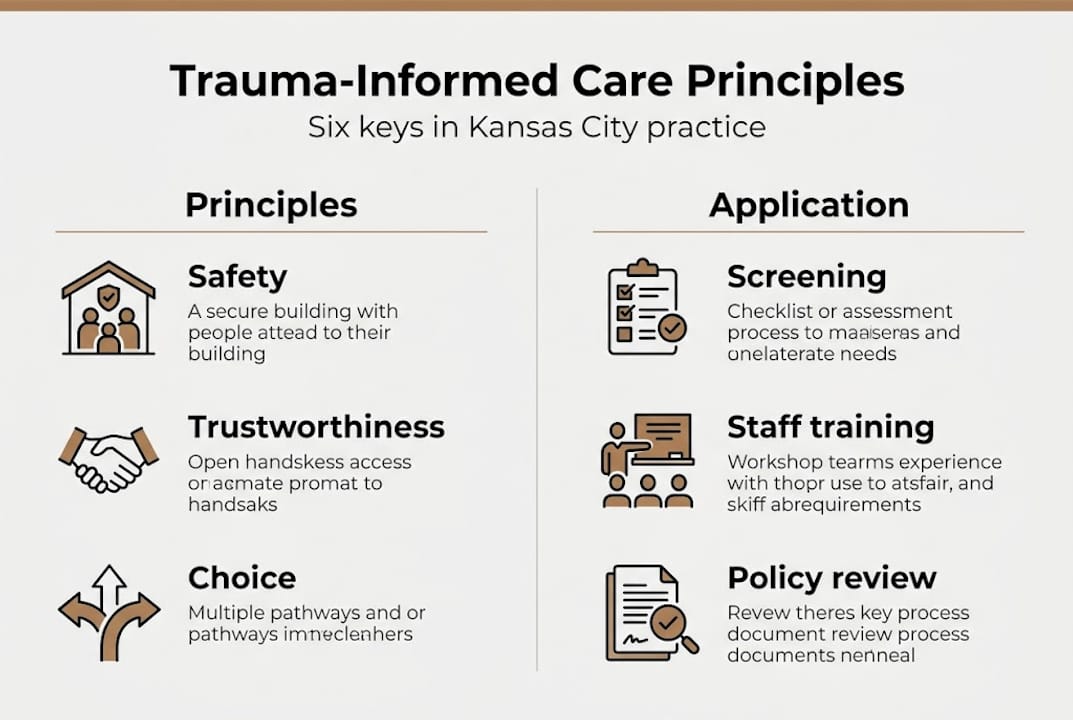
Understanding the definition, let’s go deeper into the principles and mechanics that make trauma-informed care effective. SAMHSA outlines six core principles that guide trauma-informed practice across settings.
- Safety — Every aspect of the environment, physical and relational, is designed so clients feel secure.
- Trustworthiness and transparency — Therapists are clear about what to expect, building trust through consistency.
- Peer support — Lived experience is honored; connection with others who have experienced trauma is valued.
- Collaboration and mutuality — Power is shared. Healing happens with you, not to you.
- Empowerment, voice, and choice — You are the expert on your own experience. Therapy supports your agency.
- Cultural, historical, and gender sensitivity — Your identity, background, and community context are never ignored.
In practice, these principles shape how a Kansas City therapist greets you, how they explain what will happen in a session, and how they respond when something feels too hard. It is not just philosophy. It is moment-to-moment attunement.
Pro Tip: When you first meet a potential therapist, notice whether they explain your options clearly and invite your input. That transparency is a direct expression of trauma-informed principles, and it tells you a great deal about how safe the relationship will feel over time.
Kansas City practitioners also apply these principles at the organizational level. This means universal trauma screening, ongoing staff training, and regular policy review to ensure that no part of the system inadvertently causes harm. Exploring trauma-informed self-care steps can also help you build these principles into your daily life between sessions.
Cultural humility deserves special attention here. Trauma does not exist in a vacuum. It is shaped by race, gender, community history, and lived experience. A genuinely trauma-informed therapist in Kansas City will hold your full identity with care, not just your symptoms. This is what makes the work feel real rather than clinical. Knowing what safe healing spaces look and feel like can help you trust your instincts when you walk through the door.
How trauma-informed care works for complex trauma, CPTSD, and related issues
With the principles defined, let’s examine how trauma-informed care applies to complex trauma and other challenging issues common in Kansas City.

Complex trauma, sometimes called CPTSD, develops from repeated or prolonged traumatic experiences, often in childhood or within close relationships. Unlike a single-event trauma, it affects a person’s sense of self, their ability to regulate emotions, and their capacity to trust others. It shows up as anxiety, attachment wounds, identity confusion, and grief that feels bottomless.
Trauma-informed care addresses this through a phase-based approach:
- Stabilization — Building safety, coping skills, and nervous system regulation before processing trauma directly.
- Trauma processing — Working through traumatic memories using methods like EMDR, Internal Family Systems (IFS), or somatic therapy.
- Reintegration — Reconnecting with a sense of self, relationships, and life meaning after processing.
Research confirms that TIC integrates effectively with phase-based approaches and is particularly effective for CPTSD using EMDR, trauma-focused CBT, and psychodynamic therapy. This is not a one-size-fits-all path. The pace is yours.
For those dealing with anxiety, the stabilization phase is often where the most immediate relief comes. Your nervous system learns that it is allowed to settle. For those with attachment wounds, the relational quality of the therapy itself becomes part of the healing. You experience, perhaps for the first time, what it feels like to be truly seen without judgment.
Pro Tip: If you are unsure whether you are dealing with PTSD or complex PTSD, bring that question to your first session. A trauma-informed therapist will help you understand your experience without labeling you in ways that feel reductive.
Some practical steps for Kansas City clients:
- Ask potential therapists which phase-based modalities they use.
- Look for training in EMDR, IFS, or somatic approaches.
- Prioritize relational fit, not just credentials.
- Read about trauma recovery tips to prepare yourself for the process.
- Explore resources on processing complex trauma so you understand what the journey can look like.
Evidence, outcomes, and critiques: What does the research actually show?
To ground this approach, let’s look at what the research and real-world results actually reveal, both benefits and limitations.
The evidence for trauma-informed care is genuinely encouraging. Studies document meaningful reductions in self-harm, seclusion, and restraint in clinical settings, along with improvements in housing stability and overall mental health outcomes. These are not small gains. They represent real shifts in how people experience their lives.
Key documented outcomes include:
- Reduced rates of self-harm and crisis episodes
- Decreased use of restrictive practices in care settings
- Improved engagement and therapeutic alliance
- Greater housing stability for individuals with trauma histories
- Stronger sense of empowerment and self-efficacy
“The most powerful outcome of trauma-informed care is not symptom reduction. It is the return of a person’s sense of self.”
However, the research also has real limitations. Critics note that many studies carry high bias risk, rigorous randomized controlled trials are limited, and there are concerns about overgeneralization, circular reasoning, and even the potential for unintended harm when TIC is applied without sufficient nuance or training.
This matters. It means that not every program calling itself trauma-informed is delivering genuine care. It also means that the field is still evolving, and honest practitioners acknowledge that.
For Kansas City clients, this is actually useful information. It reminds you to ask questions, to notice how a therapist responds to your feedback, and to trust your own experience of safety in the room. Exploring evidence-based trauma recovery can help you evaluate what genuine support looks like. Understanding the role of empathy in trauma therapy is equally important, because the relational quality of care is often what the research cannot fully capture.
Why trauma-informed care is misunderstood, and what Kansas City gets right
Nationally, trauma-informed care has become something of a buzzword. Organizations slap the label on their services without doing the deeper work of examining their own practices, power structures, or cultural blind spots. The result is a watered-down version that looks good on paper but does not actually feel safe to the people it claims to serve.
What Kansas City practitioners tend to get right is the relational piece. Healing is not a technique. It is a relationship. When a therapist sits with you and genuinely holds your story without flinching, something shifts in your nervous system that no worksheet can replicate.
The hard-won lesson from local practice is this: trauma-informed care only works when the practitioner has done their own work. Empathy cannot be performed. It has to be real. Empathy-led recovery is not about technique. It is about presence. Kansas City’s community-focused approach, which integrates cultural awareness and relational warmth, is what moves the needle. Not the label.
Start your trauma-informed healing journey in Kansas City
If any part of this article felt like it was written for you, that recognition matters. You do not have to keep carrying what you have been carrying alone.

At Simple Empathy KC, we offer personalized, trauma-informed therapy grounded in EMDR, IFS, and somatic approaches. Our therapists are trained to meet you exactly where you are, with warmth, honesty, and deep respect for your story. Whether you are navigating complex trauma, anxiety, grief, or a shift in identity, we hold space for all of it. Explore our Kansas City therapy services or read more about creating Kansas City safe spaces for healing. You deserve care that truly sees you.
Frequently asked questions
How is trauma-informed care different from regular therapy?
Trauma-informed care prioritizes relational safety, empowerment, and understanding what happened to you rather than focusing solely on symptom reduction. The relationship itself becomes part of the healing, not just the techniques used.
What issues are best addressed with trauma-informed care?
Complex trauma, PTSD, anxiety, grief, and identity disruptions all respond well to trauma-informed care’s phase-based relational approach. It is especially effective when the root of the struggle is relational or developmental in nature.
Is trauma-informed care evidence-based?
Research shows meaningful benefits in mental health settings, including reduced self-harm and improved stability, though some critiques point to limited rigorous trials and implementation challenges that the field continues to address.
How do Kansas City therapists apply trauma-informed care?
Local therapists build relational safety from the first contact, integrate cultural sensitivity into every session, and use phase-based methods to ensure that healing unfolds at a pace that feels safe and sustainable for each person.