
TL;DR:
- Trauma-informed self-care centers on safety, choice, and pacing tailored to nervous system states.
- Building a flexible, personalized workflow with grounding, regulation, and self-compassion supports healing.
- Professional support is recommended when self-care becomes overwhelming or distress increases.
Self-care sounds simple until trauma is part of your story. For survivors of complex trauma or anxiety, the usual advice, such as “just take a bath” or “practice gratitude,” can feel hollow or even activating. Your nervous system has learned to stay alert, and that is not a flaw. It is a survival response. This guide is written specifically for you, someone in Kansas City who is healing and wants a self-care approach that actually honors what you have been through. We will walk through what trauma-informed self-care really means, how to set up a workflow that feels safe, and how to adapt it when things get hard.
Table of Contents
- Understanding trauma-informed self-care
- Setting up your trauma-informed self-care workflow
- Step-by-step: Your self-care workflow in practice
- Troubleshooting and adapting your self-care process
- Our perspective: What most trauma-informed guides miss
- Explore trauma-informed support in Kansas City
- Frequently asked questions
Key Takeaways
| Point | Details |
|---|---|
| Focus on safety first | All self-care should help you feel secure and avoid re-traumatization. |
| Personalize your workflow | Tailor self-care steps to what feels manageable and comforting to you. |
| Compassion over perfection | Being kind to yourself is critical—even if progress is slow or inconsistent. |
| Adjust as you go | Self-care strategies should evolve with your needs and experiences. |
Understanding trauma-informed self-care
Trauma-informed self-care is not just self-care with softer language. It is a fundamentally different approach, one that centers your sense of safety, your right to choose, and your pace above all else.
Generic self-care often assumes you start from a regulated, calm baseline. Trauma-informed self-care recognizes that your nervous system may be in a state of hyperarousal (feeling wired, anxious, or on edge) or hypoarousal (feeling numb, shut down, or disconnected). Both are valid responses to trauma. The goal is not to push through them but to work gently with them.
SAMHSA’s principles offer a clear foundation. Their six guiding principles for a trauma-informed approach are:
- Safety: You feel physically and emotionally safe in your space
- Trustworthiness and transparency: Practices are predictable and honest
- Peer support: Connection with others who understand your experience
- Collaboration and mutuality: You are a partner in your own healing, not a passive recipient
- Empowerment and choice: You have voice and control over your process
- Cultural, historical, and gender issues: Your identity and background are honored
These principles prioritize avoiding re-traumatization through choice and transparency. That matters because well-meaning self-care practices, like forced deep breathing or certain meditation styles, can sometimes feel threatening to a dysregulated nervous system.
Here is a quick comparison to show the difference:
| Generic self-care | Trauma-informed self-care |
|---|---|
| One-size-fits-all routines | Personalized to your nervous system state |
| Focus on productivity or outcomes | Focus on safety and presence |
| May ignore triggers | Actively plans around triggers |
| Assumes emotional readiness | Meets you where you are |
“Healing does not happen on a schedule. It happens when you feel safe enough to let it.”
Part of creating a safe space for yourself is understanding that safety is not a luxury. It is the foundation. And the role of empathy in recovery reminds us that being witnessed, even by yourself, is one of the most healing acts possible.
Setting up your trauma-informed self-care workflow
Before you begin any practice, preparation matters. Jumping into self-care without considering your environment or current state can leave you feeling worse, not better. Think of this setup phase as laying a soft foundation.
Start by identifying what helps you feel grounded. This might be a specific chair, a familiar scent, soft lighting, or a weighted blanket. Your environment sends signals to your nervous system, and small adjustments can make a real difference.
Next, take a gentle inventory of your triggers. You do not need to process them right now. Simply knowing what tends to activate you helps you plan around those moments with more intention and less surprise.
Here is a table of tools and resources to consider as you build your workflow:
| Tool or resource | Purpose | Example |
|---|---|---|
| Grounding objects | Anchor you to the present | A smooth stone, a soft cloth |
| Regulation skills | Calm your nervous system | Box breathing, cold water on wrists |
| Journaling | Gentle reflection without judgment | Prompts focused on safety and gratitude |
| Movement | Release stored tension | Slow walking, gentle stretching |
| Peer connection | Reduce isolation | A trusted friend, a support group |
| Professional support | Deeper processing | Therapy with a trauma-informed counselor |
Research shows that body-based skills should be prioritized when your nervous system is dysregulated, and that self-compassion meaningfully supports trauma recovery. This is not about forcing positivity. It is about treating yourself with the same gentleness you would offer a dear friend.
A few things to check before each session:
- Do you have at least 20 to 30 uninterrupted minutes?
- Is your space reasonably quiet and comfortable?
- Do you have a grounding object or practice ready if needed?
- Do you know who you can reach out to if distress increases?
Pro Tip: Start with one manageable step, not an overhaul. Choosing a single grounding practice and doing it consistently for one week is more healing than attempting a full routine and feeling overwhelmed.
For more on building a solid foundation, evidence-based trauma healing tips offer practical guidance rooted in current research.
Step-by-step: Your self-care workflow in practice
Now that you are prepared, here is a workflow you can move through at your own pace. There is no timer. You are in charge.
Step 1: Grounding
Begin by connecting to the present moment. Try the 5-4-3-2-1 technique: name five things you can see, four you can touch, three you can hear, two you can smell, and one you can taste. This gently pulls your attention away from the past or future and into right now.

Step 2: Regulation
Once grounded, support your nervous system with a body-based skill. Options include slow diaphragmatic breathing, gentle movement, or placing a hand on your heart. CRM skills (Community Resiliency Model) are designed specifically to reduce stress, anxiety, and depression by tracking physical sensations in the body. Trauma-informed yoga has also shown meaningful improvements in well-being for survivors.
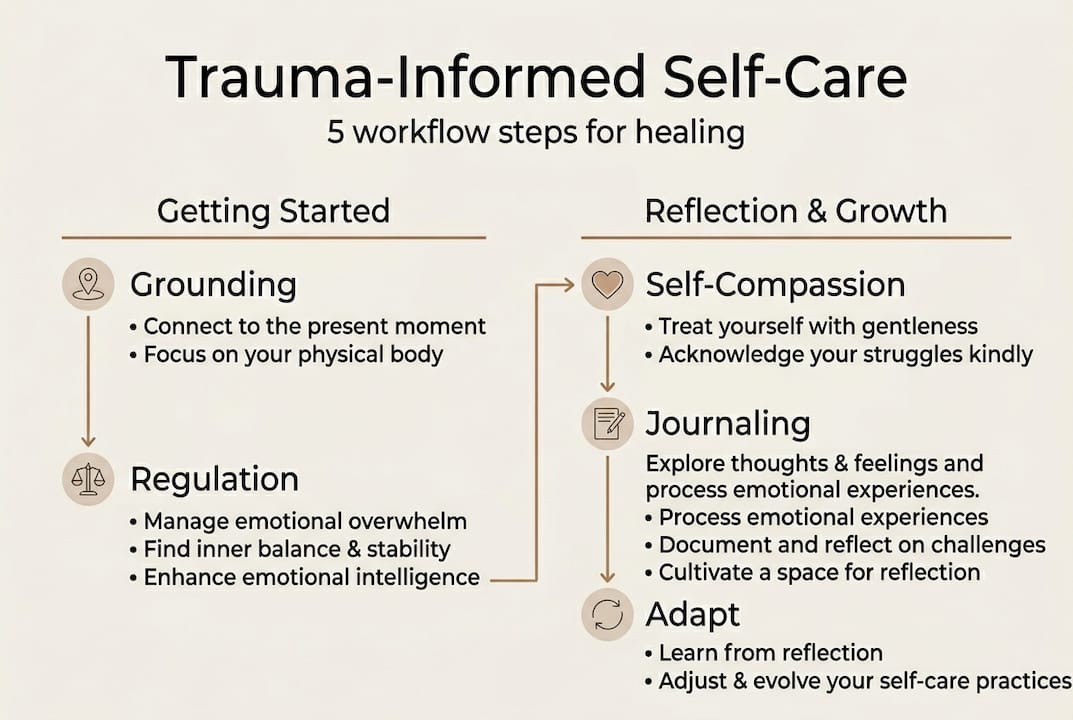
Step 3: Gentle self-compassion
Speak kindly to yourself. This does not mean toxic positivity. It means acknowledging what is hard without adding shame. A simple phrase like “This is difficult, and I am doing my best” can shift your internal experience.
Step 4: Reflection
If you feel ready, spend a few minutes journaling. Keep it low-pressure. You might write about how your body feels, what felt safe today, or one small thing you noticed. Reflection is not about solving anything. It is about witnessing yourself.
Step 5: Reconnection
Close your session by doing something that brings a sense of warmth or comfort. This could be making tea, texting a trusted person, or simply sitting quietly. Reconnection signals to your nervous system that the session is complete and that you are okay.
Pro Tip: Before moving from one step to the next, pause and check in with your body. Ask yourself: “Does this feel okay right now?” Your answer matters more than any schedule.
“You control the pace. If distress increases at any point, it is always okay to stop, rest, and return another time.”
Here is a quick guide to matching approaches with your needs:
| Need | Suggested approach |
|---|---|
| Feeling disconnected or numb | Grounding techniques, sensory anchors |
| Feeling anxious or overwhelmed | CRM body tracking, slow breathing |
| Processing emotions gently | Journaling, self-compassion phrases |
| Releasing physical tension | Trauma-informed yoga, gentle movement |
For those wanting to explore deeper support, therapy options in Kansas City can complement your personal workflow beautifully.
Troubleshooting and adapting your self-care process
Even with a thoughtful workflow, there will be days when nothing feels right. That is not failure. That is healing being honest with you.
Common obstacles include fatigue, perfectionism, and unexpected triggers. Fatigue can make even simple steps feel impossible. Perfectionism can turn self-care into another task to do correctly. Triggers can arise without warning and shift your entire state.
Here is how to adapt when things are not working:
- Shorten your practice. Even two minutes of grounding counts. You do not need a full session to benefit.
- Change your environment. Sometimes a different room or going outside can shift your nervous system state.
- Lower the bar. If journaling feels like too much, simply sit quietly with a hand on your chest for one minute.
- Reach out. Connection is a regulation tool. A brief check-in with a trusted person can help more than any solo practice.
- Skip it without guilt. Rest is also healing. Forcing yourself through a practice when you are depleted can do more harm than good.
Research also reminds us that self-compassion’s protective effects are not always consistent, meaning it does not automatically buffer every difficult moment. This is important to know so you do not blame yourself when self-compassion feels hard to access.
“Progress is not linear. Some days you will feel like you have moved backward. You have not. You are still healing.”
Pro Tip: Keep a simple journal where you note what you tried, how your body felt before and after, and what helped even a little. Over time, patterns emerge that help you personalize your workflow even further.
Know when to seek professional support. If self-care consistently feels overwhelming, if distress is increasing rather than easing, or if you are having unsafe thoughts, please reach out to a mental health professional. How therapy supports healing goes deeper into what that process can look like and how it complements your own efforts.
Our perspective: What most trauma-informed guides miss
Most trauma-informed self-care guides give you a list and send you on your way. What they often miss is this: structure, when applied too rigidly, can become its own source of stress for trauma survivors.
When you have lived through experiences that felt out of your control, being handed another system to follow perfectly can quietly activate that same sense of pressure. We have seen this with clients who come in feeling like they are failing at self-care. They are not failing. The system failed to account for their humanity.
The real heart of trauma-informed self-care is not the steps. It is the relationship you build with yourself along the way. Self-trust, flexible pacing, and the willingness to honor what your body is telling you on any given day matter far more than completing a checklist.
Self-compassion is powerful, but it is not a magic shield. On hard days, it may feel completely out of reach, and that is okay. What matters is returning to yourself gently, again and again, without punishment.
If you want to go deeper into what it means to truly feel safe in your own healing, our deeper safe space guide explores that with care.
Explore trauma-informed support in Kansas City
Sometimes self-care is the beginning, and professional support is what helps you go further. If you are ready to explore what deeper healing looks like, you do not have to figure it out alone.

At Simple Empathy KC, we offer trauma-informed therapy rooted in EMDR, Internal Family Systems, and somatic approaches, all designed to support your nervous system and honor your story. Our therapists are here to walk alongside you, not ahead of you. You can also explore our safe healing spaces resource and our collection of evidence-based recovery tips to keep building your foundation. Reaching out is a brave and worthy step.
Frequently asked questions
What are trauma-informed self-care techniques?
Trauma-informed self-care techniques prioritize safety, control, and compassion, including grounding exercises, peer support, and gentle mindfulness. SAMHSA’s six principles, including safety, trust, and peer support, form the guiding framework for applying these approaches.
Does self-compassion help trauma recovery?
Self-compassion can meaningfully support post-traumatic growth and recovery, but research shows it does not consistently protect against all symptoms or setbacks, so be gentle with yourself when it feels hard to access.
What is a simple trauma-informed self-care workflow?
A simple workflow includes grounding, body-based regulation skills, gentle self-reflection through journaling, and adapting each practice to whatever feels safe and manageable for you that day.
When should trauma survivors seek professional support?
If self-care feels consistently overwhelming, increases your distress, or you are experiencing unsafe thoughts, please reach out to a trauma-informed mental health professional in Kansas City as soon as you are able.