
TL;DR:
- Trauma-informed care emphasizes safety, trust, and collaboration to facilitate healing.
- Creating a safe environment involves physical comfort and emotional boundaries tailored to individual needs.
- Effective healing progresses through stabilization, processing, and integration with client-led pacing.
Healing asks something profound of you. It asks you to trust, to soften, to let yourself be seen. But when you carry trauma, anxiety, or grief, that kind of openness can feel impossible, even dangerous. Your nervous system has learned to protect you, and that protection is sacred. The challenge is finding an environment where safety is not just promised but genuinely built. This guide walks you through what trauma-informed care looks like in practice, how to prepare yourself and your space, and how to find the right support for your healing journey right here in Kansas City.
Table of Contents
- Understanding trauma-informed care and its principles
- Preparing your environment: Physical and emotional safety essentials
- Step-by-step: How to facilitate healing using trauma-informed approaches
- Troubleshooting and adapting: Managing challenges and special situations
- Connecting with trauma-informed therapy in Kansas City
- Why trauma-informed healing is essential, but not a cure-all
- Begin your journey with trauma-informed therapy in Kansas City
- Frequently asked questions
Key Takeaways
| Point | Details |
|---|---|
| Emphasize safety first | Prioritizing both physical and emotional safety is essential for effective healing from trauma. |
| Follow trauma-informed principles | Integrating SAMHSA’s six core principles guides every stage of the healing process. |
| Use evidence-backed therapies | TF-CBT and EMDR have the strongest support for treating complex trauma, anxiety, and grief. |
| Adapt to individual needs | Flexibility, client pacing, and cultural humility are crucial for sustainable progress in therapy. |
| Local help is available | Kansas City offers a range of trauma-informed therapists and resources to support your journey. |
Understanding trauma-informed care and its principles
Trauma-informed care, often called TIC, is not simply a therapy technique. It is a whole orientation toward healing, one that recognizes how widespread trauma is and how deeply it shapes the way people think, feel, and relate to others. When a therapist or practice is truly trauma-informed, every interaction is shaped by awareness of how trauma affects the nervous system, identity, and trust.
Trauma-informed care creates safe spaces through six core principles developed by SAMHSA. These principles are not abstract ideals. They are practical commitments that change how care is delivered.
The six SAMHSA principles are:
- Safety: Physical and emotional safety are prioritized at every step.
- Trustworthiness and transparency: Decisions are made openly, with clear communication.
- Peer support: Lived experience is honored as a source of strength and connection.
- Collaboration and mutuality: Power is shared between therapist and client.
- Empowerment, voice, and choice: You are the expert on your own experience.
- Cultural, gender, and historical issues: Your identity and background are respected, not minimized.
For people navigating complex trauma, anxiety, or grief, these principles matter because they directly address the conditions that make healing possible. You cannot process what you cannot safely feel. And you cannot safely feel in an environment that dismisses or rushes you.
“Safety is not just the absence of threat. It is the active presence of trust, predictability, and respect.”
Here is a quick comparison of what care looks like with and without a trauma-informed lens:
| Element | Trauma-informed approach | Non-trauma-informed approach |
|---|---|---|
| Pacing | Client-led, flexible | Therapist-directed, structured |
| Disclosure | Voluntary, never forced | May be expected or assumed |
| Cultural context | Centered and respected | Often overlooked |
| Power dynamic | Collaborative | Hierarchical |
| Nervous system | Actively considered | Rarely addressed |
If you are exploring therapy in Kansas City, understanding these principles helps you ask better questions and recognize whether a provider is truly aligned with your healing needs.
With this foundation, let’s see what needs to be in place before you begin practical healing work.
Preparing your environment: Physical and emotional safety essentials
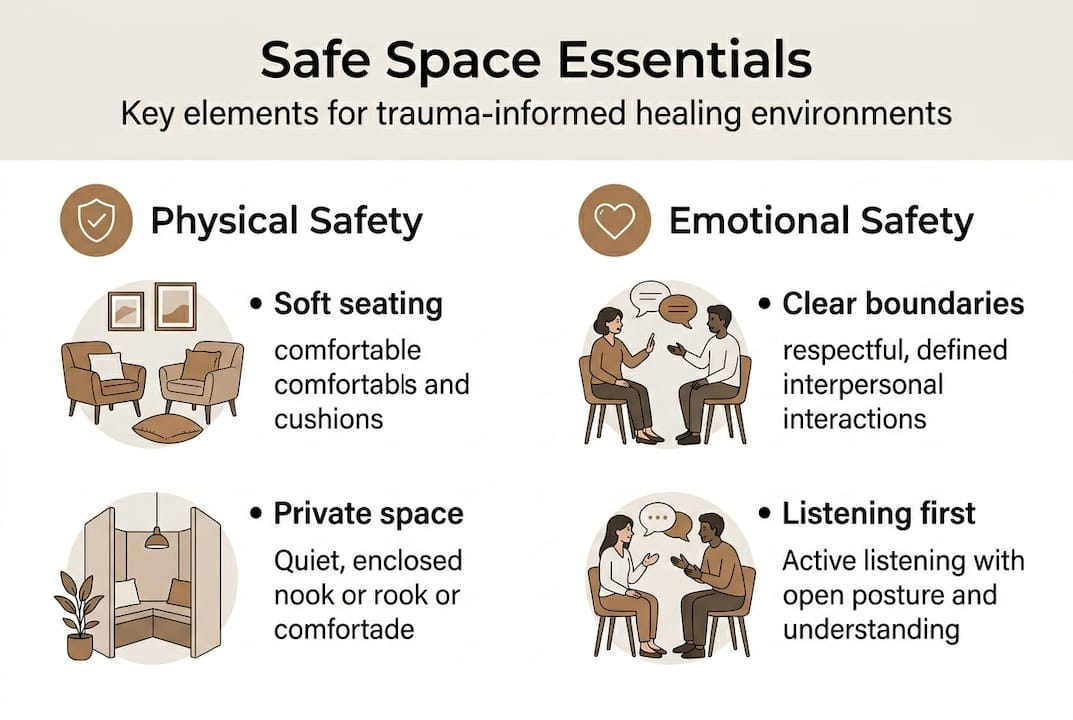
Before healing can begin, the space around you needs to feel safe. This is true whether you are preparing a therapy office, a home environment, or a virtual session setup. Mechanics for safety include a calm environment, clear boundaries, adjustable lighting, and client-led pacing.
Physical safety checklist:
- Soft, adjustable lighting that does not feel clinical or harsh
- Comfortable seating with options for different body needs
- Minimal noise or sound buffering for privacy
- Clear, unobstructed exits so you never feel trapped
- Grounding objects nearby, such as a textured item, a weighted blanket, or a plant
Emotional safety checklist:
- Transparent communication about what to expect in each session
- Explicit permission to pause, redirect, or end a conversation
- Consistent boundaries that are explained, not assumed
- Respect for your pace, your story, and your identity
- Cultural humility, especially for those navigating identity transitions or grief tied to community or heritage
| Safety element | Physical tool | Emotional tool |
|---|---|---|
| Comfort | Adjustable furniture | Welcoming, non-judgmental tone |
| Grounding | Textured objects, soft lighting | Breathing cues, check-ins |
| Privacy | Soundproofing, closed doors | Confidentiality agreements |
| Autonomy | Open exits | Choice in session direction |
Pro Tip: Before your first session, ask your provider three simple questions. “What happens if I need to stop?” “How do you handle cultural differences?” “Can I set the pace?” Their answers will tell you a great deal about whether this space is truly built for your healing.
Therapist Kieri Olmstead’s approach to creating a safe therapy environment reflects many of these principles, offering a space where your nervous system can begin to settle before the deeper work begins. You can also explore therapy services in Kansas City to find the right fit for your specific needs.

Once your environment is set, you are ready to begin the healing process itself, step by step.
Step-by-step: How to facilitate healing using trauma-informed approaches
Healing from trauma is not linear. But there is a general sequence that trauma-informed therapists follow, one that honors your nervous system and builds capacity before asking you to go deeper.
- Stabilization: Before processing anything painful, you build internal resources. This means learning grounding techniques, breathwork, and nervous system regulation skills. You develop a felt sense of safety in your own body.
- Processing: With a stable foundation, you begin to gently approach traumatic memories or emotional wounds. This is where modalities like EMDR (Eye Movement Desensitization and Reprocessing), TF-CBT (Trauma-Focused Cognitive Behavioral Therapy), IFS (Internal Family Systems), Somatic Experiencing, and Sensorimotor Psychotherapy come in.
- Integration: The insights and shifts from processing are woven into your daily life. You begin to relate to yourself and others differently. Healing becomes embodied, not just intellectual.
Prioritizing somatic tools, transparency, and client-led pacing enables the best healing outcomes across all three phases. Somatic tools, in particular, help regulate the nervous system so that emotional processing does not become overwhelming.
The evidence supports this approach. TF-CBT and EMDR have superior long-term outcomes for complex trauma, with meaningful reductions in PTSD symptoms, depression, and anxiety across multiple studies. These are not minor improvements. They represent real, lasting change for people who once felt stuck.
You can learn more about trauma-informed therapy methods and how each modality works in practice. At Simple Empathy KC, these approaches are woven together based on what your nervous system needs most.
Pro Tip: Resist the urge to “get through” your trauma quickly. Healing that lasts is healing that is paced. If you feel pressure to unpack everything in the first few sessions, that is worth naming with your therapist.
Even with strong methods, you may encounter obstacles or unique needs. Let’s troubleshoot common challenges in trauma-informed healing.
Troubleshooting and adapting: Managing challenges and special situations
Not every healing journey unfolds smoothly. Sometimes the process itself brings up unexpected responses. Knowing what to watch for can help you stay safe and supported.
Warning signs of re-traumatization or overwhelm:
- Feeling flooded, shut down, or disconnected during or after sessions
- Intrusive memories or nightmares increasing in frequency
- A growing sense of dread or avoidance around therapy
- Physical symptoms like rapid heartbeat, nausea, or dissociation
Edge cases include childhood trauma, refugees, dissociation, and risk of re-traumatization if the pace is not client-led. These situations require extra care, not faster processing.
“Healing is not about forcing open what has been closed for protection. It is about slowly, gently, creating the conditions where opening becomes possible.”
For those navigating childhood trauma, the stabilization phase often takes longer. That is not failure. That is wisdom. For those experiencing dissociation, somatic grounding tools, like feeling your feet on the floor or holding something cool in your hands, can help anchor you in the present moment.
Cultural context matters deeply here. If your trauma is tied to systemic wounds, identity transitions, or community grief, a therapist who practices cultural humility is not optional. It is essential. Contrasting perspectives on trauma-informed care remind us that no single framework fits every person or community.
While empirical analysis shows psychotherapies reduce PTSD and depression, broader trauma-informed care still needs more rigorous research, especially for diverse populations. This is why adapting your approach matters as much as following it. You can explore trauma therapy perspectives that honor both the evidence and the human complexity behind it.
To bring it all together, let’s review how to connect with trauma-informed therapy resources in Kansas City.
Connecting with trauma-informed therapy in Kansas City
Finding the right therapist is one of the most important steps you can take. Not every provider who lists “trauma” as a specialty is truly trauma-informed in practice. Here is what to look for.
Key questions to ask when choosing a therapist:
- Do you use evidence-based modalities like EMDR, IFS, or somatic therapy?
- How do you approach cultural identity and systemic trauma?
- What does a typical first session look like?
- How do you handle a client who becomes overwhelmed?
- Do you offer flexible scheduling or telehealth options?
Local trauma-informed therapists offer specialties in grief, anxiety, EMDR, and online therapy, making it possible to find care that truly fits your life and your story.
| Provider | Modalities | Specialties | Format |
|---|---|---|---|
| Simple Empathy KC | EMDR, IFS, Somatic | Complex trauma, grief, anxiety | In-person and online |
| Psychology Today listings | Varies | Varies | Varies |
| Community mental health | CBT, supportive | General mental health | In-person |
Once you begin therapy, self-advocacy does not stop. You have the right to give feedback, ask questions, and change direction if something does not feel right. Your healing is yours. Explore Kansas City therapy services to compare options, or read about therapist Taylor Esworthy’s approach to see if her specialties align with what you are carrying.
Beyond the process itself, it is vital to understand what makes trauma-informed healing effective, and where its limitations still lie.
Why trauma-informed healing is essential, but not a cure-all
Trauma-informed care is genuinely transformative. It changes the entire context of healing, making it possible for people who have never felt safe to finally begin. That is not a small thing. That is everything.
But it is worth being honest about what the research tells us. Evidence is strongest for TF-CBT and EMDR, while broader trauma-informed care frameworks still need more rigorous randomized controlled trials to confirm their full impact. This does not mean TIC is ineffective. It means we should hold our frameworks with humility and stay curious.
In Kansas City’s diverse community, community recovery challenges remind us that systemic wounds require systemic responses, not just individual therapy. Cultural humility, ongoing adaptation, and community connection are part of healing too.
Pro Tip: Track your own progress. Notice what shifts, what stays the same, and what you need more of. Healing is not a destination. It is a direction, and you get to help choose it.
Begin your journey with trauma-informed therapy in Kansas City
You do not have to keep carrying this alone. Whether you are healing from complex trauma, navigating grief, or finding your way through an identity transition, support is available right here in Kansas City. At Simple Empathy KC, the approach is built around you, your pace, your story, and your nervous system.

Our therapists, including Kieri Olmstead, bring deep training in EMDR, IFS, and somatic therapy to every session. You will be met with presence, not pressure. Explore our Kansas City trauma-informed therapy services and take the first gentle step toward coming home to yourself.
Frequently asked questions
What are the six core principles of trauma-informed care?
The six SAMHSA principles are safety, trustworthiness, peer support, collaboration, empowerment, and cultural acknowledgment. Each one shapes how care is delivered to ensure healing happens in a genuinely safe environment.
How do I know if my therapist uses trauma-informed practices?
Look for client-led pacing and clear boundaries alongside honest, open communication throughout your sessions. A trauma-informed therapist will always prioritize your sense of safety over moving quickly.
What are the most effective therapies for complex trauma?
TF-CBT and EMDR show the strongest outcomes for long-term recovery from complex trauma, supported by multiple evidence-based studies. Both work by helping your nervous system process and release what it has been holding.
Can trauma-informed care help with anxiety or grief?
Yes, trauma-informed therapists specializing in grief and anxiety use both physical and emotional safety as the foundation for healing. When your nervous system feels safe, it becomes possible to process even the most tender wounds.