
TL;DR:
- Empathy is vital but must be paired with structure and boundaries for trauma healing.
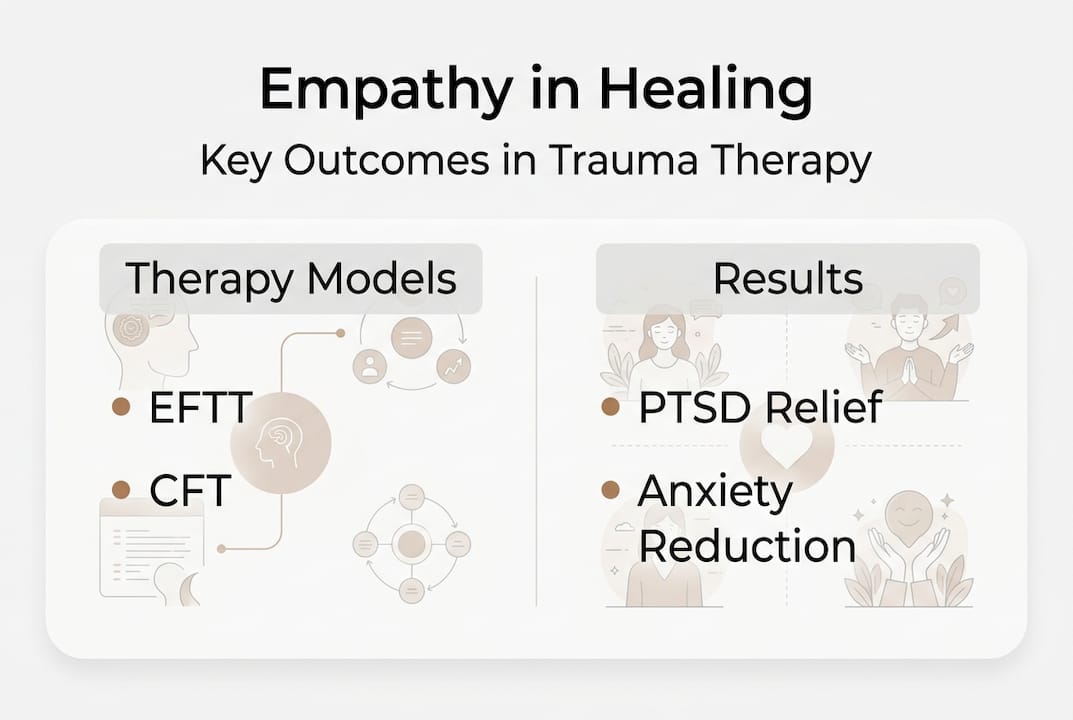
- Trauma therapy models like EFTT and CFT effectively process emotions and reduce symptoms.
- Excessive empathy without challenge can reinforce avoidance and hinder long-term recovery.
Empathy is often described as the heart of healing. But here’s what most people don’t realize: empathy alone doesn’t heal trauma. It’s a starting point, not a destination. Therapeutic alliance research shows that therapist empathy correlates with outcomes at r=0.278 across psychotherapies, a meaningful but incomplete picture. True recovery from complex trauma, anxiety, and attachment wounds requires something more layered. It asks for empathy paired with structure, boundaries, and evidence-based methods. This article walks you through what that actually looks like, and why getting this balance right can change everything for your healing journey.
Table of Contents
- Understanding empathy in trauma healing
- Empathy-enhanced therapies: Methods that work
- The risks and limits of empathy in healing
- Applying empathy in practice: Tools for healing
- What most therapists miss: True empathy is more than emotional resonance
- Take the next step: Empathy-based therapy in Kansas City
- Frequently asked questions
Key Takeaways
| Point | Details |
|---|---|
| Empathy boosts outcomes | Empathy within therapy is linked to better results for trauma, anxiety, and CPTSD recovery. |
| Specialized methods matter | Therapies like EFTT and CFT enhance healing by processing disrupted emotions via empathy. |
| Balance is essential | Too much empathy can hinder progress; boundaries and structured models are crucial. |
| Actionable healing steps | Choose therapists with relational expertise, evidence-based tools, and clear boundaries for lasting change. |
Understanding empathy in trauma healing
Empathy in therapy isn’t just about feeling sorry for someone. It’s about truly understanding and validating what a person has lived through, without judgment, without minimizing, and without rushing them toward a resolution they’re not ready for. When you sit with a therapist who practices empathy in therapy, you feel witnessed. That experience of being seen is, for many trauma survivors, something they’ve rarely known.
Research confirms this matters deeply. Therapeutic alliance, which includes empathy, correlates robustly with positive outcomes across psychotherapies (r=0.278, equivalent to d=0.579). For people healing from complex PTSD (CPTSD), this connection is even more significant because trauma often lives in the relational space. It was caused in relationship, and it heals in relationship.
“Healing doesn’t happen in isolation. It happens when someone finally feels safe enough to tell the truth, and safe enough to be met there.”
But here’s where the picture gets more nuanced. Empathy alone isn’t enough. For CPTSD in particular, what’s needed are corrective relational experiences, moments in therapy where old patterns of fear, shame, or disconnection are gently interrupted by something new. That’s why trauma-informed therapy options that go beyond empathy, incorporating structured approaches and relational repair, tend to produce the most lasting results.
Key elements that make empathy effective in trauma healing:
- Validation without reinforcement of avoidance: Feeling heard is healing, but a skilled therapist also gently challenges patterns that keep you stuck.
- Relational attunement: Especially important for those with insecure attachment histories or dissociative symptoms.
- Consistent presence: Empathy isn’t a one-time gesture. It’s a sustained quality of attention across the entire therapeutic relationship.
- Clinical discernment: Knowing when to lean in emotionally and when to introduce structure or challenge.
Therapists who receive clinical supervision insights regularly tend to maintain this balance more effectively over time, because they have a space to reflect on their own relational patterns and blind spots.
Empathy-enhanced therapies: Methods that work
Once you understand why empathy matters in healing, the next question is: which therapy models actually use it well? Two approaches stand out for complex trauma and anxiety: Emotion-Focused Therapy for Trauma (EFTT) and Compassion-Focused Therapy (CFT).
EFTT works by helping clients access and process disrupted emotions at the root of their trauma responses. Rather than just talking about what happened, EFTT guides you through the emotional experience itself, with a therapist who holds steady, empathic presence throughout. EFTT for trauma shows large effects on PTSD (g=1.18) and anxiety disorders (g=0.83 to 0.95), making it one of the most effective empathy-enhanced approaches available.
CFT, or Compassion-Focused Therapy, targets the self-critical and shame-driven patterns that often accompany trauma. It builds self-compassion as a genuine skill, not just a concept. CFT research from a recent meta-analysis shows g=0.72 reduction in negative outcomes, g=0.49 improvement in depression, and g=0.51 increase in self-compassion. These are meaningful, sustained gains.
| Therapy model | Primary focus | Key outcome ||
|—|—|—|
| EFTT | Emotional processing of trauma | PTSD: g=1.18, anxiety: g=0.83 to 0.95 |
| CFT | Self-compassion and shame reduction | Self-compassion: g=0.51, depression: g=0.49 |
| EMDR | Trauma memory reprocessing | Significant PTSD symptom reduction |
| IFS | Internal parts work and self-leadership | Reduced emotional reactivity, increased self-trust |
These models share something important: they don’t just soothe. They process. They move you through the emotional material rather than around it.
How to find the right fit:
- Ask potential therapists about their specific training in trauma-focused models.
- Look for someone who integrates relational skills with structured approaches.
- Consider therapists like Taylor Esworthy or Kieri Olmstead, who bring both warmth and clinical depth.
- If you’re in a relationship, couples therapy with empathy can also address relational trauma patterns.
Pro Tip: When exploring therapy in Kansas City, ask directly: “What trauma models are you trained in, and how do you balance empathy with structure?” A thoughtful answer tells you a lot.
The risks and limits of empathy in healing
This is the part most people don’t talk about. Empathy, when misapplied, can actually slow healing. It’s not a comfortable truth, but it’s an important one.
One of the most common risks is that excessive empathy can reinforce avoidance. When a therapist consistently validates distress without gently challenging the patterns that maintain it, clients can remain stuck in a victim identity, not because they want to, but because the therapeutic environment never creates enough friction for growth. Empathy risks include retraumatization through enabling avoidance, which requires the therapist to bring confrontation, boundaries, and discernment alongside emotional resonance.

There’s also the risk of therapist burnout. When a clinician absorbs too much of a client’s emotional pain without proper boundaries or supervision, their effectiveness diminishes. This affects you as the client, even if you can’t name why something feels off.
Psychologist Paul Bloom has argued that rational compassion often produces better outcomes than pure empathy, because empathy is biased and can spotlight individual suffering while missing the larger picture. Compassion, paired with cognitive understanding and action, tends to sustain therapeutic effectiveness over time.
| Approach | When it helps | When it hinders |
|---|---|---|
| Pure empathy | Early trust-building, acute distress | Reinforces avoidance, enables passivity |
| Rational compassion | Long-term healing, pattern change | Can feel cold if not paired with warmth |
| Balanced empathy | Throughout the healing process | Requires ongoing clinical discernment |
The clinical discernment that skilled therapists bring is what keeps empathy from becoming counterproductive. It’s the ability to feel with you and still hold a steady, honest presence that doesn’t collapse under the weight of your pain.
Pro Tip: If your therapy sessions feel endlessly validating but nothing seems to shift, it may be worth asking your therapist how they balance empathy with challenge. Growth often lives just outside the comfort zone.
Applying empathy in practice: Tools for healing
Knowing that empathy works best when paired with structure, what does that actually look like in practice? Here’s how you can apply this understanding to your own healing journey.
The alliance-outcome correlation of r~0.28 is one of the most robust findings in psychotherapy research. What this tells you is simple: the relationship with your therapist matters enormously. Not just their credentials, but how they show up, how they listen, and whether you feel genuinely safe with them.
Statistic to hold onto: A therapeutic alliance r~0.28 means that therapist relational quality accounts for a significant portion of your healing outcome, separate from any specific technique used.
For those healing from CPTSD with insecure attachment or dissociative symptoms, relational focus is especially important. Psychodynamic elements within trauma therapy help sustain gains beyond symptom relief, addressing the deeper relational wounds that drive ongoing distress.
Checklist for a healthy therapeutic alliance:
- You feel safe enough to say hard things without fear of judgment.
- Your therapist validates your experience and gently challenges unhelpful patterns.
- Sessions feel productive, not just comfortable.
- Your therapist has clear training in evidence-based trauma models such as CPT, PE, or TF-CBT.
- You notice gradual shifts in how your nervous system responds to stress outside of sessions.
Self-compassion practices between sessions also matter. Journaling, body-based grounding, and mindfulness all support the work happening in the therapy room. They help your nervous system practice safety in small, everyday moments.
Exploring therapy services Kansas City that integrate these elements gives you the best chance of building a healing relationship that truly moves the needle.
What most therapists miss: True empathy is more than emotional resonance
Here’s a perspective that might surprise you. The most healing therapists aren’t always the ones who feel the most with you. They’re the ones who can hold steady when your pain is enormous, who don’t flinch, and who bring both warmth and honest presence to the room.
Conventional wisdom says more empathy equals better therapy. But compassion over empathy research suggests that empathy in excess can cause burnout and bias, while blending empathy with rational compassion and action gets better results. True empathy includes the courage to stay present without merging, to care deeply without losing clinical clarity.
In Kansas City, the therapists who achieve lasting results with complex trauma are those who marry genuine emotional attunement with structured, evidence-based practice. They don’t just sit with your pain. They help you move through it. The empathetic clinical approach that works isn’t soft or passive. It’s grounded, skilled, and deeply human.
Your softness is not a flaw. And healing it doesn’t require someone who simply agrees with your pain. It requires someone who can witness it, hold it, and help you find your way through.
Take the next step: Empathy-based therapy in Kansas City
You deserve a therapist who truly gets it. Not just someone who nods along, but someone trained to hold your story with care and guide you toward real, lasting change.

Simple Empathy KC offers trauma-informed therapy grounded in empathy, evidence-based practice, and genuine relational presence. Our therapy services are designed for people who feel deeply and are ready to heal deeply. You can explore therapist profiles, including Kieri Olmstead, to find the right fit for your journey. Healing starts when you feel truly witnessed. We’re here to offer exactly that. Reach out today and take the first step toward coming home to yourself.
Frequently asked questions
Can empathy-based therapy help with CPTSD and anxiety?
Yes. Empathy-enhanced approaches like EFTT and CFT show large effects on PTSD (g=1.18) and anxiety (g=0.83 to 0.95), especially when paired with evidence-based trauma models that address root emotional disruptions.
What are the signs of too much empathy in therapy?
If sessions feel endlessly validating but nothing shifts, empathy may be reinforcing avoidance. Excessive empathy can enable victim identity, and healthy therapy balances deep understanding with gentle challenge and clear boundaries.
How can I find a therapist who uses empathy wisely?
Look for therapists trained in CPT, PE, or TF-CBT with strong relational skills. The alliance-outcome benchmark of r~0.28 confirms that both relational quality and evidence-based training matter for lasting results.
Is empathy alone enough for healing?
Empathy is essential, but it’s not sufficient on its own. Rational compassion research shows that sustainable healing requires structure, boundaries, and proven trauma-focused therapy alongside genuine emotional attunement.